Ancient Engineering · Abydos, Sohag Governorate, Egypt

The Osirion at Abydos

A half-sunken megalithic hall unlike anything else in New Kingdom Egypt — deliberately archaic, or genuinely archaic?

Mainstream: c. 1290–1279 BC (reign of Seti I, 19th Dynasty)Alternative: Pre-dynastic, possibly before 10,000 BC (proposed by West and Schoch for the megalithic core)26.18°, 31.92°

At a glance

The Osirion at Abydos
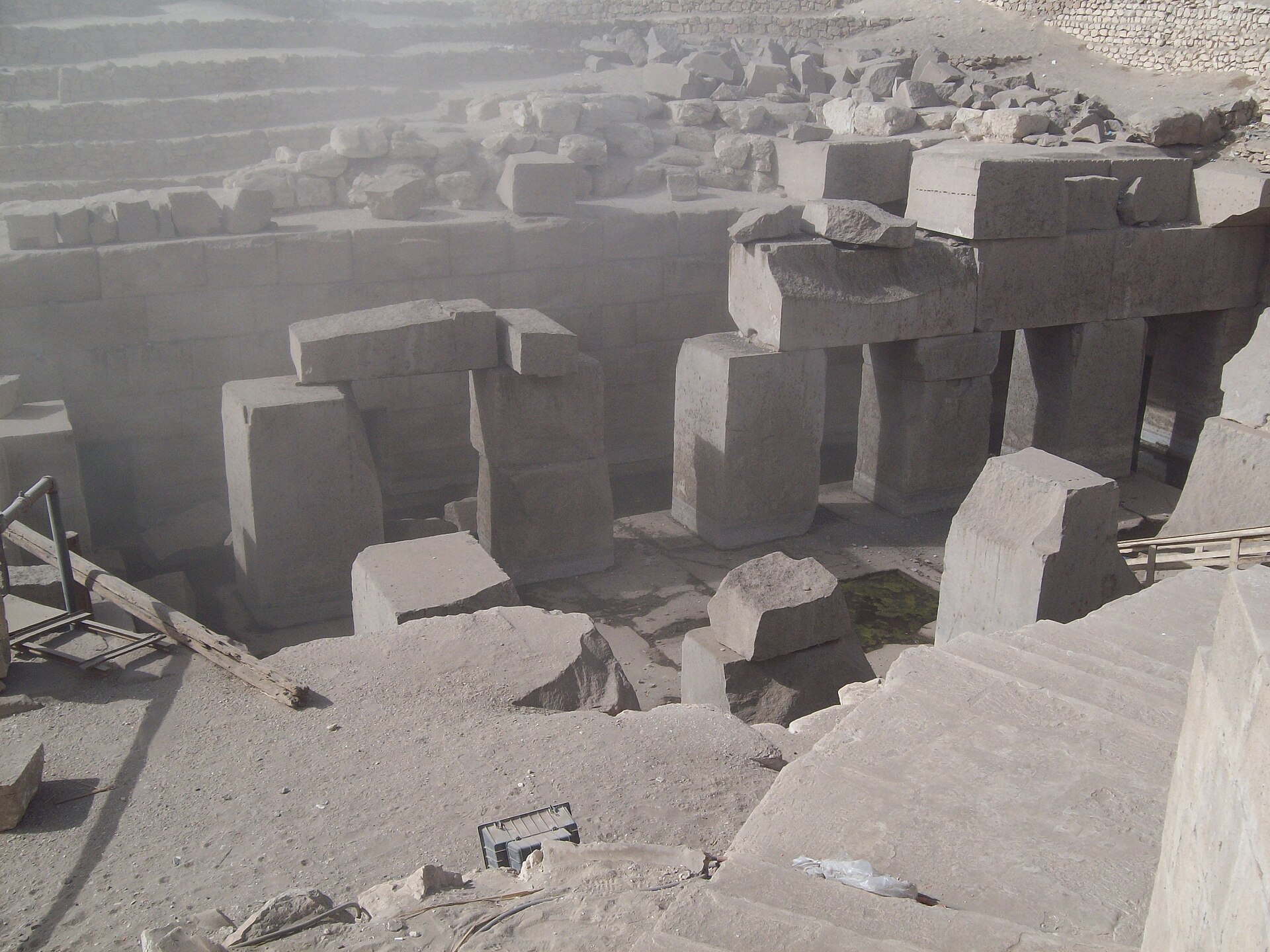
Photo: Institute for the Study of the Ancient World (Kyera Giannini) · CC BY 2.0

Behind the exquisitely decorated temple of Seti I at Abydos lies one of Egypt's strangest buildings. The Osirion is a massive subterranean hall built of red granite and sandstone, its central 'island' platform surrounded by a water channel fed by the ground water table, reached today by descending well below the level of the temple behind it. Ten enormous rose-granite pillars, some weighing on the order of 55–100 tonnes, once carried architraves and a roof. Its stark, undecorated megalithic style is utterly unlike the refined relief-covered temple beside it — closer in feel to the Sphinx's Valley Temple at Giza, built more than a thousand years earlier. It was conceived, in the mainstream reading, as a symbolic tomb (cenotaph) of the god Osiris, whose chief cult centre was Abydos.

See it on the globe →
The mainstream view

What archaeology says

Flinders Petrie and Margaret Murray located the structure in 1902–03, and Edouard Naville cleared it in 1912–14. Struck by the cyclopean masonry, Naville declared it perhaps the oldest building in Egypt — an Old Kingdom or earlier work. But Henri Frankfort's systematic excavations for the Egypt Exploration Society in 1925–30 settled the question for most Egyptologists: he found cartouches of Seti I in the fabric of the building, including on foundation elements and in the connecting passages, dedication texts, and decoration completed by Seti's grandson Merenptah. A dedication naming the building 'Menmaatre (Seti I) is Beneficial to Osiris' ties it directly to the king. Peter Brand's detailed 1998 study of Seti's monuments reaffirmed that the Osirion can be dated confidently to his reign.

The architectural strangeness is read as deliberate archaism. The Osirion was designed as the tomb of Osiris himself: a primeval mound rising from the waters of creation, encircled by a channel so the central platform literally floats as an island. Its builders sank it into the water table on purpose and evoked the austere granite style of a mythic past — much as a modern architect might build a 'Gothic' chapel. Sloping entrance passages decorated with the Book of Gates mirror royal tombs in the Valley of the Kings.

The famous 'flower of life' circles on two granite pillars are not carved but drawn, probably in red ochre, and sit high on the columns — at a level reachable only after the hall had substantially filled with sand. Accompanying Greek letters date this graffiti to late antiquity, over a thousand years after Seti, demolishing claims that the symbol was somehow 'burned into the stone' in deep prehistory.

Key evidence cited
  • Cartouches and dedication texts of Seti I integral to the structure and its passages (Frankfort, 1925–30)
  • Decoration completed under Merenptah, with the Book of Gates in the entrance passage as in royal tombs
  • The dedication formula naming the building as Seti's monument 'Beneficial to Osiris'
  • The 'flower of life' circles are ochre drawings accompanied by Greek letters, dating to late antiquity
  • The 'helicopter' panel explained as a Seti I / Ramesses II palimpsest with fallen plaster infill
The alternative view

What the skeptics propose

The alternative case begins where Naville left off. John Anthony West and geologist Robert Schoch, fresh from their redating of the Sphinx, argued in the 1990s that the Osirion's megalithic core is vastly older than Seti I. Their evidence is contextual and geological: the structure sits many metres below the floor level of Seti's temple, which they read as an older ground surface; its undecorated cyclopean granite style matches the Valley Temple at Giza (another building they consider pre-dynastic); and Schoch has pointed to weathering he considers consistent with a much wetter climate regime, potentially pushing the core structure back towards the end of the last Ice Age. In this reading Seti I did not build the Osirion — he found it, restored it and attached his temple to a monument already ancient, adding the inscribed passages later. Graham Hancock gave the argument wide circulation in Fingerprints of the Gods.

New Age authors add the 'flower of life' motif, popularised by Drunvalo Melchizedek, who claimed the geometric pattern was etched into the granite by advanced means in remote antiquity. And in Seti's temple next door, ancient-astronaut proponents point to the famous 'helicopter' panel — a lintel where the hieroglyphs appear to show a helicopter, a submarine and an aircraft.

Egyptologists answer each point. The building is sunk because it was designed to reach the water table — the whole theology requires an island in the primeval waters — and its foundations were cut down from Seti's ground level, with his cartouches integral to the structure, not later additions. The archaic style is intentional theatre. The ochre circles are late-antique graffiti beside Greek text. And the 'helicopter' is a palimpsest: Seti I's titles were re-carved with those of Ramesses II, plaster filling the old signs later fell away, and the overlapping glyphs plus erosion produce the illusory machines — unanimously so, in the view of Egyptologists who have examined it.

Key evidence cited
  • The hall lies well below the floor level of Seti's temple, suggesting to West an older ground surface
  • Cyclopean, undecorated granite style closely echoing the Sphinx's Valley Temple
  • Naville's original professional judgement that it was the oldest building in Egypt
  • Schoch's weathering arguments hinting at exposure during a wetter climate era
  • The core megaliths themselves carry no original inscriptions — Seti's texts cluster in the passages

Genuinely open questions

  1. Why did Seti I choose a radically archaic megalithic style found almost nowhere else in New Kingdom architecture?
  2. How did the builders quarry, move and place 100-tonne granite pillars in a pit cut below the water table?
  3. What did the rising water table originally look like in the hall — and was the channel ever navigable as ritual required?

Worth knowing

The 'helicopter' of Abydos is really two royal names stacked on top of each other — Seti I's titles were plastered over and re-carved for Ramesses II, and when the plaster fell out 3,000 years later the overlap spelled 'aircraft' to modern eyes.