What archaeology says
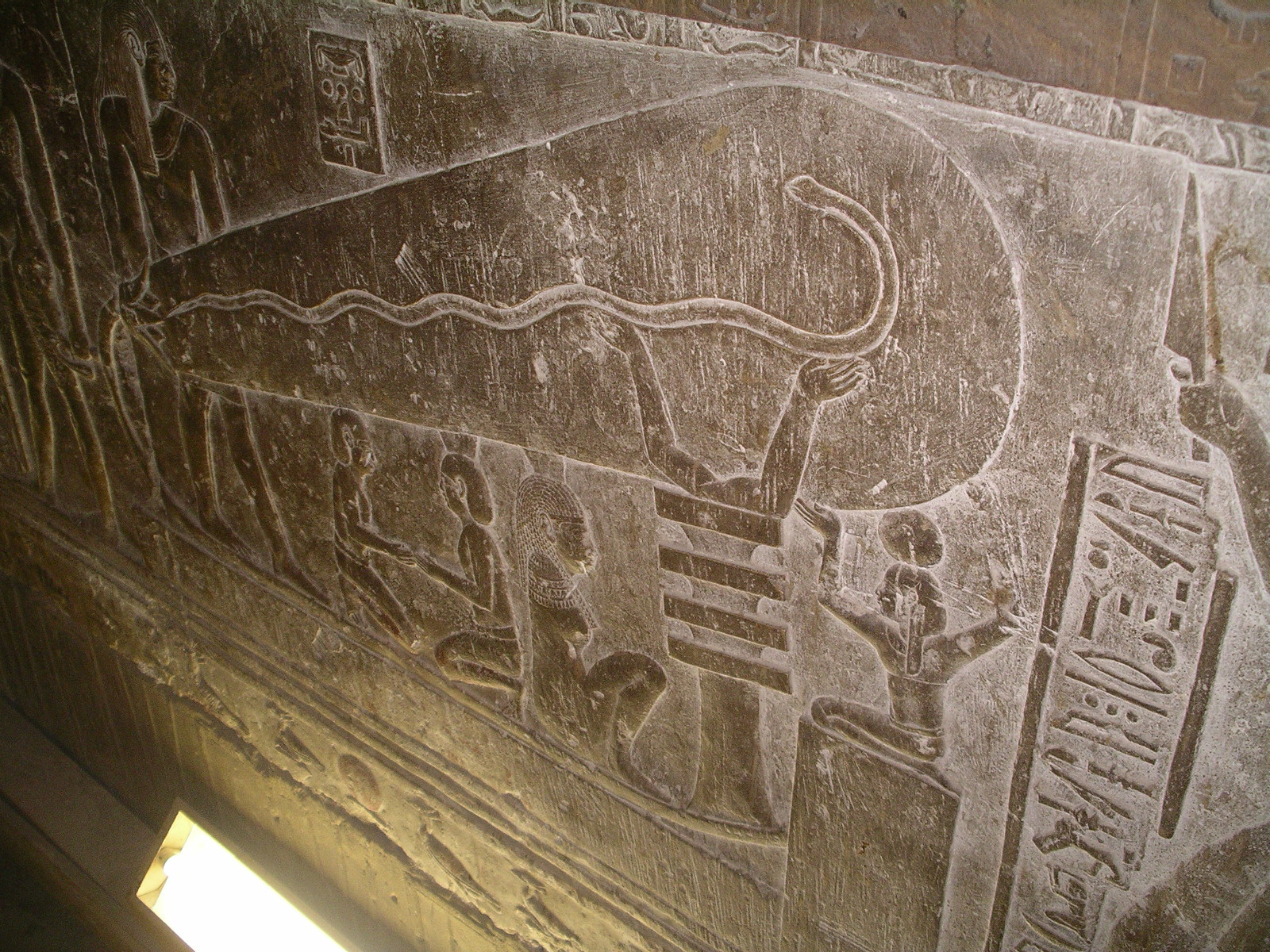
Egyptologists read the crypt reliefs through the temple's own inscriptions, which describe the scenes in detail. The 'bulb' is a hn-container or the womb of the sky-goddess Nut; the 'filament' is the serpent-form of Harsomtus (Horus the uniter), the creator-god emerging at dawn from a lotus flower; the 'cable' is the lotus stem; and the 'socket' supported by a djed pillar is the symbol of stability whose outstretched arms carry the sun. The same lotus-and-serpent motif appears elsewhere in Egyptian art in unmistakably mythological contexts, and Egyptologist Wolfgang Waitkus, who published the definitive study of the crypt texts, found the accompanying hieroglyphs narrate a creation scene — not a technical diagram. The crypts themselves were secure stores for the temple's cult statues and ritual equipment, decorated with images of the objects kept there.
The zodiac controversy is a classic of scientific history. When Napoleon's savants publicised the ceiling after 1798, astronomers such as Joseph Fourier and Johann Karl Burckhardt argued from the positions of the constellations that it might be 4,000 to 14,000 years old — placing it before the Biblical creation date and igniting a furious row between science and church. Jean-François Champollion, after deciphering hieroglyphs, read the royal cartouches and dated the chapel firmly to the Greco-Roman era. He has been vindicated: modern analysis (notably by Éric Aubourg) shows the five visible planets are drawn in positions matching around 50 BC, and two eclipses depicted correspond to real events of 52 and 51 BC. The dating is now considered settled.
- Crypt inscriptions describing the scenes as Harsomtus emerging from the lotus at creation (studied by Wolfgang Waitkus)
- Standard parallels for every element — lotus, serpent, djed, hn-container — across Egyptian religious art
- Planetary positions on the zodiac matching the sky of c. 50 BC, with eclipses of 52 and 51 BC depicted
- Royal cartouches and building inscriptions dating the temple to the late Ptolemaic and Roman periods
- No excavated wires, bulbs, sockets or generators anywhere in dynastic Egypt