Ancient Engineering · Kom el-Hettan, West Bank, Luxor, Egypt

Colossi of Memnon & Amenhotep III's Quarries

Twin 720-tonne giants hauled 675 kilometres — one of which 'sang' to Roman emperors at dawn.

Mainstream: c. 1370–1350 BC (reign of Amenhotep III, 18th Dynasty)Alternative: Date not seriously disputed — sceptics instead question how 720-tonne quartzite monoliths were carved and moved 675 kilometres with Bronze Age technology25.72°, 32.61°

At a glance

Colossi of Memnon & Amenhotep III's Quarries
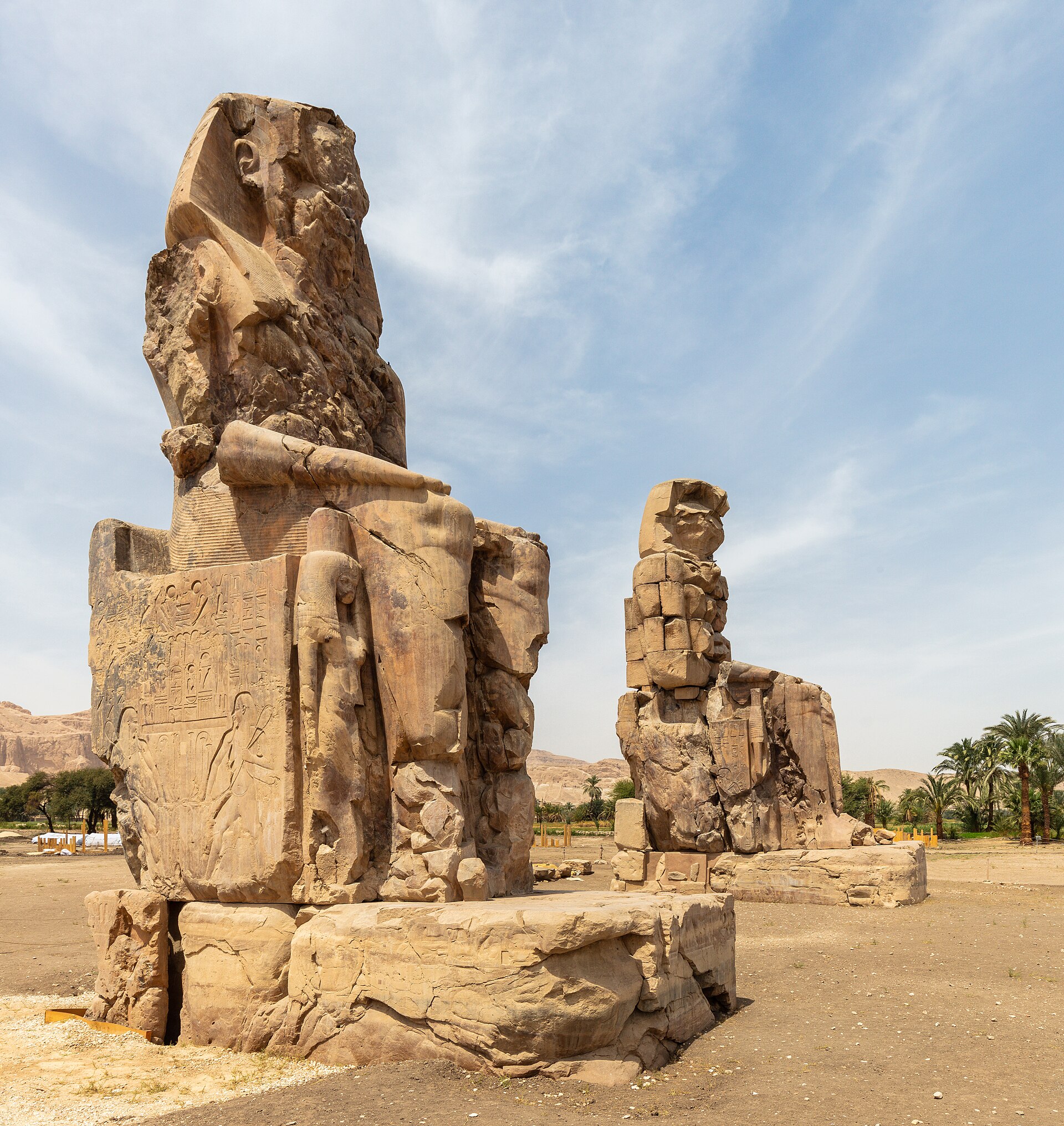
Photo: Diego Delso · CC BY-SA 4.0

The Colossi of Memnon are two enthroned statues of Pharaoh Amenhotep III, each about 18 metres tall with its platform and estimated at around 720 tonnes. They once flanked the entrance pylon of his mortuary temple at Kom el-Hettan — in its day the largest and richest temple complex in Egypt, bigger than Karnak — which was levelled by an earthquake around 1200 BC and quarried away, leaving the two giants standing almost alone. Each colossus was carved from a single block of quartzite, one of the hardest stones the Egyptians ever worked, quarried at Gebel el-Ahmar near modern Cairo and moved some 675 kilometres upriver to Thebes. After an earthquake in 27 BC cracked the northern statue, it began emitting a musical note at dawn, drawing tourists from across the Roman world.

See it on the globe →
The mainstream view

What archaeology says

The statues are exhaustively documented in their own historical context. They portray Amenhotep III with small flanking figures of his wife Tiye and mother Mutemwiya, and belong to a temple whose remains — including hundreds of statues, stelae and column bases — have been excavated and partly re-erected since 1998 by the Colossi of Memnon and Amenhotep III Temple Conservation Project under Hourig Sourouzian, working with the German Archaeological Institute. The pharaoh's famous architect, the deified official Amenhotep son of Hapu, records on his own statues that he oversaw the quarrying and transport of the king's 'mountains of quartzite' — a rare case of a named ancient engineer claiming credit for the exact feat under debate. Because the statues stand upstream of the quarry, and ancient sources suggest such loads were not rowed against the current, scholars generally accept the Egyptians' own implication of an overland haul, using sledges, rollers, lubricated slipways and enormous traction teams, possibly combined with canal stages during the flood.

The 'singing' is equally well documented. After the 27 BC earthquake cracked the northern colossus, it emitted a note at sunrise — most likely dew or trapped moisture evaporating and air escaping through the fissured stone as it warmed. The phenomenon made the statue a wonder of the Roman world: Greeks identified it with Memnon, the Trojan War hero, and 107 inscriptions in Greek and Latin survive on its legs, including poems by the court poet Julia Balbilla recording Emperor Hadrian's visit in AD 130. When Septimius Severus had the crack repaired around AD 199, the statue fell silent and has stayed so — a neat natural experiment confirming the mundane mechanism. In December 2025 Egyptian and German conservators completed a major restoration returning the reassembled statues to public display.

Key evidence cited
  • Amenhotep son of Hapu's own inscriptions claiming responsibility for quarrying and transporting the colossi
  • The statues' integral place in Amenhotep III's excavated mortuary temple at Kom el-Hettan
  • Sourouzian's excavations since 1998 recovering hundreds of statues and re-erecting fallen colossi from the same temple
  • The Djehutihotep relief and friction experiments demonstrating large-scale sledge transport methods
  • The singing phenomenon starting with the 27 BC earthquake and stopping after the Severan repair — a documented natural cause
The alternative view

What the skeptics propose

The alternative case here is not about dating but capability. Quartzite is a silica-cemented stone of roughly Mohs 7 hardness — harder than granite to carve — and each colossus was fashioned from a single 700-tonne-plus block, then finished with crisp detail on thrones and side panels. Writers and researchers including Brien Foerster and Ben van Kerkwyk highlight that these are among the heaviest monoliths ever moved anywhere on Earth; nothing comparable was transported again until the modern industrial era (the 1,250-tonne Thunder Stone in 1770 required a purpose-built machine and years of effort over a fraction of the distance). They question whether ropes, sledges and manpower could really drag 720 tonnes some 675 kilometres, and note that no Egyptian image or text actually depicts the move — Amenhotep son of Hapu boasts of it without explaining it.

Some proponents go further, suggesting the colossi and other quartzite giants of Amenhotep III's reign (his reign produced an extraordinary concentration of colossal hard-stone statuary) reflect an inherited technology or even re-use of far older monuments, with dynastic inscriptions added later — an argument made for other Egyptian megaliths by the lost-civilisation school. The precision flat surfaces on the thrones' side panels are offered as evidence of capabilities beyond bronze chisels and stone hammers.

Mainstream engineers and archaeologists respond that the Egyptians demonstrably moved comparable loads — the 1,000-tonne colossus of Ramesses II at the Ramesseum ended up even further from its quarry — and that scaled-up sledge haulage is brutally labour-intensive but mechanically straightforward: the physics requires only enough men, rope and a prepared track. Experimental work and reliefs such as the Djehutihotep tomb scene (a 58-tonne statue on a sledge with water poured before it) establish the method; friction studies show wetted sand roughly halves the drag. On this view the colossi mark the extreme end of a known, documented engineering tradition — the astonishing thing being organisation, not machinery.

Key evidence cited
  • Each statue is a single quartzite monolith of roughly 720 tonnes — among the heaviest objects ever moved before the industrial age
  • Quartzite's extreme hardness, exceeding granite, worked here at colossal scale with crisp finished detail
  • A 675-kilometre transport distance with no surviving depiction or description of the method
  • The unmatched concentration of colossal hard-stone statuary in this one reign
  • Comparisons with feats like the Thunder Stone, which strained even 18th-century European technology

Genuinely open questions

  1. What was the actual route and method for moving 720-tonne blocks from Gebel el-Ahmar to Thebes — land, water, or both?
  2. Could Nile barges of the period carry such loads, and if not, how was the river crossed?
  3. What did the complete mortuary temple look like, and why was so colossal a statuary programme concentrated in Amenhotep III's reign?

Worth knowing

Emperor Hadrian camped overnight at the colossi in AD 130 to hear the northern statue 'sing' at dawn — and his court poet Julia Balbilla carved four poems about the visit into the statue's leg, ancient celebrity graffiti still legible today.