Ancient Engineering · Theban Necropolis, Luxor, Egypt

The Ramesseum

The shattered thousand-tonne colossus that inspired Shelley's Ozymandias — the heaviest statue ever moved in ancient Egypt.

Mainstream: c. 1279-1213 BC (reign of Ramesses II)Alternative: Colossus transport questioned; some claim inherited older statuary25.73°, 32.61°

At a glance

The Ramesseum
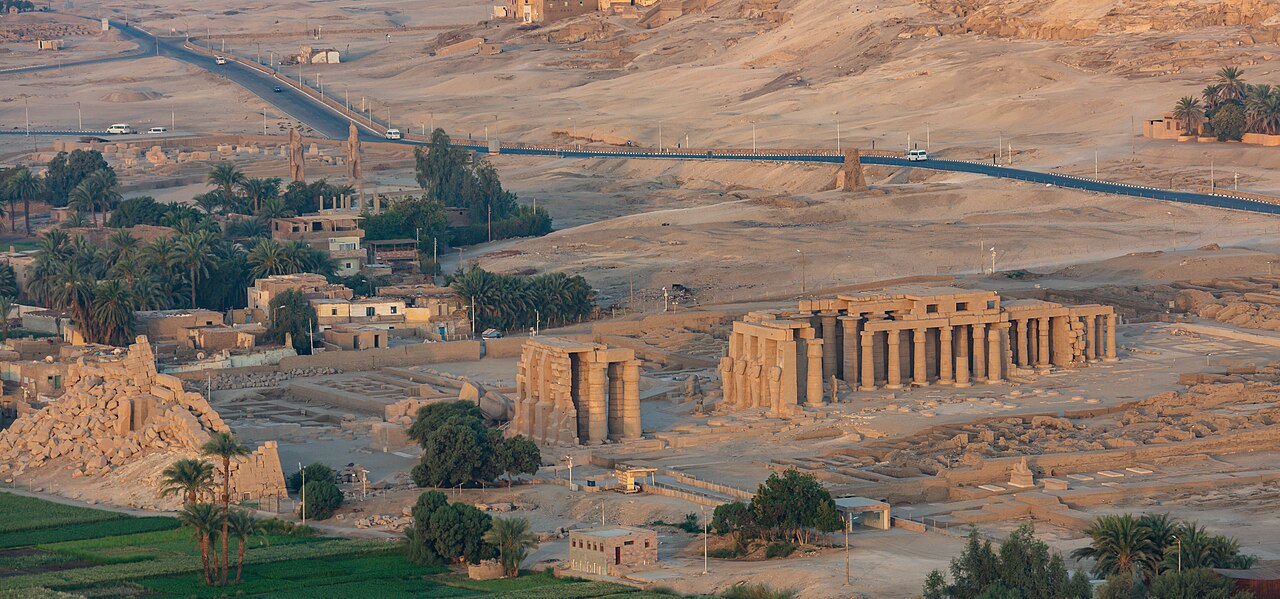
Photo: Diego Delso · CC BY-SA 4.0

The Ramesseum is the mortuary temple of Ramesses II on the west bank at Luxor, built in the 13th century BC. In its second court lie the ruins of the largest known monolithic statue moved in Egyptian history: a seated colossus of the king, originally 17-19 metres high and estimated at around 1,000 tonnes, carved from a single block of granite (often described as syenite) quarried at Aswan, more than 200 kilometres upstream. Diodorus Siculus described the statue and its boast as the tomb of 'Osymandias'; a garbled report of it inspired Shelley's 1818 sonnet Ozymandias. Its transport remains one of the great logistics puzzles of the Bronze Age.

See it on the globe →
The mainstream view

What archaeology says

Egyptologists date the Ramesseum precisely from its reliefs, foundation deposits and texts to the long reign of Ramesses II (c. 1279-1213 BC). The colossus, of which the throne base and enormous torso fragments survive, was quarried at Aswan and shipped roughly 220 kilometres downstream on the Nile — the river doing the heavy work — on a purpose-built barge, then hauled overland from a canal or quay to the temple on sledges over prepared causeways.

The method is not guesswork: Egyptian sources depict colossus transport directly. The tomb relief of Djehutihotep (12th Dynasty) shows a roughly 58-tonne statue on a sledge hauled by 172 men while a worker pours liquid before the runners; a 2014 physics study confirmed that wetting sand to the right degree roughly halves hauling friction. Scaling up implies teams in the low thousands with compound rope systems, well within the state's demonstrated manpower. Records also attest barges built to carry obelisk pairs weighing hundreds of tonnes.

The statue was almost certainly erected before or during construction of surrounding walls, then finished in place. Its collapse — probably in an earthquake in antiquity — left the fragments Diodorus saw and tourists still see, an ironic monument to the poem it inspired.

Key evidence cited
  • Reliefs, texts and foundation deposits date the Ramesseum to Ramesses II's reign
  • The Djehutihotep relief documents Egyptian colossus-hauling technique, including sand lubrication
  • A 2014 study verified that wetted sand dramatically reduces sledge friction, matching the relief
  • Nile barges for multi-hundred-tonne obelisks are attested in texts and reliefs
  • The granite matches Aswan quarry sources, where extraction beds for colossal monoliths survive
  • The statue's style and inscriptions are consistent, integral 19th Dynasty work
The alternative view

What the skeptics propose

Alternative researchers, including Ben van Kerkwyk of UnchartedX and Graham Hancock in earlier writings, treat the thousand-tonne class of Egyptian statuary — the Ramesseum colossus and the Colossi of Memnon (each around 700 tonnes and moved further, against the current for some claims about their quartzite source) — as the strongest single challenge to ramp-and-sledge orthodoxy. Scaling the Djehutihotep relief from 58 to 1,000 tonnes, they argue, is not linear: rope strength, sledge materials, ground bearing pressure and turning manoeuvres all hit practical limits, and no experiment has ever moved anything close to this weight with Bronze Age means.

Van Kerkwyk also points to the statue's execution: hard granite carved to smooth compound curves and crisp detail at enormous scale, which he links to the broader case for lost machining evidenced elsewhere in Egypt. Some proponents suggest the greatest colossi and their transport feats might inherit techniques — or actual monuments — from an earlier technological culture, later recut and inscribed for Ramesses II, noting that usurpation and recarving of older statues was in fact common Egyptian practice.

Mainstream Egyptologists respond that the colossus is stylistically pure 19th Dynasty, that Ramesses' name is integral to its carving rather than overwritten, and that while a full-scale replication has never been attempted, nothing in the physics forbids large, organised teams from doing what the Egyptians themselves repeatedly claimed, depicted and accounted for in their own records.

Key evidence cited
  • At around 1,000 tonnes, the colossus is roughly seventeen times heavier than the largest documented Egyptian statue-hauling scene
  • No experiment has ever moved a 1,000-tonne monolith using only Bronze Age materials
  • Rope, sledge and ground-pressure limits at this scale are cited by van Kerkwyk as unresolved engineering problems
  • Precision carving of hard granite at this scale is linked by proponents to Egypt's wider lost-machining debate
  • Egyptians demonstrably recut and usurped older statues, leaving room to question original authorship
  • The Colossi of Memnon, of similar class, were moved overland reportedly without river transport, deepening the puzzle

Genuinely open questions

  1. What rope, sledge and causeway specifications would a 1,000-tonne haul actually require, and were they attainable?
  2. How was the colossus erected upright at the temple — ramp, sand pit, or another method?
  3. When and how did the statue fall — earthquake, deliberate toppling, or gradual collapse?
  4. Could modern experimental archaeology attempt even a fractional-scale replication of the transport?

Worth knowing

Shelley never saw the colossus he immortalised — he wrote Ozymandias in a friendly sonnet competition in 1817-18, prompted by news of the British Museum acquiring a different, far smaller Ramesses statue, the Younger Memnon.