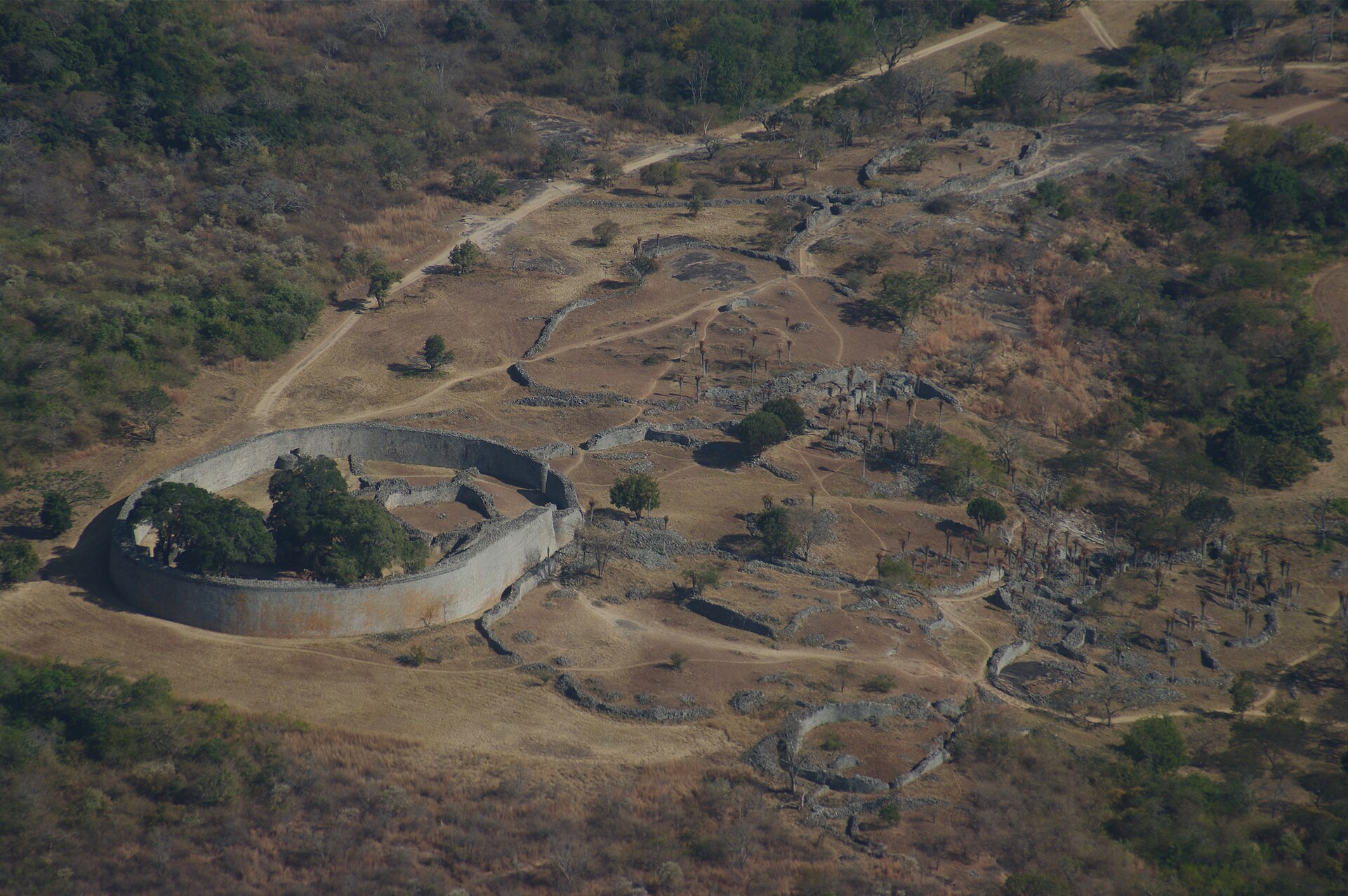
What archaeology says
Every line of modern evidence shows Great Zimbabwe was built by the ancestors of the Shona-speaking people who still live in the region. The first professional excavation, by David Randall-MacIver in 1905–06, found the material culture 'unquestionably African' in every detail; Gertrude Caton-Thompson's rigorous stratigraphic campaign of 1929 confirmed a medieval, Bantu-African origin 'without a shadow of doubt'. Radiocarbon dating brackets the main occupation between about AD 1100 and 1450–1550, with Bayesian modelling of new AMS dates refining the sequence of wall construction. The city may have housed several thousand to upwards of ten thousand people (recent work by Shadreck Chirikure and colleagues has argued older estimates of 18,000–20,000 were too high), sustained by an ingenious water system of 'dhaka' pits — clay-extraction hollows repurposed as reservoirs, mapped in a 2022 study by Innocent Pikirayi's team.
Trade goods excavated at the site tell the story of its wealth: Chinese celadon, Persian glazed ware, Near Eastern glass and a coin of Kilwa, the Swahili sultanate that brokered the gold trade. Eight carved soapstone birds, unique to the site, likely stood for royal ancestors. The city declined in the 15th century — through some combination of resource exhaustion, shifting trade routes and drought — as power moved to successor states like Mutapa and Torwa, whose stone-building traditions descend directly from Great Zimbabwe. Portuguese records of the 16th century already connected the ruins to the local African kingdoms.
- Radiocarbon and Bayesian AMS dating placing construction and occupation at c. AD 1100–1450
- Randall-MacIver (1905) and Caton-Thompson (1929) finding exclusively African material culture in sealed deposits
- Continuity of pottery, architecture and oral tradition with Shona successor states (Mutapa, Torwa, Khami)
- Trade imports — Chinese celadon, Persian ware, a Kilwa coin — matching the medieval Indian Ocean gold trade
- The 2022 mapping of dhaka pits revealing an indigenous climate-smart water harvesting system