What archaeology says
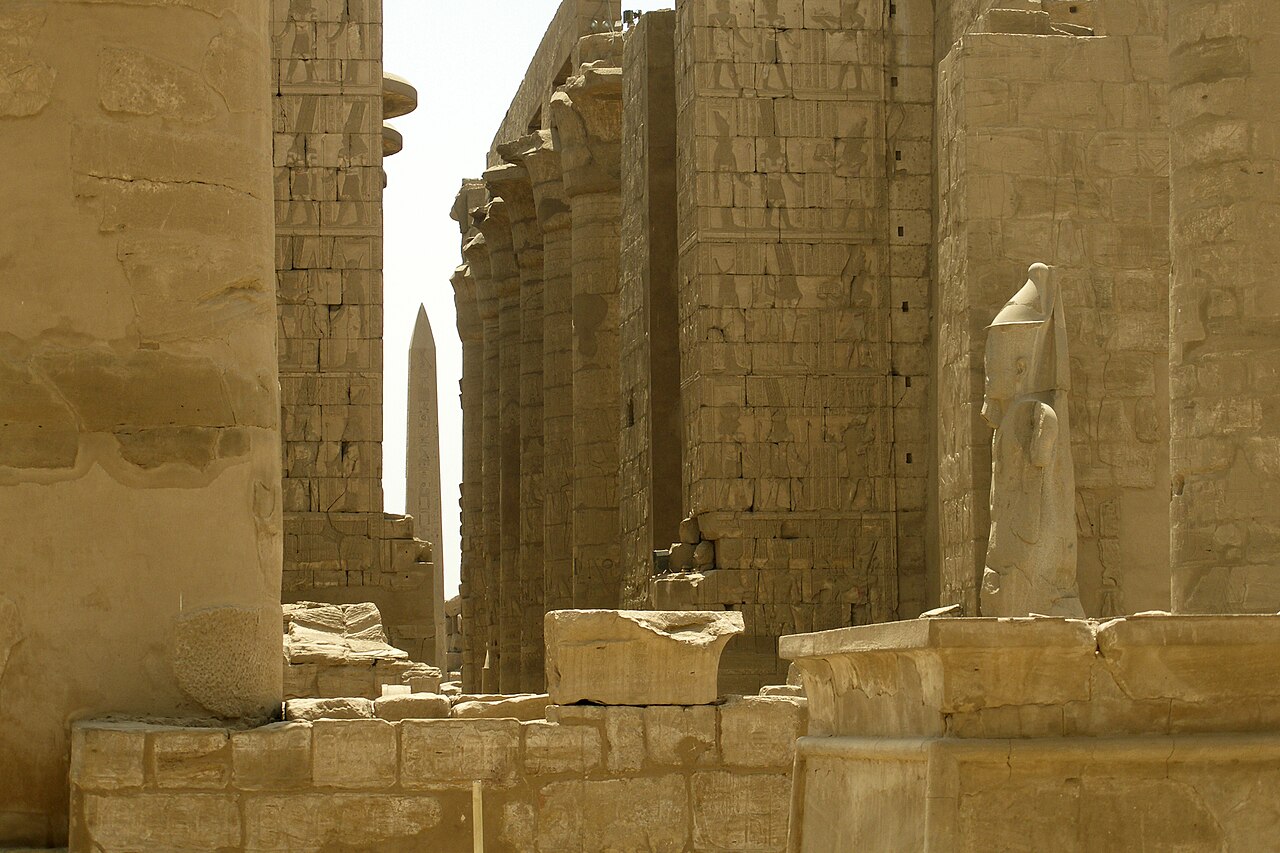
The archaeological sequence at Karnak is unusually well documented. Construction began under Senusret I in the Middle Kingdom, around 1970 BC, and continued through the New Kingdom — Hatshepsut, Thutmose III, Amenhotep III — into Ptolemaic times. The Great Hypostyle Hall was decorated under Seti I and Ramesses II, and thousands of inscriptions, foundation deposits and reused blocks let Egyptologists reconstruct the building history in detail.
The obelisks are explained by the archaeology of the Aswan quarries, where the famous Unfinished Obelisk — abandoned after cracking at over 1,000 tonnes — preserves the extraction method: pounding trenches with dolerite hammerstones. Records such as Hatshepsut's own inscriptions describe quarrying her pair of obelisks in seven months, and reliefs from Deir el-Bahari show obelisks loaded on huge Nile barges. Erection is modelled with earthen ramps and sand-pit lowering, techniques tested in modern experiments.
As for the drill marks, tubular drilling in granite is well attested from the Old Kingdom onward. Flinders Petrie catalogued drill cores in the nineteenth century, and Denys Stocks' experiments show that copper tubes rotated with quartz sand abrasive cut granite and leave exactly the kind of tapering holes and spiral-free striations seen at Karnak — slowly, but effectively, given cheap organised labour.
- Thousands of dated inscriptions and foundation deposits document Karnak's construction sequence reign by reign
- The Unfinished Obelisk at Aswan preserves dolerite-pounding extraction of a 1,000-tonne monolith in progress
- Hatshepsut's inscriptions state her obelisk pair was quarried in seven months; Deir el-Bahari reliefs show obelisk barges
- Petrie documented granite drill cores in the 1880s; Stocks replicated them with copper tubes and sand abrasive
- Tool marks, ramp remains and construction embankments survive at Karnak itself, including against the first pylon
- The building style, materials and iconography match the well-established Theban historical context