What archaeology says
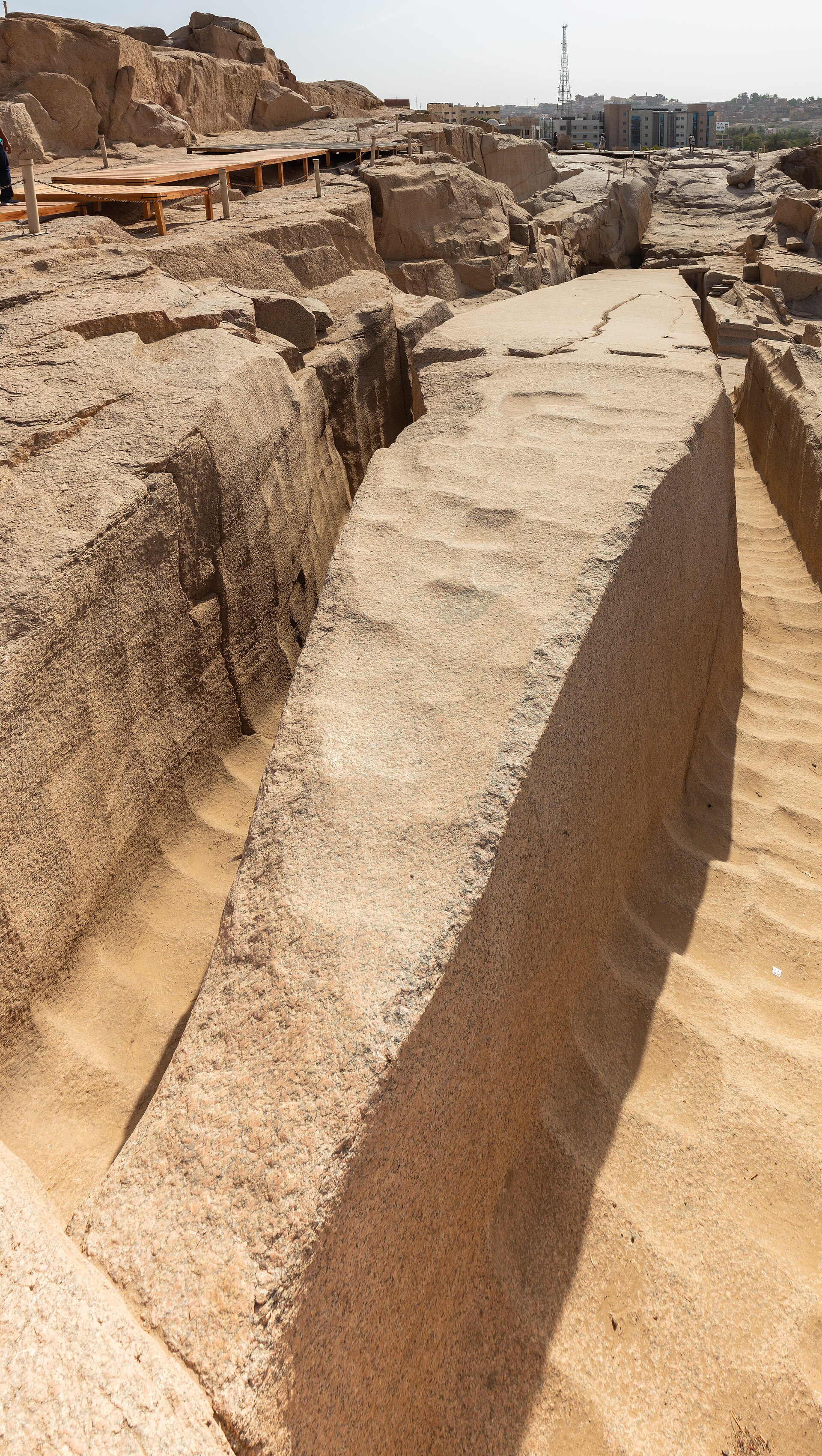
Egyptologists attribute the project to the 18th Dynasty, most likely to Hatshepsut (c. 1473–1458 BC), whose completed obelisks at Karnak came from these same quarries. The site was studied in detail by Reginald Engelbach in 1922, who documented the working method: fire-setting to strip the weathered upper granite, then teams of workers pounding parallel trenches around the monolith using hand-held balls of dolerite — an igneous rock as hard as the granite itself. Thousands of used dolerite pounders still litter the quarry, and the concave scoop marks match the sweep of a two-handed pounding stroke. Ochre setting-out lines and inspection holes survive on the stone, and the project was abandoned exactly as a manual process would fail — when unforeseen fissures propagated through the mass.
Experimental archaeology has repeatedly tested the method. Engelbach himself measured pounding rates in the 1920s; Denys Stocks spent decades demonstrating that dolerite pounders, copper saws and drills fed with sand abrasive can quarry, cut and hollow granite; and a 2023 photogrammetric study in the Journal of Archaeological Science: Reports measured modern test-pounding beside the obelisk itself, confirming that the technique works and allowing labour estimates for the whole undertaking — enormous, but feasible for a state that demonstrably erected dozens of large obelisks. For mainstream scholars the Unfinished Obelisk is not a mystery but the best textbook of Bronze Age quarrying in existence: an unfinished manuscript showing every tool stroke.
The transport question is answered by Egyptian sources themselves: reliefs at Hatshepsut's temple at Deir el-Bahari show two obelisks loaded end-to-end on a giant Nile barge towed by oared ships, and the quarry sits close to the river for exactly that reason.
- Thousands of used dolerite pounders found in situ throughout the Aswan quarries
- Engelbach's 1922 documentation of trenches, test shafts and ochre setting-out lines
- Experimental pounding (Engelbach, Denys Stocks, and a 2023 photogrammetric study) reproducing the scoop marks
- Deir el-Bahari reliefs showing Hatshepsut's obelisks transported on a giant Nile barge
- Abandonment due to natural fissures, consistent with a manual, high-risk extraction process