Ancient Engineering · Nushabad, near Kashan, Isfahan Province, Iran

Nushabad (Ouyi) Underground City

A three-storey refuge city hidden beneath the Iranian desert

Mainstream: Sassanian era (AD 224–651), used into Safavid timesAlternative: Foundations possibly Achaemenid or earlier34.08°, 51.44°

At a glance

Nushabad (Ouyi) Underground City
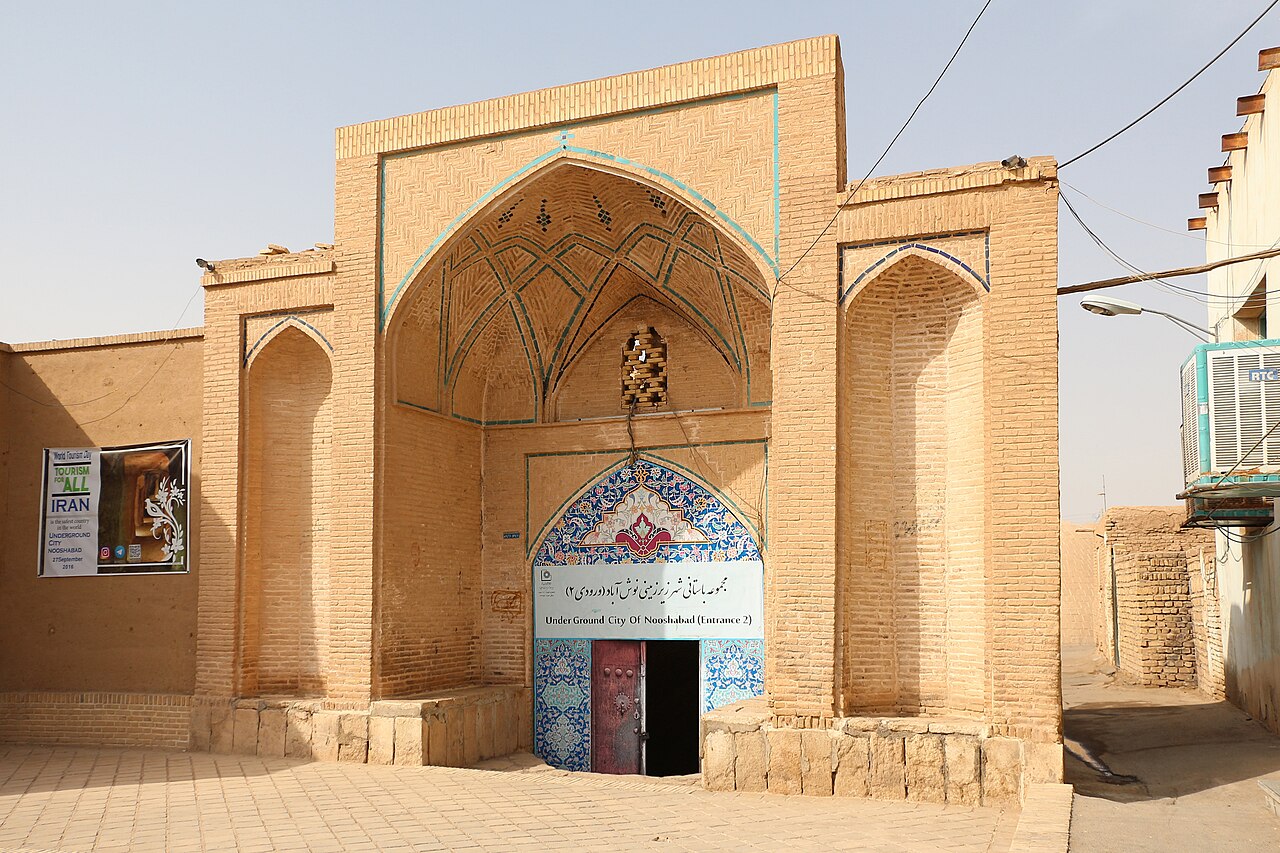
Photo: Bernard Gagnon · CC BY-SA 4.0

Beneath the small desert town of Nushabad, north of Kashan, lies Ouyi, a hand-cut underground city on three levels reaching depths of between 4 and 22 metres. Its tunnels, chambers, wells and traps sheltered the population from raiders for well over a millennium, while an ingenious system of vertical ventilation shafts kept air breathable and temperatures cool even at the deepest level — often described as ancient air-conditioning. Largely forgotten in modern times, the complex was rediscovered by accident in 2004 when a local resident digging on his property broke through into the tunnels.

See it on the globe →
The mainstream view

What archaeology says

Iranian archaeologists date the founding of Ouyi to the Sassanian period, the last pre-Islamic Persian empire (AD 224–651). Local tradition ties the town's name to a Sassanian king who, passing through, drank from a spring of exceptionally cold, sweet water and ordered a settlement built around it: Anushabad, the city of cold, tasty water. The underground complex was cut into the soft sediment beneath the town as a purpose-built refuge, with narrow, easily defended entrances opening from private houses, the fort and the congregational mosque.

The city is arranged on three storeys. The uppermost level had a largely defensive function, designed with dog-leg passages, ambush points and traps to confuse and slow intruders; the middle level served as temporary living quarters with food stores and water channels; and the deepest level, around 20 metres down, was the last and safest resort during a siege. Stone doors could seal passages, and carved niches held oil lamps whose soot still blackens the walls.

Pottery and artefacts recovered from the tunnels span the Sassanian, Ilkhanid, Safavid and Qajar periods, showing the refuge remained in intermittent use for some 1,500 years — most intensively during the Mongol invasions of the 13th century and later Afghan raids. Archaeologists regard the ventilation shafts, which exploit temperature and pressure differences to draw fresh air downwards, as sophisticated but fully consistent with Persian engineering traditions such as qanats and windcatchers.

Key evidence cited
  • Three excavated levels at depths of 4 to 22 metres, with defensive traps, stone doors and ambush passages
  • Pottery finds spanning Sassanian to Qajar periods, indicating about 1,500 years of intermittent refuge use
  • Ventilation shafts consistent with documented Persian engineering such as qanats and windcatchers
  • Entrances concealed inside houses, the fort and the mosque, matching a civilian refuge function
  • Historical record of Mongol and Afghan raids on the Kashan region explains the need for shelter
  • Rediscovery in 2004 during private digging shows the complex had passed out of living memory
The alternative view

What the skeptics propose

Some Iranian commentators and alternative-history writers argue that Ouyi's origins are older than the Sassanian date allows. They note that the refuge tradition in the Iranian plateau is ancient, that the lowest galleries have never been exhaustively excavated, and that a settlement founded on a celebrated cold spring in a desert would plausibly have attracted occupation long before late antiquity — perhaps in Parthian, Achaemenid or even earlier times. Because the city is cut into soil and rock rather than built, they stress, its true age cannot be directly measured, only inferred from what happens to be found inside.

Writers who extend Graham Hancock's underground-refuge hypothesis beyond Cappadocia have folded Nushabad into a claimed wider pattern of subterranean shelters across the ancient world, from Turkey to Iran, suggesting a shared memory of catastrophe or a common threat that drove whole communities underground. Popular treatments also dwell on the ventilation system, presenting engineering that keeps air fresh 20 metres down as anomalously advanced for its supposed date.

Mainstream archaeologists reply that the artefact record is unambiguous: nothing recovered from Ouyi predates the Sassanian period, and the engineering, while impressive, is exactly what one would expect from the culture that perfected qanat irrigation tunnels centuries earlier. The threats that drove people underground are also well documented history — Arab, Mongol and Afghan invasions — requiring no lost cataclysm to explain them.

Key evidence cited
  • No direct dating of the excavation itself is possible; only its contents have been dated
  • The deepest galleries have not been fully excavated, leaving earlier material a possibility
  • The cold-spring foundation legend hints at a settlement history older than the Sassanian record
  • The refuge's scale and air-management are argued to exceed the needs of occasional raids
  • Alternative writers place Nushabad in a claimed trans-regional family of underground refuges with Cappadocia
  • Nearby Kashan sits close to Tepe Sialk, occupied since the 6th millennium BC, showing deep antiquity of settlement in the district

Genuinely open questions

  1. How far does the unexcavated portion of the complex extend beneath the modern town?
  2. Does any material in the lowest level predate the Sassanian era?
  3. Was the underground city dug in one planned campaign or accreted over centuries?
  4. How exactly did the builders survey and ventilate the deepest chambers with the tools of the period?

Worth knowing

The ventilation shafts still work: on a summer day when the desert surface bakes at over 40 degrees Celsius, the deepest level of Ouyi stays naturally cool — visitors routinely describe it as walking into air-conditioning that was installed some fourteen centuries ago.