What archaeology says
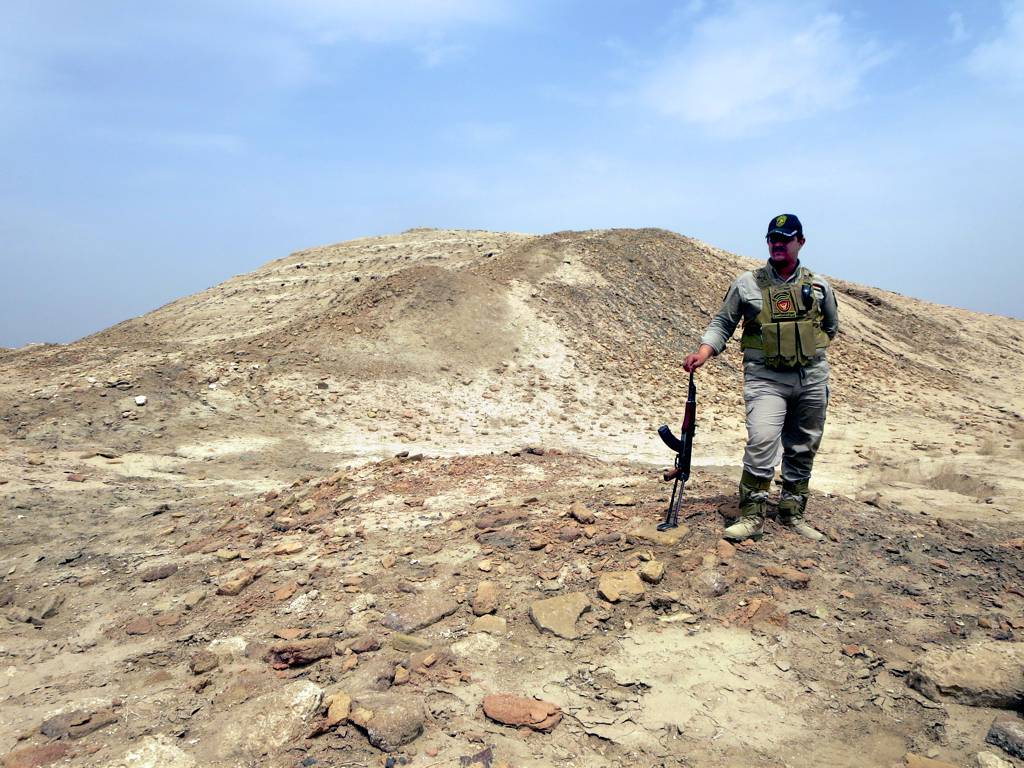
The defining excavations were led by Fuad Safar with Seton Lloyd for Iraq's Directorate General of Antiquities between 1946 and 1949. Cutting beneath the unfinished Ur III ziggurat of king Ur-Nammu (c. 2100 BC), they uncovered a sequence of mud-brick temples reaching down to a small single-roomed shrine of the earliest Ubaid period — a continuous architectural pedigree for Enki's sanctuary stretching back more than two millennia before the ziggurat itself. Thick deposits of fish bones among the offerings fit Enki's watery character with almost uncanny neatness. The earliest pottery defines the 'Eridu phase' (c. 5400–4700 BC) of the Ubaid culture, and the sequence runs on through the Uruk period into historic times. After decades of interruption, fieldwork resumed in 2019 with a joint Iraqi, Sapienza University of Rome and University of Strasbourg project focused on the Ubaid cemetery and settlement.
On the Sumerian King List, mainstream Assyriology reads the document as ideology rather than chronicle: composed and copied mainly in the late third and early second millennium BC, it projects a theory of legitimate kingship rotating between cities, and its earliest known manuscript lacks the antediluvian section entirely — the eight pre-flood kings reigning a combined 241,200 years appear to be a later literary addition using schematic sexagesimal numbers. As for the flood itself, Leonard Woolley announced in 1929 that a three-metre silt layer at Ur was Noah's flood, but subsequent work showed the flood deposits at Ur, Kish and Shuruppak date to different centuries and none covers a whole city — evidence of repeated, devastating but local river floods on a flat alluvial plain, plausibly the seedbed of the flood tradition rather than a single global event.
- Eighteen superimposed temples beneath the ziggurat, from a simple Ubaid shrine to monumental platforms
- The 'Eridu phase' pottery sequence anchoring settlement to c. 5400 BC
- Fish-offering deposits matching Enki's cult continuously across millennia
- Flood layers at Ur, Kish and Shuruppak dating to different centuries — local river floods, not one deluge
- The earliest King List manuscript lacking the antediluvian kings, marking them as a later literary addition