Belief & Society · Gobustan, near Baku, Azerbaijan (Boyukdash, Kichikdash and Jinghirdagh hills)

Gobustan

Six thousand carvings above the Caspian — and the reed boats that convinced Thor Heyerdahl the Vikings' god sailed from Azerbaijan

Mainstream: c. 13,000 BC to the medieval period; boat images mainly Neolithic to Bronze AgeAlternative: Thor Heyerdahl's reading: home waters of boat-builders whose descendants, led by a historical Odin, migrated to Scandinavia40.11°, 49.38°

At a glance

Gobustan
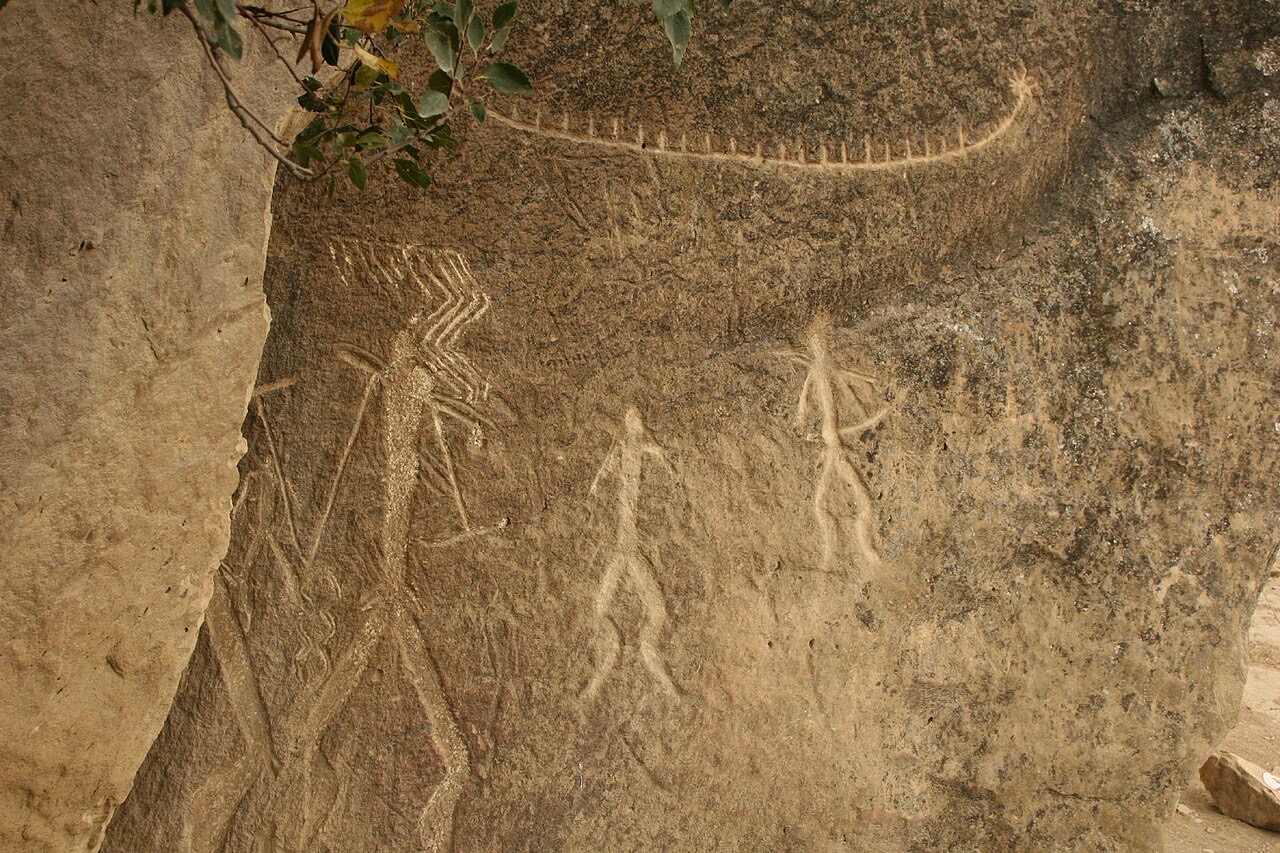
Photo: Walter Callens · CC BY 1.0

On three rocky hills between the Caucasus foothills and the Caspian Sea, the Gobustan reserve preserves more than 6,000 rock engravings spanning perhaps fifteen millennia: dancing figures, hunters, bulls, goats, pregnant women, and — most famously — long sickle-shaped boats crowded with oarsmen, some bearing sun-disc emblems at the prow. Soviet archaeologist Isaak Jafarzadeh began systematic study after quarrymen stumbled on the carvings in the 1930s, and the site became a state reserve in 1966 and a UNESCO World Heritage Site in 2007. Gobustan's boats drew the Norwegian adventurer Thor Heyerdahl back repeatedly between 1981 and his death in 2002; struck by their resemblance to Scandinavian Bronze Age ship carvings, he built his last great theory here — that Norse tradition's Odin was a real chieftain who led a migration from the Caspian to Scandinavia.

See it on the globe →
The mainstream view

What archaeology says

Mainstream archaeology treats Gobustan as an exceptional but thoroughly local record of life on the Caspian shore from the end of the Ice Age onward. The earliest engravings — large naturalistic aurochs and full-figured human forms — are attributed to Upper Palaeolithic and Mesolithic hunter-fisher communities, with later phases adding domesticated animals, collective dances, camel caravans and eventually medieval inscriptions. Excavated shelters at the site yielded tens of thousands of stone tools and occupation deposits that anchor this long chronology. The boats, generally placed in the Neolithic to Bronze Age, fit a shoreline community that fished and travelled the Caspian, whose waters then lapped much closer to the hills; some boats carry sun symbols, a motif common across prehistoric Eurasia.

Heyerdahl's Odin hypothesis receives short shrift from professional archaeologists and historians. His argument chained together the Gobustan boat carvings' resemblance to Scandinavian petroglyphs, the thirteenth-century Ynglinga Saga's tale of Odin migrating from a land of the Aesir east of the Black Sea, and the phonetic similarity between Aesir and Azerbaijan/Azeri. Norwegian academics — who publicly debated Heyerdahl and the co-authored Jakten på Odin (The Search for Odin, 2001) — showed that Snorri Sturluson's saga is medieval learned myth-making, not migration history; that the name resemblance is coincidence; and that boat imagery with crews and sun symbols arose independently in many waterside cultures. The similarity is real; the genealogical link is not demonstrable.

None of this diminishes the site's standing. UNESCO's 2007 inscription cites the outstanding testimony the engravings give to hunting, fauna, flora and lifeways across millennia of climatic change, and Gobustan remains the cornerstone of Azerbaijani prehistory — no Vikings required.

Key evidence cited
  • Excavated occupation deposits and tens of thousands of stone tools tie the engravings to continuous local habitation from the late Ice Age onward
  • The engraving sequence (aurochs and hunters, then herders, then camel caravans and inscriptions) tracks known regional cultural development
  • Boat images with crews and sun symbols occur independently in many prehistoric waterside cultures, weakening any unique Scandinavian link
  • Snorri Sturluson's Ynglinga Saga is thirteenth-century learned euhemerism, written two millennia after the boats were carved
  • Philologists reject the Aesir-Azerbaijan name equation as coincidental sound-alikeness
  • A first-century AD inscription of Rome's Legio XII Fulminata at Gobustan shows the site's later visitors are documented when they really came
The alternative view

What the skeptics propose

Thor Heyerdahl's case deserves to be stated as he argued it, because it is more historical-diffusionist than mystical. Visiting from 1981 onward and doing fieldwork in the 1990s, he documented Gobustan's sickle-shaped reed-style boats with raised prows and, in some cases, sun discs — and observed that virtually identical vessels appear pecked into Bronze Age rocks in Norway and Sweden. Rather than coincidence, he proposed a migration: the Ynglinga Saga describes Odin as a chieftain who led his people, the Aesir, from a homeland called Asaland east of the Black Sea north through Russia to Scandinavia, where he was later deified. Heyerdahl took the saga literally, identified Asaland with Azerbaijan (noting the Aesir/Azeri echo and the Udi people of the Caucasus), and argued waterways linked the Caspian to the Baltic. He pressed the case in As-Napoleon (1998) and Jakten på Odin (2001), and Azerbaijan embraced him warmly; he remains celebrated there.

The reaction in Norway was severe: historians and archaeologists accused him of selective quotation, naive literalism about a thirteenth-century text, and abandoning method for pattern-matching — some reviews of Jakten på Odin rank among the harshest ever given a Norwegian bestseller. Heyerdahl, who had crossed oceans on Kon-Tiki and Ra to prove ancient mobility was possible, replied that academics systematically underestimate prehistoric peoples' capacity for long-distance movement.

Beyond Heyerdahl, Gobustan attracts lighter fringe attention: the boat-with-sun-disc motif appears in ancient-astronaut compilations as a solar barque carrying sky-beings, and the site's Roman inscription and musical Gaval Dash stone feed a general aura of anomaly. Azerbaijani tradition, for its part, has long woven the carvings into local identity — a reminder that the site's deepest meaning has always been made locally, whichever direction the boats are imagined to sail.

Key evidence cited
  • Gobustan's sickle-shaped, high-prowed boat carvings do genuinely resemble Bronze Age Scandinavian ship petroglyphs, as Heyerdahl documented
  • The Ynglinga Saga independently locates Odin's homeland east of the Black Sea, roughly where Heyerdahl went looking
  • River systems connect the Caspian basin northward toward the Baltic, making the proposed migration route physically plausible
  • Heyerdahl's own ocean crossings on Kon-Tiki and Ra demonstrated that dismissals of ancient long-distance travel can be premature
  • Sun-disc emblems on some Gobustan boats parallel the sun-ship motif central to Scandinavian Bronze Age religion

Genuinely open questions

  1. How old are the earliest Gobustan engravings, and did any truly Upper Palaeolithic phase exist?
  2. What did the boat-and-sun-disc compositions mean to the carvers — transport, ritual, cosmology, or all three?
  3. Does the resemblance between Caspian and Scandinavian boat carvings reflect any contact at all, however indirect, or pure convergence?
  4. How did the Caspian's dramatic shoreline shifts shape settlement and imagery at the site?

Worth knowing

Gobustan holds graffiti from history's best-documented visitors as well as its most mysterious: a first-century AD inscription left by Rome's Twelfth Legion — the easternmost Roman inscription ever found — sits below hills carved with boats thousands of years older.