Ancient Engineering · Kaymaklı, Cappadocia, Turkey

Kaymaklı Underground City

Eight storeys of refuge carved beneath a Cappadocian village

Mainstream: 8th–7th century BC (Phrygian), expanded into the Byzantine eraAlternative: c. 2000 BC (Hittite) or earlier38.47°, 34.75°

At a glance

Kaymaklı Underground City
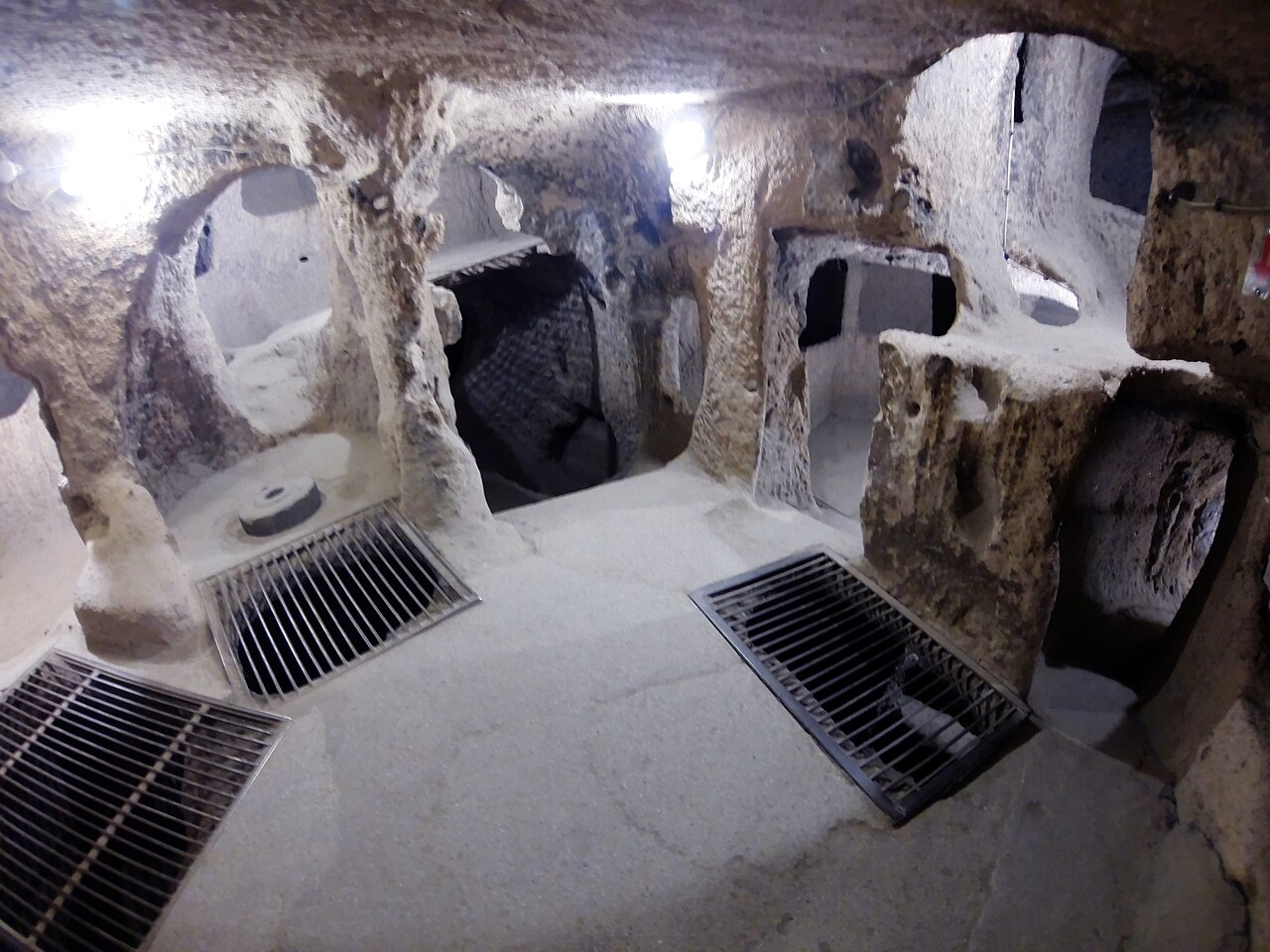
Photo: Nevit Dilmen · CC BY-SA 3.0

Kaymaklı is one of the largest of Cappadocia's underground cities, a warren of tunnels, stables, kitchens, wineries, churches and storerooms cut into soft volcanic tuff beneath the modern village of the same name. Eight levels have been identified, of which four are open to visitors, and local tradition holds that a tunnel of some 8 to 9 kilometres once linked it to its larger sister city at Derinkuyu. Opened to tourists in 1964, it remains partly entangled with the village above, whose houses still use the uppermost galleries as cellars and stables. Who first broke ground here, and when, is genuinely uncertain.

See it on the globe →
The mainstream view

What archaeology says

The standard account, followed by the Turkish Department of Culture, credits the Phrygians with the first excavations in the 8th to 7th centuries BC, taking advantage of tuff so soft it can be worked with hand tools. The complex was then enlarged over many centuries. Xenophon's Anabasis, written around 370 BC, describes Anatolian villagers living in excavated underground houses with their livestock, showing the tradition was well established by the Classical period.

The city as visitors see it today is overwhelmingly a Byzantine creation. During the Arab-Byzantine wars of the 7th to 10th centuries AD, Christian communities deepened and fortified the complex, adding chapels, ventilation shafts and the great circular millstone doors that could seal each level from the inside. Population estimates for Kaymaklı at its height commonly run to around 3,500 people, with some scholars arguing the vast storage capacity implies considerably more.

Some archaeologists accept that the earliest chambers could be older than the Phrygians, possibly Hittite work of the 2nd millennium BC, noting Hittite-era artefacts found in the region and the strategic pressures of the Bronze Age collapse. But no excavated layer has yet proven occupation earlier than the Iron Age, and dating rock-cut voids, which contain no datable material of their own, remains notoriously difficult.

Key evidence cited
  • Eight identified levels reaching roughly 80 metres down, with four open to the public since 1964
  • Byzantine-era chapels, crosses and millstone blocking doors consistent with 7th–10th century AD refuge use during Arab raids
  • Xenophon's Anabasis (c. 370 BC) independently describes underground dwellings in Anatolia
  • Turkish Department of Culture attributes the first excavation to the Phrygians, 8th–7th century BC
  • Extensive storage rooms, wineries and stables indicating planned refuge for thousands of people and livestock
  • No excavated artefact layer at Kaymaklı predates the Iron Age
The alternative view

What the skeptics propose

Alternative researchers argue the conventional timeline is far too shallow. Graham Hancock, in Magicians of the Gods (2015), discusses Cappadocia's underground cities as possible refuges built or begun by survivors of a cataclysm at the end of the last Ice Age, linking them to his wider case for a lost civilisation destroyed around 10,800 BC in the Younger Dryas. On this reading, sheltering thousands of people and their animals deep underground makes most sense as a response to something falling from the sky, not merely to passing raiders.

Ancient-astronaut writers, including Erich von Däniken, have similarly presented the Cappadocian cities as evidence that early humans hid from an airborne threat, and note that no one has convincingly explained where the enormous volume of excavated spoil was dumped without leaving tell-tale heaps. Proponents also point out that the millstone doors seal from within against intruders coming from the surface, which they read as fear of something above rather than of neighbouring armies.

Mainstream archaeologists respond that every datable find at Kaymaklı is Iron Age or later, that the spoil was likely spread on fields and eroded over centuries, and that historical records amply document the Arab raids the cities defended against. The absence of Palaeolithic or Neolithic material anywhere in the complex is, they argue, decisive against an Ice Age origin, though they concede the first digging phase is simply not well dated.

Key evidence cited
  • The earliest levels contain no inscriptions or datable material, leaving their true age open
  • Some archaeologists have themselves proposed Hittite origins around 2000 BC, based on regional finds
  • Graham Hancock argues underground refuge on this scale fits a Younger Dryas catastrophe scenario
  • The missing spoil problem: millions of cubic feet of tuff were removed with no obvious dump sites
  • Reported tunnel connexion of 8–9 km to Derinkuyu implies coordinated regional engineering
  • Over 200 underground settlements are known in Cappadocia, suggesting a tradition older than any single historical threat

Genuinely open questions

  1. Which culture actually cut the first chambers — Hittite, Phrygian, or someone earlier?
  2. Has the full extent of Kaymaklı been mapped, given that four of eight levels remain closed?
  3. Does a continuous traversable tunnel to Derinkuyu really exist, and has it ever been fully surveyed?
  4. Where was the excavated spoil deposited?

Worth knowing

The village of Kaymaklı still sits directly on top of the underground city, and residents traditionally used the coolest upper galleries as cellars, stables and vegetable stores — the antique city never entirely went out of service.