What archaeology says
Persepolis is one of the best-documented construction projects of antiquity. Foundation inscriptions of Darius I fix the founder and purpose, and the Persepolis Fortification and Treasury tablets — tens of thousands of Elamite administrative texts recovered from the site itself — record the actual workforce: paid labourers and craftsmen (kurtash) of many nationalities, including Egyptians, Ionians, Lydians and Babylonians, receiving rations of grain, wine and silver, with women workers listed and some women recorded as supervisors on equal or higher pay. Slavery built neither the terrace nor the palaces; a multi-ethnic imperial payroll did, and we can read the receipts.
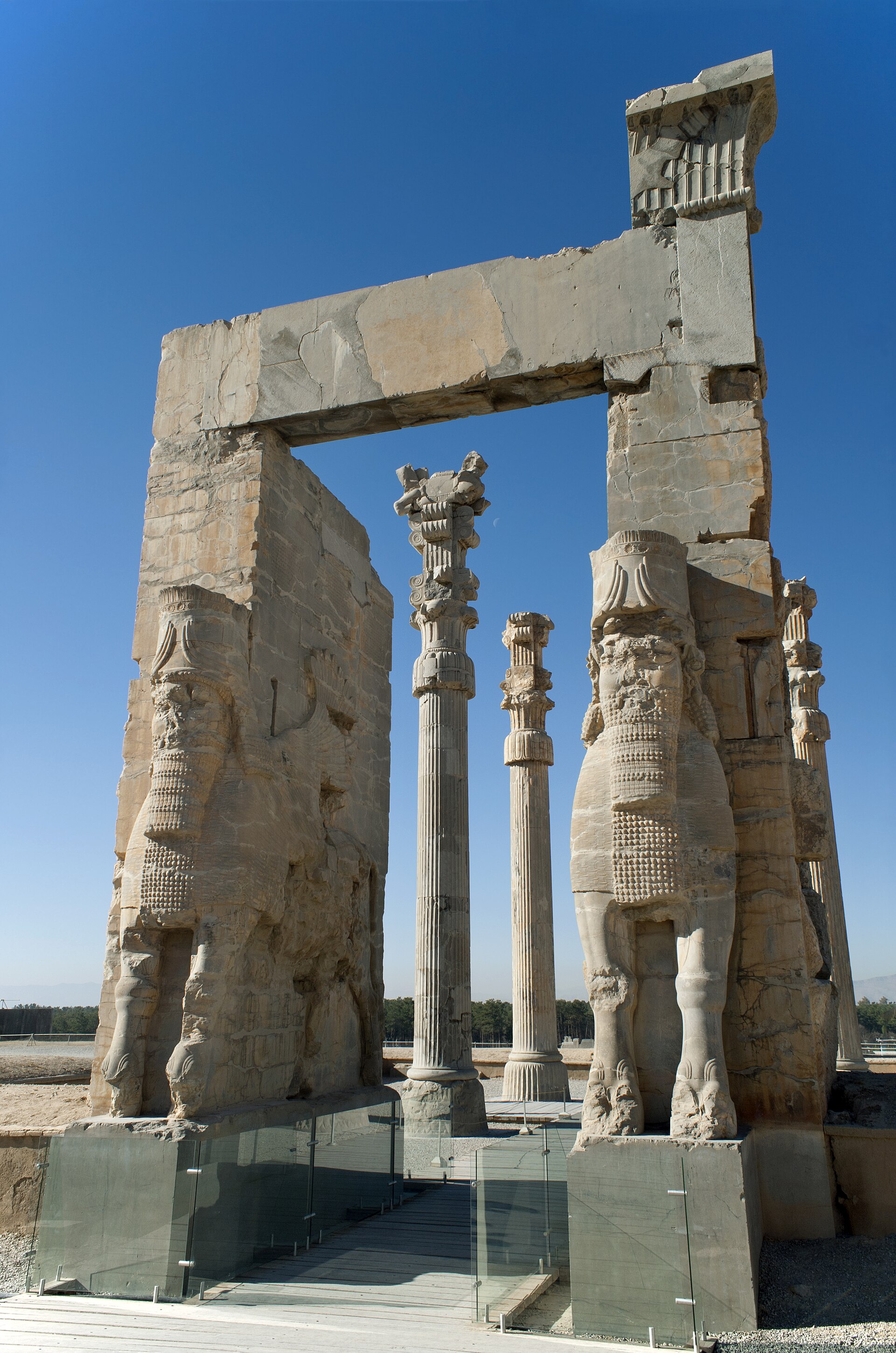
The stone technology has been studied in detail, notably by Ann Britt and Giuseppe Tilia of the Italian restoration mission from the 1960s, and by later researchers cataloguing tool marks across the site and its quarries. The sequence is legible on unfinished blocks: quarrying with iron picks and wedges, rough dressing with pointed and toothed chisels, then fine claw-chisel work and abrasive polishing that gave the grey limestone its lustrous, marble-like surface. Neat cylindrical holes show tube drilling and drill-and-chisel hollowing, and long curved kerfs at Achaemenid sites have been interpreted as the work of large swinging saws — the so-called pendulum saw — used with abrasive to slice stone; iron clamps in lead-caulked sockets tied blocks together against earthquakes. Unfinished column drums, abandoned capitals and a roughed-out gate (the 'Unfinished Gate') freeze every stage of the process in place.
Craft lineages are also traceable: Ionian Greek and Lydian masons' marks appear on Persepolitan stones, and the polish and jointing clearly influenced — or shared ancestry with — later traditions from Mauryan India to the Hellenistic world. For archaeologists, Persepolis is the definitive proof of what organised iron-age craftsmanship could achieve, precisely because the payroll, the quarries, the tool marks and the unfinished pieces all survive together.
- Foundation inscriptions of Darius I naming founder, purpose and construction on the terrace
- Tens of thousands of Fortification and Treasury tablets recording a paid, multinational workforce
- Tool-mark studies (Tilia and successors) tracing quarry pick, chisel, tube-drill and saw sequences
- Unfinished blocks, column drums and the 'Unfinished Gate' preserving every production stage
- Ionian and Lydian masons' marks tying the stonework to known iron-age craft traditions