What archaeology says
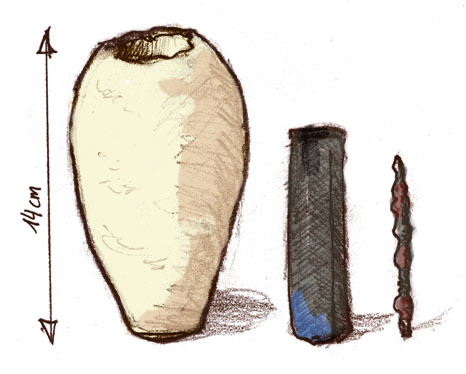
Most archaeologists and historians of technology regard the electrical interpretation as unlikely. The jar's form closely matches vessels from nearby Seleucia known to have held rolled papyrus or parchment scrolls; an organic scroll decaying around an iron pin would produce exactly the acidic corrosion residues observed. No wires, conductors, electroplated objects or written references to electricity have ever been found from Parthian or Sasanian Mesopotamia, and the bitumen seal — which completely covered the copper cylinder — would have made attaching a circuit awkward and replacing the electrolyte harder still.
Analyses of allegedly electroplated Mesopotamian objects that Koenig cited have shown they were fire-gilded with mercury amalgam, a well-documented ancient technique needing no electricity. Sceptical assessments, including those publicised by archaeometallurgist Paul Craddock of the British Museum, note that a couple of flashlight batteries outperform anything the jar could deliver, and that a technology leaving a single ambiguous example and no lineage is best explained conventionally.
The dating is also looser than popular accounts suggest: the jars were long labelled Parthian, but stylistic comparisons place them in the Sasanian period, possibly as late as the sixth century AD.
- Near-identical jars from Seleucia and Ctesiphon contained rolled scrolls, and decayed organic matter around an iron pin explains the acidic corrosion
- No wires, terminals, conductors or electroplated artefacts have ever been excavated from the region or period
- Mesopotamian gilded objects cited as electroplated proved to be fire-gilded with mercury amalgam
- The bitumen seal fully enclosed the copper cylinder, making electrical connection and electrolyte replacement impractical
- No Parthian or Sasanian text mentions anything resembling electricity, despite rich surviving craft literature
- The find was never properly excavated, so the 'battery' has no reliable archaeological context at all