What archaeology says
Only one tomb is identified with certainty: the trilingual DNa inscription of about 490 BC names Darius the Great, lists the lands of his empire from Macedon to India, and proclaims his devotion to Ahura Mazda. On stylistic and historical grounds the other three are attributed to Xerxes I, Artaxerxes I and Darius II, spanning roughly 486 to 404 BC. The site was excavated scientifically by Erich Schmidt of the University of Chicago's Oriental Institute between 1936 and 1939, and classical sources record that the tombs were looted after Alexander's conquest — Ctesias preserves the detail that even relatives could reach Darius's tomb chamber only by being hauled up on ropes, so high was the entrance cut.
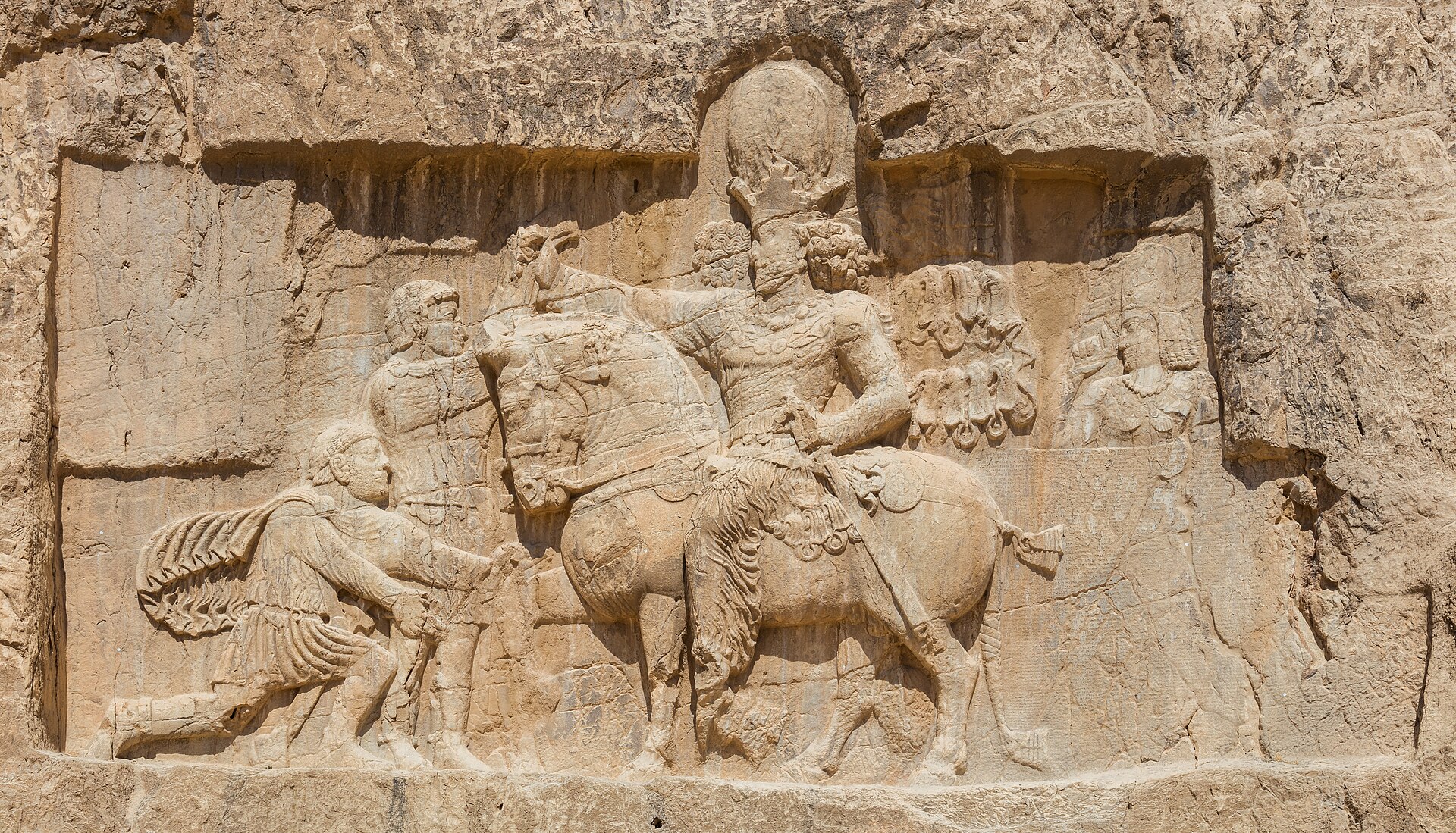
The Ka'ba-ye Zartosht is an Achaemenid tower of the early 5th century BC, twin to the ruined Zendan-e Soleyman at Pasargadae, with a single raised chamber reached by a now-lost stair. Its purpose has divided scholars for a century. Kurt Erdmann and others argued for a fire temple; critics answer that a permanently sealed, windowless chamber with no smoke vent is a poor place for a sacred fire. Ernst Herzfeld proposed a repository for royal archives or the sacred Avesta; the Dutch Iranologist Heleen Sancisi-Weerdenburg suggested in 1983 that the towers were connected with royal investiture — coronation towers; still others see a temporary royal tomb. What is certain is that the tower mattered enormously later: in the 3rd century AD the Sasanian high priest Kartir and King Shapur I had major inscriptions carved on its walls, including Shapur's account of his victories over three Roman emperors — effectively a state gazette chiselled onto the mystery building.
- The trilingual DNa inscription naming Darius the Great and dating his tomb to c. 490 BC
- Erich Schmidt's 1936–1939 Oriental Institute excavations documenting the site's Achaemenid and Sasanian sequence
- The twin tower at Pasargadae (Zendan-e Soleyman), anchoring the Ka'ba-ye Zartosht in early Achaemenid architecture
- Sasanian inscriptions of Shapur I and the priest Kartir on the tower, showing its continued prestige and reuse
- Tool marks, unfinished tomb cuttings and classical accounts documenting rope-and-scaffold construction methods