Catastrophe & Climate · Buldhana district, Maharashtra, India

Lonar Crater

A meteorite crater in ancient lava, ringed with temples that cast its cosmic wound as a battle of gods and demons.

Mainstream: c. 50,000 years ago (impact); some dating suggests olderAlternative: Remembered in the Puranas as the slaying of a demon19.98°, 76.51°

At a glance

Lonar Crater
Photo: Amitabhkhare · Public domain

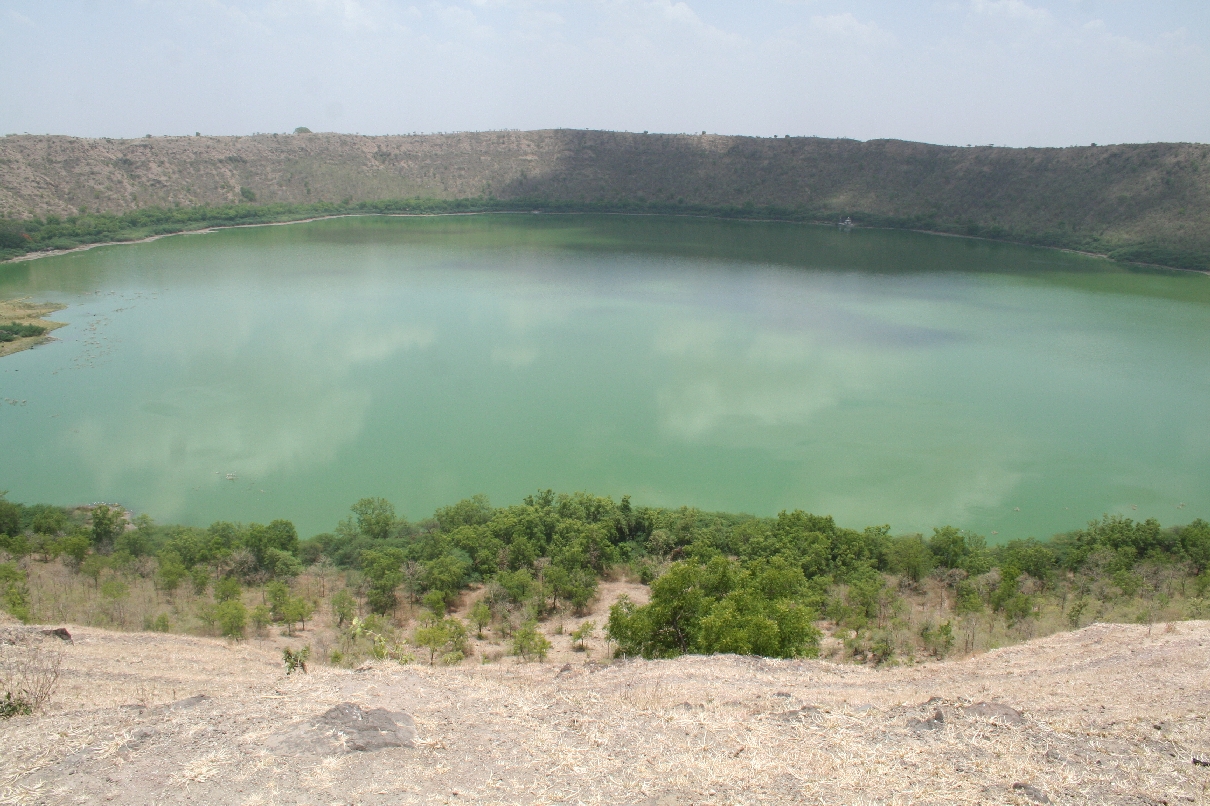
Lonar Crater is a near-circular basin nearly two kilometres across, punched into the hard basalt of the Deccan Plateau by a meteorite tens of thousands of years ago. It is one of the few large impact craters formed in basalt, prized by scientists as an analogue for craters on the Moon and Mars. Around its rim stand medieval Hindu temples, and its origin is woven into the Puranas as the place where Vishnu slew the demon Lonasura, an unusually direct meeting of impact geology and sacred landscape.

See it on the globe →
The mainstream view

What archaeology says

Lonar is a genuine hypervelocity impact crater, one of the very few excavated in flood basalt rather than sedimentary or crystalline rock. A meteorite struck the Deccan Traps and blasted out a bowl roughly 1.8 kilometres in diameter and around 150 metres deep, later partly filled by a saline, alkaline lake. Shock-metamorphic features, maskelynite, planar deformation, impact melt and ejecta, confirm the impact origin.

The age is debated. A commonly cited figure is about 50,000 years, but some argonand luminescence dating has suggested the impact could be considerably older, and the number is not settled.

Because it formed in basalt chemically similar to lunar and Martian surfaces, Lonar is studied as a planetary analogue, and its unusual lake chemistry and microbiology add further scientific interest. The surrounding temples, built in the Hemadpanthi style, date from the medieval period, long after the impact, and mark the crater as a sacred place rather than recording the event itself.

Key evidence cited
  • A near-circular crater about 1.8 kilometres across sits in Deccan Trap basalt, a rare setting for a large impact.
  • Shock-metamorphic features (maskelynite, planar deformation, impact melt) confirm a hypervelocity impact.
  • Ejecta and an overturned rim stratigraphy ring the crater.
  • A saline, alkaline lake fills the floor, giving distinctive water chemistry and microbiology.
  • The basalt target makes Lonar a valued analogue for lunar and Martian impact craters.
  • Dating (commonly cited near 50,000 years, though contested toward older ages) places the impact far in prehistory.
The alternative view

What the skeptics propose

The alternative and folk reading of Lonar reframes a cosmic impact as mythic drama. Local and Puranic tradition, associated with the Skanda and Padma Puranas, tells of the demon Lonasura, who terrorised the region until Vishnu, in the form Daityasudan, destroyed him; the crater and its temples commemorate that victory. Some enthusiasts read this as a folk memory of the impact itself, fire from the sky, a great wound in the earth, dressed in the language of gods and demons.

This is a gentler version of the recurring alternative claim that catastrophe myths encode real events. If a community lived near enough to witness or later marvel at a fresh crater, the reasoning goes, the memory might survive as a story of divine battle.

The honest standing is cautious. The impact is far older than any plausible continuous human tradition, and the temples and texts are medieval, tens of thousands of years after the event, so a direct eyewitness memory is very unlikely. What the tradition genuinely shows is how a striking geological feature becomes sacred and mythologised, not that it preserves a record of the impact.

Key evidence cited
  • The Skanda and Padma Puranas link the site to Vishnu slaying the demon Lonasura, casting it as a place of catastrophe.
  • Medieval temples ring the crater, marking it as a sacred and mythologised landscape.
  • The demon-slaying story is read by some as folk memory of fire and destruction from the sky.
  • The crater's dramatic, unnatural form invites explanation as a divine event.
  • It exemplifies the general claim that myth can grow around real geological catastrophe.
  • The saline lake and legends give the site an aura of the uncanny that sustains such readings.

Genuinely open questions

  1. How old is the Lonar impact really, closer to 50,000 years or considerably older?
  2. Could any human tradition plausibly bridge tens of millennia to remember the impact itself?
  3. Do the Puranic stories reflect the crater's form, or an actual witnessed event?
  4. How did the distinctive lake chemistry and its microbial life develop after the impact?

Worth knowing

Lonar is one of the rare large craters gouged into volcanic basalt, so similar to lunar rock that scientists treat it as a stand-in for the Moon here on Earth.