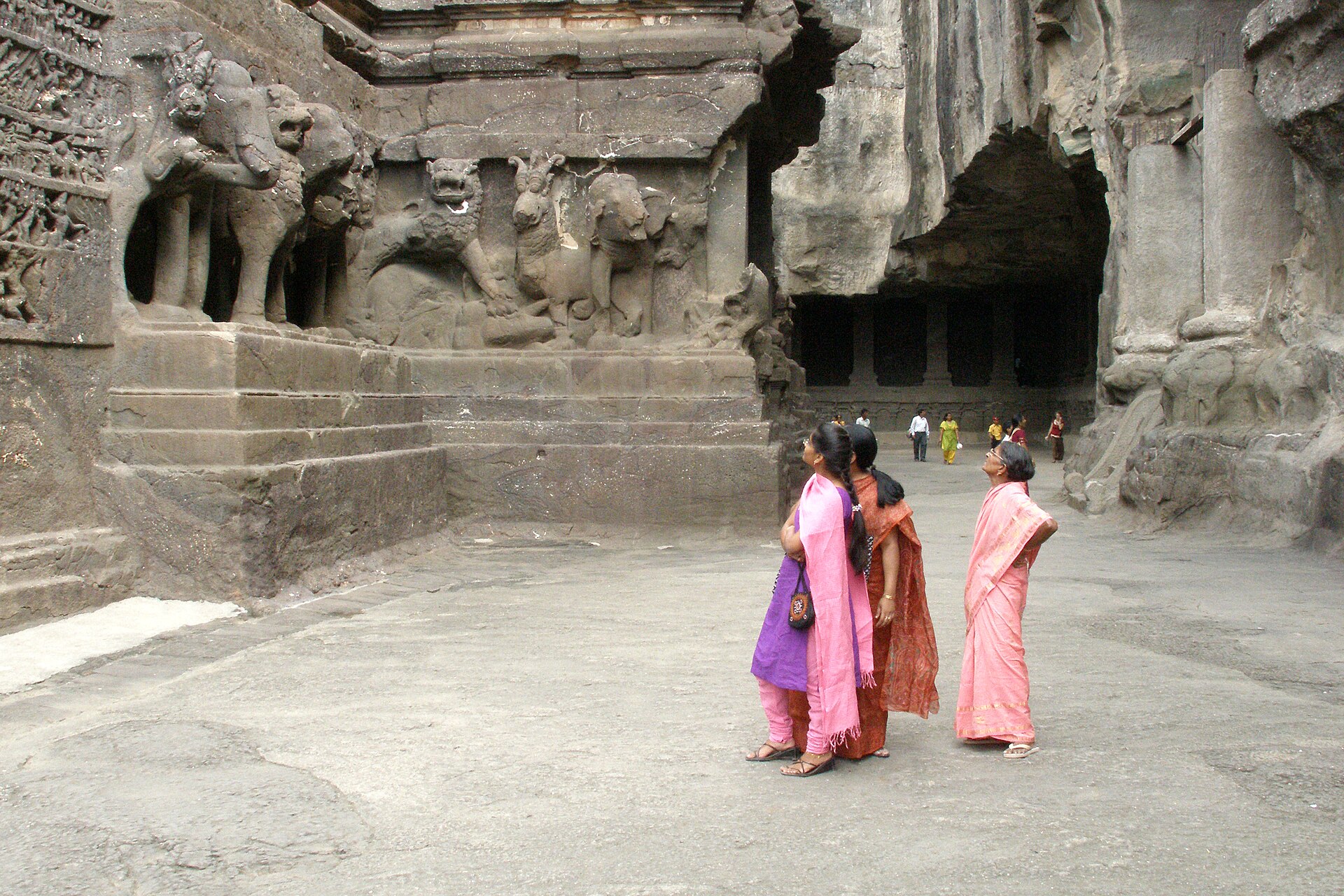
What archaeology says
Historians attribute the Kailasa to King Krishna I of the Rashtrakuta dynasty (r. c. 756–773). The key document is the Baroda copper-plate inscription of Karka II (c. AD 812), which describes a wonderful Shiva temple at Elapura (Ellora) built by Krishna that astonished even the gods and left its own architects marvelling that they could not have made it a second time. Architectural historians add that the temple's plan and sculptural program closely follow the Virupaksha temple at Pattadakal and, behind that, the Kailasanatha at Kanchipuram — southern structural temples the Rashtrakutas knew well after their campaigns in the Deccan — so the design did not appear from nowhere but translated an existing masonry blueprint into living rock.
The engineering, while extraordinary, sits inside a 1,200-year Indian tradition of rock-cut architecture that runs from the Mauryan Barabar caves through Ajanta, Elephanta and the earlier Ellora excavations. Working top-down eliminated the need for scaffolding, and the vesicular Deccan basalt, though hard, splits predictably under iron chisels and wedges. Archaeologists such as M. K. Dhavalikar have argued that the bulk of the monument — the main shrine, gateway and Nandi pavilion — was excavated in a single well-planned campaign under Krishna I, with subsidiary shrines, the river-goddess shrine and galleries added by later rulers, which is why unfinished passages and rough-dressed surfaces survive in the outer parts. Earlier, art historian Hermann Goetz went further, proposing the complex accumulated over multiple reigns from Dantidurga onward — a mainstream debate about phasing, not feasibility.
On the arithmetic, even the high-end estimate of 400,000 tonnes over about 20 years requires removing some 50–60 tonnes of rock a day — heavy but achievable for a royal workforce of several hundred labourers splitting basalt with wedges rather than pulverising it, since large blocks could be levered off and tipped down the slope. Chisel marks remain visible across the monument, and traces of the white plaster that once made the temple gleam like a snow-capped mountain still cling to the tower.
- Baroda copper-plate inscription of Karka II (c. AD 812) crediting a marvellous Shiva temple at Elapura to Krishna
- Close architectural dependence on the dated Virupaksha temple at Pattadakal and Kailasanatha at Kanchipuram
- Visible chisel marks, wedge slots and unfinished surfaces recording manual excavation stages
- A continuous 1,200-year Indian rock-cut tradition, with 33 other excavations at Ellora itself
- Workload calculations showing block-splitting by a few hundred workers fits a two-decade royal campaign