What archaeology says
The frustrating fact about Elephanta is that no foundation inscription survives, so the temple must be dated by style, architecture and circumstantial evidence — which is why serious scholarly attributions have ranged across the 5th to 8th centuries and from the Konkan Mauryas to the Chalukyas and Rashtrakutas. The position most scholars now accept, argued in detail by art historians including Walter Spink, Charles Collins and George Michell, places the main cave around the mid-6th century AD and credits Krishnaraja I of the Kalachuri dynasty, a devoted Pashupata Shaivite. The strongest material clue is numismatic: large numbers of Krishnaraja's copper coins have been found on the island, and the cave's iconographic program matches the Pashupata Shaivism his dynasty patronised.
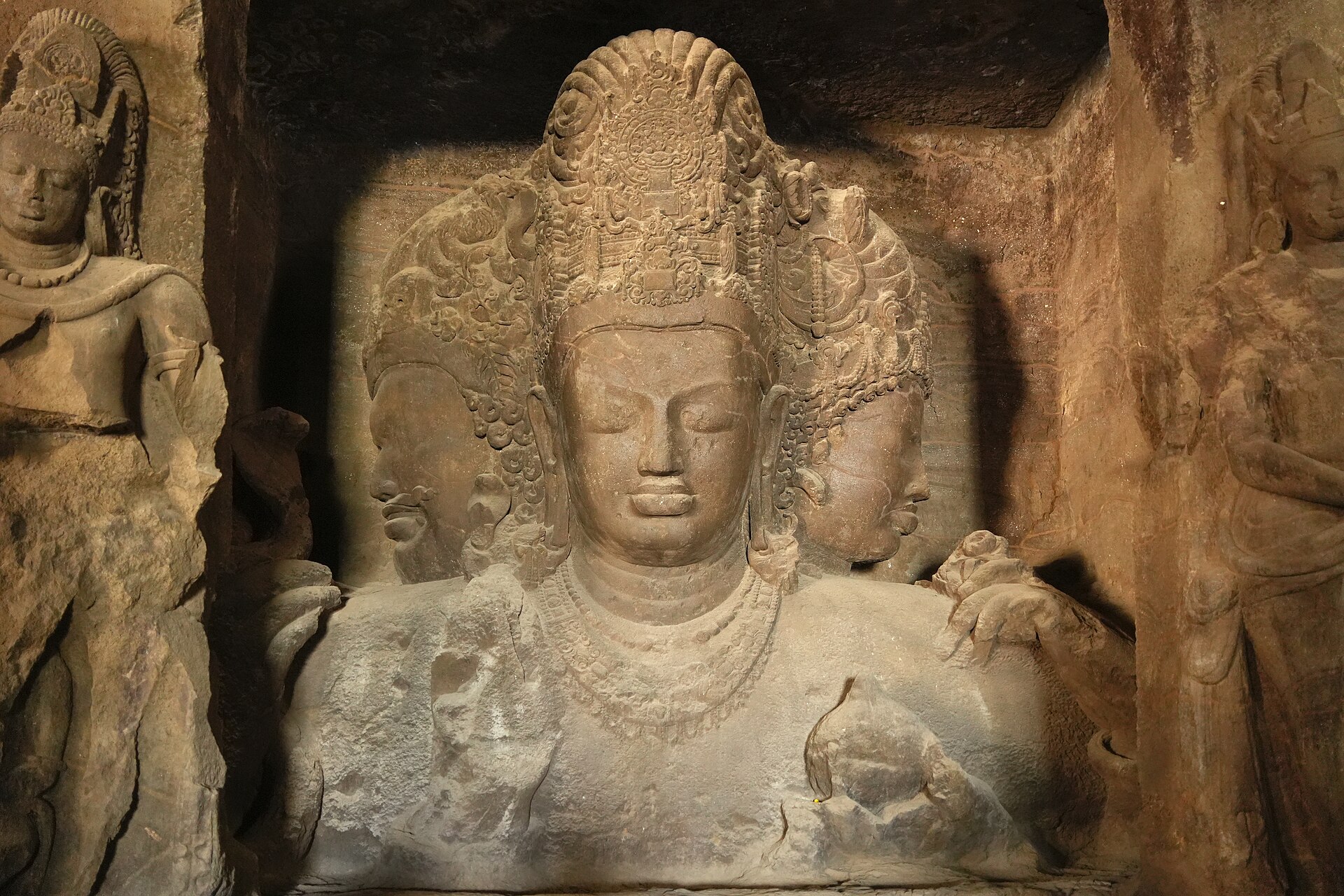
Stylistically the sculpture belongs to the last great flowering of the Gupta-derived idiom, with close cousins at the Jogeshwari and Mandapeshwar caves on the mainland and at Ellora's early Shaivite caves. Art historian Stella Kramrisch read the Sadashiva as a profound theological statement — the unmanifest absolute emerging into creation, protection and destruction — carved with a subtlety that argues for a mature, well-funded royal workshop.
The mystery of the builder was probably self-inflicted by the colonisers: the Portuguese chronicler Diogo do Couto recorded that a large, prominently displayed stone inscription was prised out of the cave and shipped to the Portuguese king around 1540 — and then lost. Most historians assume that stone named the patron and date, meaning the single document that could settle Elephanta's chronology may lie forgotten in Europe or at the bottom of the sea.
- Hoards of copper coins of Kalachuri king Krishnaraja I (c. AD 550–575) found on Elephanta Island
- Iconography matching the Pashupata Shaivism patronised by the Kalachuris, argued by Spink, Collins and Michell
- Close stylistic kinship with dated 6th-century caves at Jogeshwari, Mandapeshwar and early Ellora
- Diogo do Couto's 16th-century record of a large inscription removed by the Portuguese — evidence a dedication once existed
- A 2nd-century BC Buddhist stupa and earlier occupation debris explaining older finds on the island