Catastrophe & Climate · Rub al Khali (the Empty Quarter), eastern Saudi Arabia

The Wabar Craters

A meteorite that turned desert sand to black glass, in the dunes where an explorer hunted for a lost city.

Mainstream: Within the last few centuries (dating debated, roughly 250-6400 years)Alternative: Linked to the destruction of the legendary city of Ubar21.50°, 50.47°

At a glance

The Wabar Craters
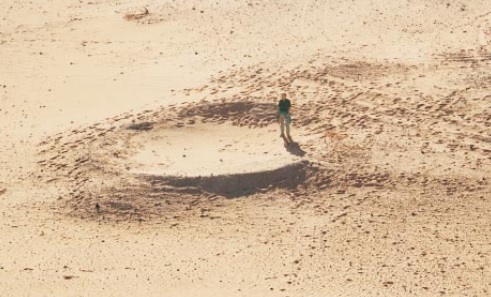
Photo: Jeffrey C. Wynn and Eugene M. Shoemaker · CC BY-SA 4.0

Deep in the sands of the Empty Quarter lie the Wabar craters, gouged by an iron meteorite that struck the dunes and flash-melted sand into glittering black glass. They were brought to Western attention in 1932 by the explorer Harry St John Philby, who was not looking for a crater at all, but for Ubar, the fabled 'Atlantis of the Sands' said to have been destroyed for its wickedness. He found impact glass instead, and the tangle of star-fallen fire and lost-city legend has clung to the site ever since.

See it on the globe →
The mainstream view

What archaeology says

The Wabar craters are a small but genuine impact site. An iron asteroid, perhaps around fifteen metres across, broke up and struck the dunes, forming a cluster of craters (the largest about a hundred metres across) and scattering meteoritic iron together with abundant impact glass. The glass is roughly nine-tenths local sand and one-tenth meteoritic iron and nickel, and occurs as black beads, dumbbells and scoria-like fragments, wind-sorted by size across the field.

The impactor is classified as an iron meteorite, and fragments have been recovered and studied. The craters are partly buried and reshaped by moving dunes, which has complicated study and dating.

The age is genuinely uncertain. Estimates have ranged widely, from only a couple of centuries to several thousand years, with some thermoluminescence and other work favouring a very young age, possibly within the last few hundred years. There is no accepted evidence that the impact destroyed any city, and the craters are far too small to level a settlement even if one had stood there.

Key evidence cited
  • A cluster of impact craters, the largest around a hundred metres wide, sits in the dunes of the Empty Quarter.
  • Abundant black impact glass, about 90 percent local sand and 10 percent meteoritic iron and nickel, litters the field.
  • Fragments of an iron meteorite have been recovered and classified.
  • Glass beads are wind-sorted by size, decreasing with distance from the craters, as expected for an airfall of melt.
  • Geophysical surveys have mapped the buried and dune-covered crater structures.
  • Dating work, including thermoluminescence, points to a young age, possibly only centuries old.
The alternative view

What the skeptics propose

The alternative interest in Wabar is really about the legend that led to its discovery. Philby went into the Empty Quarter hunting Ubar (which he transliterated as Wabar), a city the Quran and local tradition described as destroyed by God for defying the prophet Hud. When he found blackened glass and craters, it was natural to wonder whether a real cosmic catastrophe lay behind the story of a city consumed by fire from the sky.

Alternative and popular writers have kept that link alive: a star-fallen impact glassing the desert, a legend of a proud city obliterated by heavenly fire, and the romantic label 'Atlantis of the Sands'. Some suggest the impact and the legend are two views of one remembered event.

The honest standing is sceptical. The Wabar craters are too small and probably too recent to be the destroyer of an ancient city, and the actual site linked archaeologically to the Ubar legend is generally identified elsewhere, at Shisr in Oman, a collapsed caravan settlement over a sinkhole. Wabar is a real impact wrapped in a good story, not proof of the story.

Key evidence cited
  • The site was found while searching for the legendary lost city of Ubar, tightly coupling impact and legend.
  • Local and Quranic tradition describes a proud city destroyed by fire from the sky, echoing an impact.
  • Blackened, melted desert glass gives the legend a tangible, dramatic anchor.
  • The romantic 'Atlantis of the Sands' label keeps the lost-city association in circulation.
  • Some argue such vivid glass and craters could seed a durable oral memory of catastrophe.
  • The Empty Quarter's remoteness leaves room for stories that are hard to fully test.

Genuinely open questions

  1. Exactly when did the Wabar impact occur, centuries or millennia ago?
  2. Could a young, small impact nonetheless have been witnessed and remembered locally?
  3. Is there any real historical connection between the craters and the Ubar legend, or only a coincidence of geography?
  4. How much of the crater field remains hidden beneath the shifting dunes?

Worth knowing

Philby set out to find a lost city and came home with lumps of black glass instead; the 'Atlantis of the Sands' he sought is now usually identified with a collapsed sinkhole settlement at Shisr in Oman, hundreds of kilometres away.