Ancient Engineering · Aurangabad district, Maharashtra, India

Ajanta Caves

Thirty Buddhist monasteries carved into a horseshoe gorge — hidden by jungle for a thousand years until a tiger hunt in 1819.

Mainstream: Phase 1: 2nd–1st century BC (Satavahana); Phase 2: c. AD 460–480 (Vakataka)Alternative: Date not seriously disputed — sceptics instead question how thirty basalt monasteries and their murals were carved and painted with hammer, chisel and lamplight20.55°, 75.70°

At a glance

Ajanta Caves
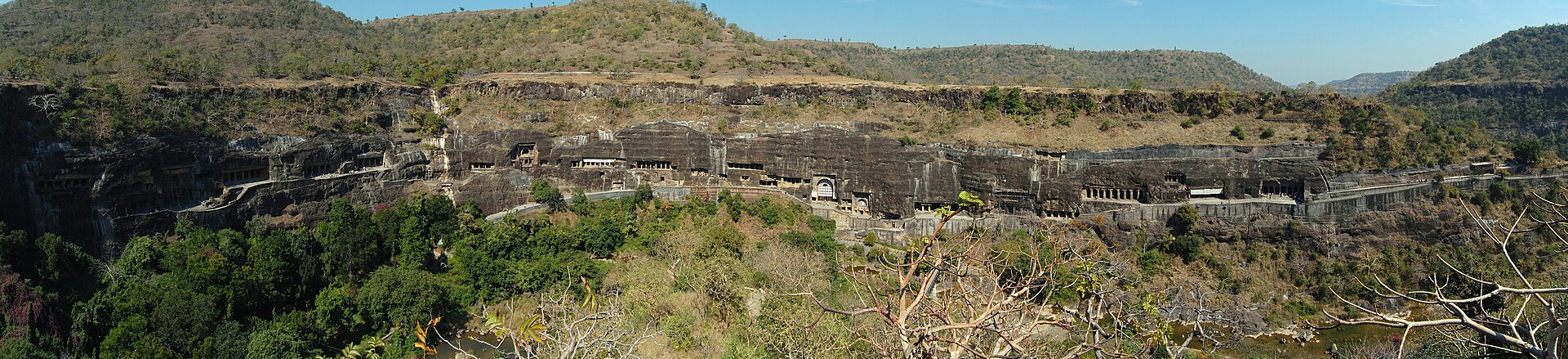
Photo: Marcin Białek · CC BY-SA 4.0

The Ajanta Caves are a crescent of 30 rock-cut Buddhist monasteries and prayer halls hewn into a 76-metre basalt cliff above the Waghora River in Maharashtra. Their interiors preserve the finest surviving body of ancient Indian painting — vast murals of the Jataka tales, courtly life, animals and bodhisattvas rendered in mineral pigments on plastered stone, alongside pillared halls, shrines and stupas all cut downward from the living rock. UNESCO lists them as masterpieces of Buddhist religious art that influenced painting traditions across Asia. After Buddhism declined in the region the caves were abandoned, the forest closed over the gorge, and Ajanta vanished from memory for roughly a millennium. On 28 April 1819 a British cavalry officer, John Smith of the 28th Madras Cavalry, was hunting tiger when a local shepherd boy led him to a hidden doorway — the entrance of what is now Cave 10. Smith scratched his name and the date across a painted bodhisattva, graffiti that survives to this day, and the 'rediscovery' set off two centuries of scholarship, copying expeditions and conservation battles over the fragile murals.

See it on the globe →
The mainstream view

What archaeology says

Archaeologists and art historians divide Ajanta into two construction phases separated by about four centuries. The earlier caves — including the chaitya halls 9 and 10 — belong to the Hinayana tradition and were excavated under the Satavahana dynasty in the 2nd–1st centuries BC, dated by donor inscriptions in early Brahmi script, architectural style and their aniconic stupa worship. The second, far more ambitious Mahayana phase produced most of the site, including the great painted viharas of Caves 1, 2, 16 and 17.

The chronology of that second phase was transformed by the University of Michigan art historian Walter M. Spink, who spent more than five decades arguing — cave by cave, doorway by doorway — that virtually all of it was accomplished in a single frenetic generation, roughly AD 460 to 480, under Emperor Harishena of the Vakataka dynasty. Inscriptions name the patrons: Harishena's minister Varahadeva sponsored Cave 16, and the local king Upendragupta sponsored Caves 17–20. When Harishena died around 477 the money stopped, work collapsed mid-stroke, and dozens of unfinished excavations froze every stage of the process in stone. Those unfinished caves are the mainstream's best evidence for method: they show the sequence of pilot tunnels, roughing-out and finishing by iron chisel, with millions of chisel marks still legible, while scientific study of the murals by the Archaeological Survey of India (notably conservation scientist Rajdeo Singh) has identified the plaster recipes, lamp-lighting arrangements and pigments — including lapis lazuli imported from Afghanistan.

Key evidence cited
  • Donor inscriptions in datable Brahmi scripts spanning both phases, naming patrons such as Varahadeva, minister of Vakataka emperor Harishena
  • Walter Spink's cave-by-cave chronology tying the second phase to c. AD 460–480, with work collapsing at Harishena's death
  • Dozens of unfinished excavations preserving every stage of manual carving, with iron-chisel marks throughout
  • Pigment and plaster analyses (ASI, Rajdeo Singh) matching known ancient materials, including imported lapis lazuli
  • Architectural and stylistic continuity with other dated Satavahana and Vakataka monuments in the Deccan
The alternative view

What the skeptics propose

Ajanta's dates are not seriously contested; the alternative conversation is about capability. YouTube researcher Praveen Mohan, whose videos on Indian rock-cut sites draw millions of views, argues that the flatness of Ajanta's ceilings, the symmetry of its pillars and the sheer volume of basalt removed — hundreds of thousands of tonnes across the gorge — sit uneasily with hand tools, and he points to what he interprets as machine-like tool marks and impossibly consistent surfaces. Similar arguments are made in the Ancient Aliens television franchise, which folds Ajanta and neighbouring Ellora into a broader claim of lost high technology in ancient India.

A second strand of wonder concerns the paintings themselves: how artists executed subtle shading, foreshortening and thousand-figure compositions in near-total darkness. Alternative writers have proposed everything from lost lighting technology to polished-metal light-piping systems, and some suggest the murals encode knowledge from a far older tradition than the Buddhist one that painted them.

Mainstream researchers respond that the evidence for manual work at Ajanta is about as complete as archaeology ever gets: unfinished caves preserve every step from rough tunnel to polished hall, iron chisels of the correct type are known from the period, and Spink's chronology shows what a determined imperial workforce could achieve in twenty years. Experiments and ASI documentation show the halls can be adequately lit with oil lamps, cloth and water-tray reflectors bouncing daylight from the entrances, and conservators note the murals were painted on a dung-and-rice-husk plaster typical of Indian technique — extraordinary artistry, but entirely human. Critics of Mohan, such as the Indian sceptic blog Mayiliragu, have catalogued cases where his 'machining' interpretations ignore visible chisel marks and documented construction sequences.

Key evidence cited
  • Praveen Mohan's videos arguing the flatness, symmetry and scale of the basalt excavation exceed plausible hand-tool work
  • The estimated hundreds of thousands of tonnes of hard Deccan basalt removed with no surviving engineering records
  • The puzzle of painting elaborate murals deep inside dark halls, prompting lost-lighting speculation
  • Claims of machine-like regularity in pillars and ceiling surfaces in the finest caves
  • The near-total absence of contemporary texts describing the construction methods or project organisation

Genuinely open questions

  1. Is Spink's radical 20-year chronology for the second phase correct, or did work extend over a longer period as earlier scholars believed?
  2. Exactly how were the deep interiors lit well enough for master painters to work — lamps, reflected daylight, or both?
  3. Why was the thriving site abandoned so completely that it vanished from regional memory for around a thousand years?

Worth knowing

The graffiti John Smith scratched over a bodhisattva mural in Cave 10 — 'John Smith, 28th Cavalry, 28th April 1819' — was carved standing on debris that then filled the cave, so his signature sits absurdly high up the pillar today.