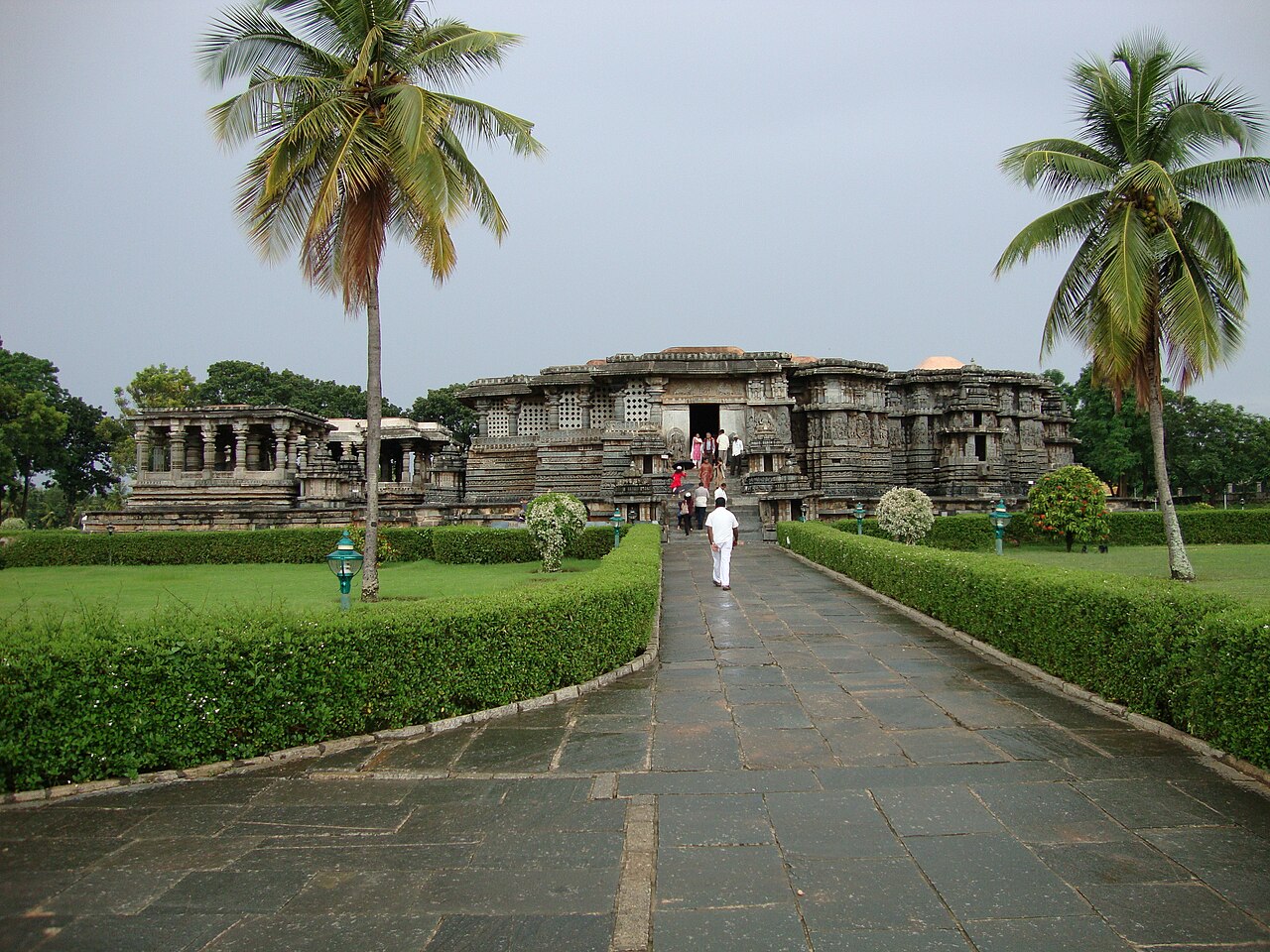
What archaeology says
Historians of Indian architecture date the temple firmly to the 12th century: inscriptions name the patrons, the deity dedications and even individual sculptors, who sometimes signed their work. The building belongs to a continuous, well-studied evolution of Hoysala style out of Western Chalukya architecture, which had already developed circular lathe-finished pillars generations earlier.
The key to the pillars is the material. Hoysala builders switched from sandstone to chloritic schist — soapstone — which is soft enough to carve easily when freshly quarried and then hardens on exposure to air. Scholarship on Hoysala craft describes rough pillar blanks being mounted vertically and rotated, probably on a wooden pivot arrangement turned by teams of workers, while a fixed chisel or abrasive scraped the profiles true — a genuine lathe process, human-powered, applied to an unusually forgiving stone. Final detail was cut by hand with iron chisels, and the mirror polish was achieved by abrasive finishing.
For mainstream scholars, the temple is spectacular evidence of medieval Indian craft organisation — guilds, signed masterpieces, royal patronage — rather than of anachronistic technology: everything visible is achievable with iron tools, rotation, abrasives and extraordinary skill applied to soapstone.
- Inscriptions date the temple to c. 1121 CE and name patrons and individual sculptors, some of whom signed their work
- Chloritic schist (soapstone) is soft when quarried and hardens with exposure, enabling fine carving with iron tools
- Lathe-turned pillars appear earlier in Western Chalukya temples, showing a documented regional technique evolving over centuries
- Hand-powered vertical turning of pillar blanks is described in scholarship on Hoysala construction methods
- Iron chisels, abrasives and drills of the period are attested archaeologically and in texts
- Unfinished sections show conventional tool marks and staged workflows, not machine cutting