Ancient Technology · Hampi, Karnataka, India

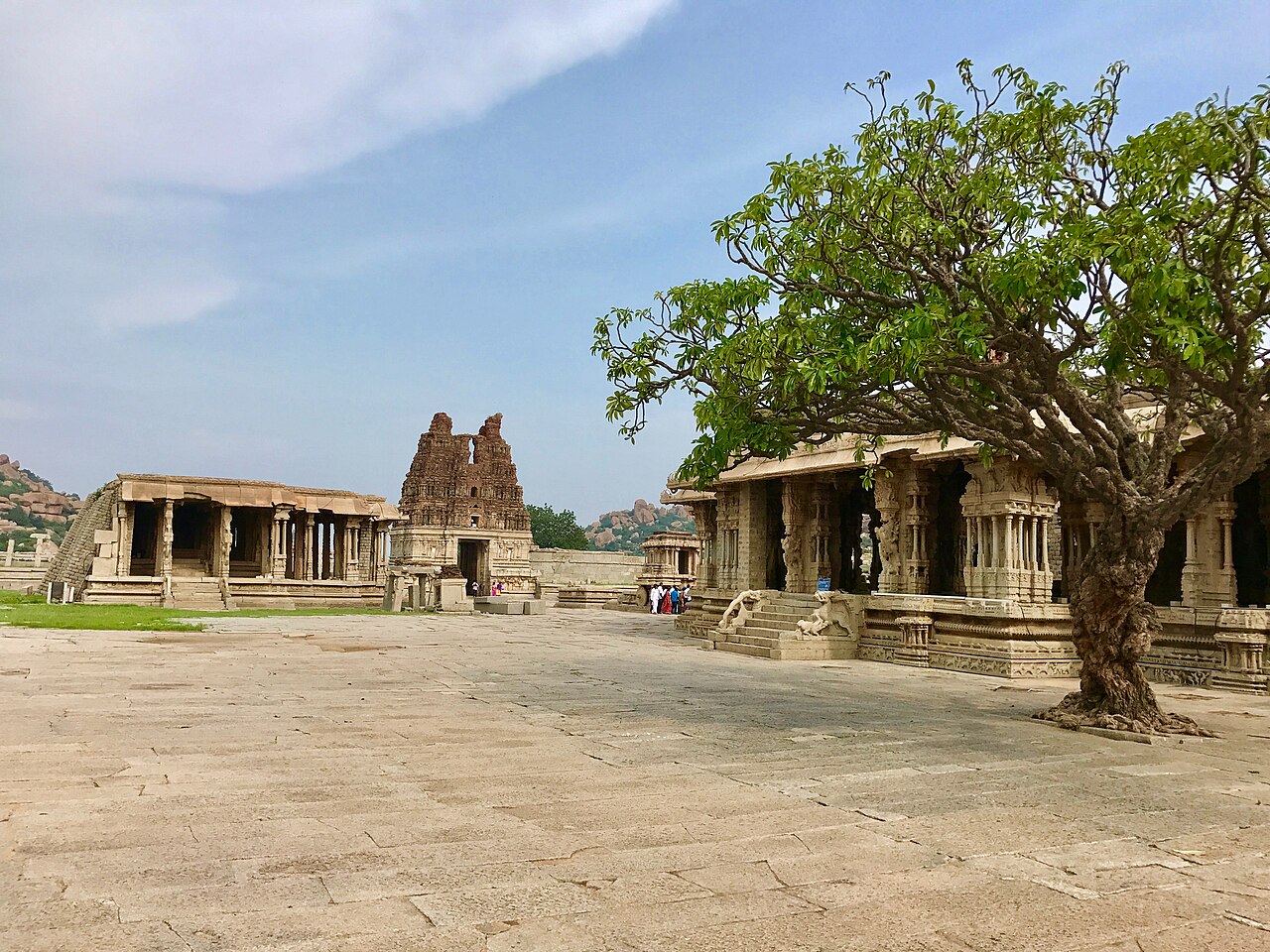
Vittala Temple, Hampi

Granite pillars that ring like bells and a stone chariot with once-turning wheels — the acoustic showpiece of the Vijayanagara Empire.

Mainstream: 15th-16th century CE (Vijayanagara Empire)Alternative: Accepted date, but acoustic engineering claimed to imply lost science15.34°, 76.48°

At a glance

Vittala Temple, Hampi
Photo: Ms Sarah Welch · CC BY-SA 4.0

The Vittala Temple at Hampi, capital of the Vijayanagara Empire, was begun in the 15th century and lavishly expanded under Krishnadevaraya (reigned 1509-1529). Its Ranga Mantapa is famed for 56 'musical pillars' — slender granite colonnettes that emit distinct musical tones when tapped, collectively nicknamed the SaReGaMa pillars. In the courtyard stands the iconic stone chariot, actually a shrine to Garuda, assembled from granite blocks with joints concealed by carving, whose stone wheels once rotated on their axles. The site raises a genuine engineering question: how did 16th-century masons tune solid granite?

See it on the globe →
The mainstream view

What archaeology says

The temple is thoroughly documented within Vijayanagara history: inscriptions, chronicles of foreign visitors to Hampi, and the archaeological record of the city sacked in 1565 after the Battle of Talikota. The musical pillars are understood as deliberate acoustic engineering by Vijayanagara craftsmen. Each main pillar is surrounded by slender colonnettes cut from the same granite block; their pitch depends on length, thickness and the stone's density, and analysis has shown the granite's composition and the colonnettes' proportions produce sustained, bell-like resonance. Achieving specific pitches would have involved iterative carving and testing — tuning by subtraction, as with any idiophone.

Colonial-era curiosity left its mark: the British are recorded to have cut open two pillars in the 19th century to see whether anything was hidden inside, finding only solid stone — the resonance is a property of geometry and material, not concealed devices.

The stone chariot is likewise conventional in construction: separate granite blocks assembled and carved so the joints disappear, in imitation of the wooden processional chariots still used in South Indian temple festivals. Its wheels genuinely rotated on stone axles until they were fixed in place in modern times to prevent damage.

Key evidence cited
  • Inscriptions and chronicles date the temple's expansion to Krishnadevaraya's reign (1509-1529)
  • Acoustic studies attribute the tones to colonnette geometry and the local granite's density and elasticity
  • British investigators cut two pillars open in the colonial era and found solid stone throughout
  • The stone chariot copies wooden processional chariots, a known Vijayanagara artistic practice
  • Musical pillars exist at several other South Indian temples, showing a regional craft tradition
  • The city's destruction in 1565 is historically documented, explaining the site's abandoned state
The alternative view

What the skeptics propose

Praveen Mohan and other alternative researchers present the musical pillars as evidence that Vijayanagara builders — or their predecessors — possessed a sophisticated, now-lost science of acoustics and materials. Mohan has demonstrated on video that different colonnettes produce different swaras and even mimic instruments (bells, drums), and argues that predicting the resonant behaviour of granite before carving implies knowledge equivalent to modern modal analysis. He also highlights the precision of the colonnettes' slender geometry in one of the hardest common stones on Earth.

Some proponents extend the argument to the stone chariot's once-rotating wheels and to musical pillars at other South Indian temples (Nellaiappar, Suchindram, Lepakshi), suggesting a systematic acoustic tradition whose theoretical basis was never written down — or was lost when Hampi was destroyed in 1565.

Mainstream acousticians and historians agree the pillars are remarkable but see empirical craft knowledge, not lost science: generations of temple masons learned by ear which proportions rang true, exactly as bell founders in Europe tuned bells for centuries before the physics of vibration was formalised. The 19th-century British cutting of two pillars, both camps agree, settled at least one thing — there is nothing inside but granite.

Key evidence cited
  • 56 colonnettes produce distinct, repeatable musical tones — implying pre-planned acoustic design in granite
  • Praveen Mohan's demonstrations show different pillars mimicking different instruments
  • Tuning solid granite by carving requires predicting resonance, arguably beyond trial-and-error, proponents say
  • The stone chariot's wheels originally rotated on granite axles, a striking mechanical feature
  • Similar musical pillars across South India hint at a systematic, transmitted acoustic science
  • No treatise explaining the tuning method survives, suggesting deliberate or catastrophic knowledge loss

Genuinely open questions

  1. Can modern modal analysis reconstruct the masons' tuning method for the colonnettes?
  2. Were the pillars tuned to a deliberate scale, and how consistent are their pitches today?
  3. How much acoustic knowledge was shared between the great South Indian temple workshops?
  4. What did the two pillars cut by the British actually reveal about internal structure and grain?

Worth knowing

Tapping the pillars is now banned to protect them — visitors damaged the resonance of some colonnettes so much that guides today play recordings of the tones instead.