What archaeology says
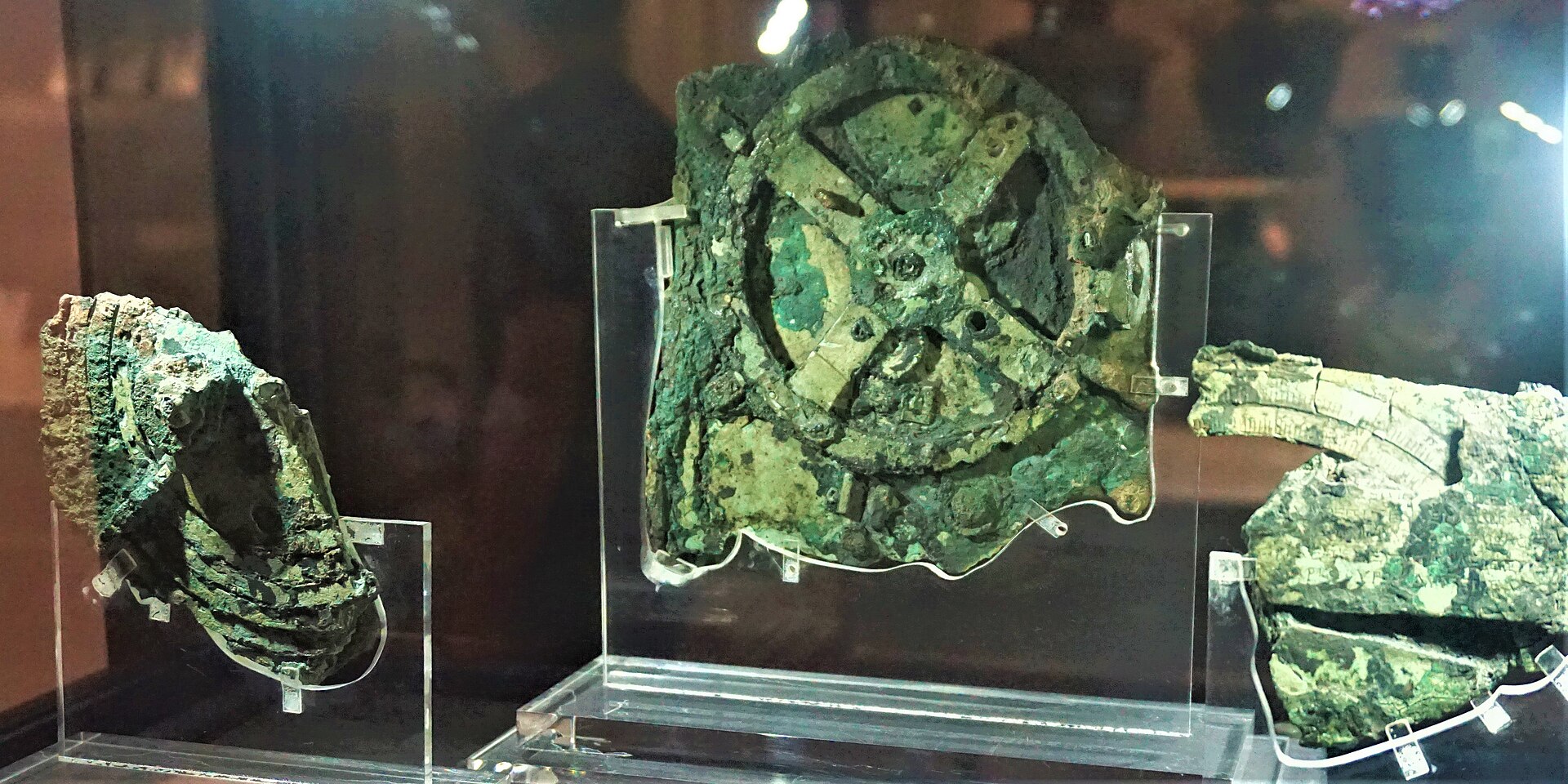
A century of research has progressively decoded the device. Derek de Solla Price's X-ray study, published as Gears from the Greeks in 1974, first revealed the differential-style gearing; the international Antikythera Mechanism Research Project's microfocus X-ray CT scans in 2005 then exposed hidden inscriptions and tooth counts, allowing Tony Freeth, Mike Edmunds and colleagues to reconstruct dials for the 19-year Metonic calendar, the Saros eclipse cycle — complete with glyphs predicting eclipse times and colours — and even the four-year cycle of Panhellenic games including the Olympics. In 2021 Freeth's UCL team published a full working model of the front 'Cosmos' display, deriving planetary gear trains from cycles described in the mechanism's own inscriptions. In 2024, gravitational-wave researchers Graham Woan and Joseph Bayley applied Bayesian statistics to X-ray images of the broken calendar ring, showing it originally held 354 holes — a lunar calendar — and demonstrating that its holes were placed with remarkable hand-crafted accuracy. A 2025 simulation by Argentine physicists suggested the surviving gears' triangular teeth and spacing errors would have caused jamming — though the authors caution that two millennia of corrosion may distort the measurements.
Crucially, mainstream scholarship does not see the mechanism as an isolated miracle. Cicero, writing in the first century BC, describes geared planetary spheres built by Archimedes and by Posidonius of Rhodes; the mechanism's Corinthian month names and Babylonian-derived astronomy root it in known Hellenistic science; and a thin thread of descendants — a Byzantine geared sundial-calendar, Islamic geared astrolabes described by al-Biruni — connects Greek gearing to the medieval clockmakers. The wreck itself remains under active excavation: the 'Return to Antikythera' programme, led since 2021 by the Swiss School of Archaeology in Greece under Angeliki Simosi and Lorenz Baumer, recovered a young man's skeleton (2016), statue fragments, and in 2024–2025 a connected section of the ship's hull — while confirming a second ancient vessel lies nearby.
- X-ray CT scans (2005) revealing gearing, tooth counts and thousands of Greek inscription characters
- Freeth's 2021 UCL Cosmos model reproducing planetary cycles stated in the mechanism's own inscriptions
- Cicero's first-hand descriptions of geared planetaria by Archimedes and Posidonius
- Corinthian month names and Babylonian-derived eclipse cycles rooting the device in Hellenistic science
- Ongoing wreck excavations (hull section recovered 2025; second ship confirmed) documenting an ordinary 1st-century BC cargo vessel