Ancient Engineering · Barabar Hills, Bihar, India

Barabar Caves

India's oldest rock-cut caves — granite chambers polished to a mirror finish that still baffles engineers and swallows the human voice in echo.

Mainstream: c. 261–230 BC (reigns of Ashoka and Dasharatha, Mauryan Empire)Alternative: Inscription dates are accepted, but some argue the chambers themselves are older works that Ashoka merely dedicated25.01°, 85.06°

At a glance

Barabar Caves
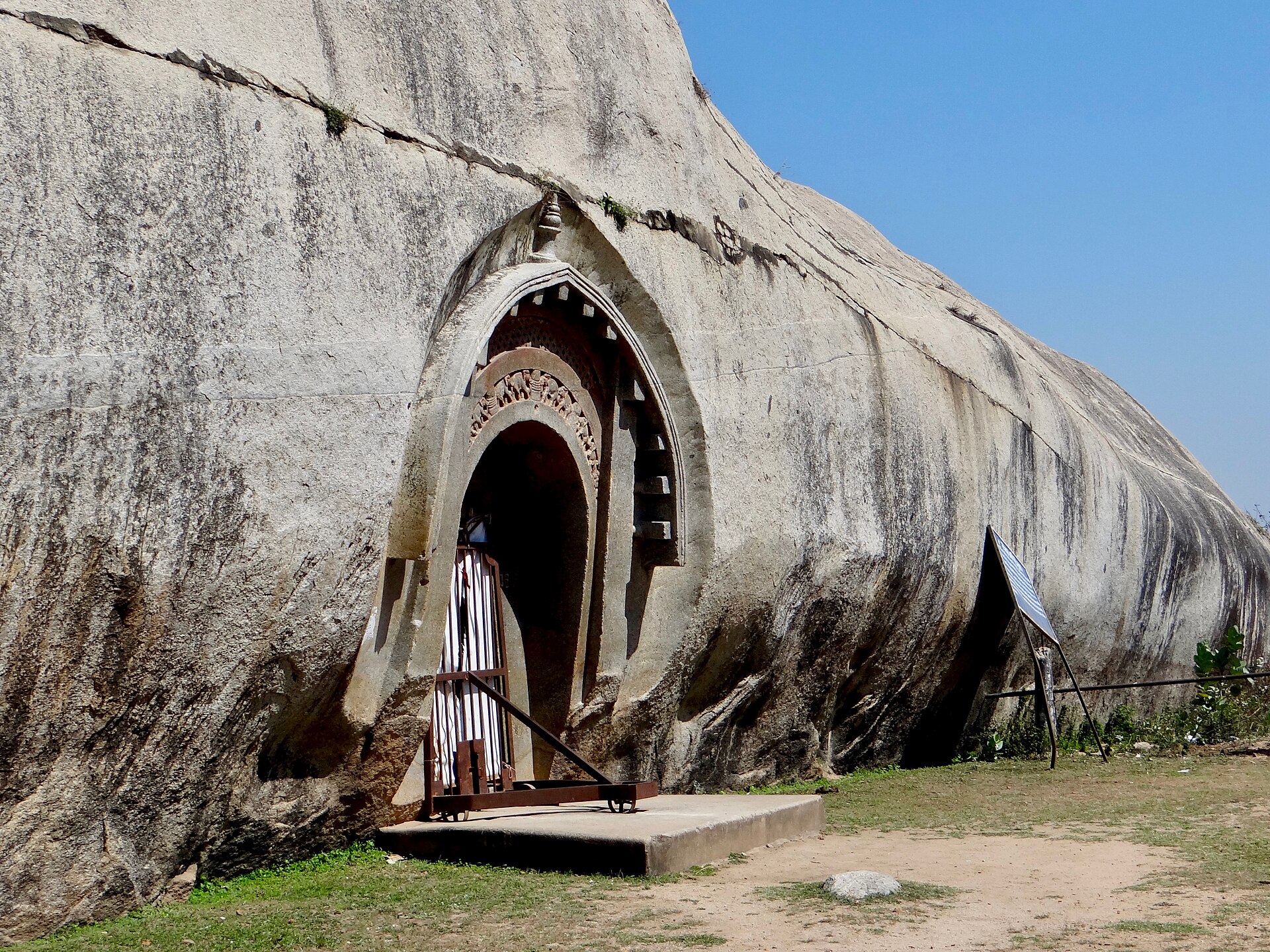
Photo: Srijitakundan · CC BY-SA 4.0

Cut into two whale-backed granite outcrops in Bihar, the four Barabar caves (Sudama, Lomas Rishi, Karan Chaupar and Visvakarma) and the three neighbouring Nagarjuni caves are the earliest surviving rock-cut architecture in India. Their interiors are astonishing: simple rectangular and circular chambers whose granite walls and vaulted ceilings carry the famous 'Mauryan polish' — a glassy, mirror-like finish that has survived more than 2,200 years and is smoother than most modern machined stone. The chambers produce extraordinary acoustics, with reverberation so long that speech dissolves into a sustained hum. Dedicatory inscriptions of the emperor Ashoka and his grandson Dasharatha record that the caves were gifted to the Ajivikas, an austere ascetic sect that once rivalled Buddhism and Jainism.

See it on the globe →
The mainstream view

What archaeology says

The dating rests on inscriptions cut into the caves themselves. Ashoka's dedications in Brahmi script — one in the Sudama cave dated to the 12th year of his reign (c. 261 BC) and another from his 19th year — record the granting of the caves on Khalatika Mountain to the Ajivikas, and Dasharatha's inscriptions in the Nagarjuni group show the tradition continuing around 230 BC. The caves are therefore the first dated appearance of the Mauryan polish also seen on Ashokan pillars, and they stand at the head of India's entire rock-cut lineage: the carved chaitya-arch facade of the Lomas Rishi cave, imitating contemporary timber architecture, became the template repeated for a thousand years at Ajanta, Karla and Ellora.

Archaeologists reconstruct the working method from the caves' own unfinished states. The Lomas Rishi cave was abandoned partway — its rear chamber incomplete, its floor rough, possibly halted by a rock fault — and it preserves the sequence: rough excavation with iron chisels and pecking, fine dressing, then progressively finer abrasive rubbing and burnishing to reach the final lustre. Granite cannot be carved like sandstone, but Mauryan India possessed good iron and, above all, state patronage that could fund the staggering labour hours of grinding. Some historians have suggested craftsmen or techniques arriving from the fallen Achaemenid world after Alexander's conquests influenced the polish, given its similarity to the finish at Persepolis; others see a purely Indian development.

The acoustics — the Sudama chamber resonates strongly at low frequencies and sustains echoes for many seconds — are generally treated as a consequence of hard, polished, curved surfaces enclosing a simple volume, though scholars accept the effect may have been valued and even sought by meditating ascetics.

Key evidence cited
  • Ashoka's in-situ Brahmi dedications dated to his 12th and 19th regnal years (c. 261 and 254 BC)
  • Dasharatha's matching dedications in the Nagarjuni caves, c. 230 BC
  • The unfinished Lomas Rishi cave preserving every stage from rough chiselling to polish
  • Identical Mauryan polish on securely dated free-standing Ashokan pillars
  • The Lomas Rishi facade's timber-imitating chaitya arch, ancestral to all later Indian rock-cut architecture
The alternative view

What the skeptics propose

Barabar became a centrepiece of alternative prehistory through the 2019 French documentary BAM (Builders of the Ancient World) by Patrice Pooyard, and through visits by researchers such as Ben van Kerkwyk of UnchartedX. A French team associated with the film carried out laser scanning and metrology inside the caves and reported walls and vaults flat or evenly curved to within millimetres over spans of several metres, together with the near-optical polish — precision they argue is extremely difficult to explain with hand-held chisels and rubbing stones in granite, one of the hardest building stones on Earth. Praveen Mohan and others have showcased the caves' strange acoustics, arguing the chambers behave like engineered resonators tuned to low frequencies, perhaps for chanting or altered states, implying deliberate acoustic design beyond credited capability.

A second strand questions the attribution itself. The inscriptions, proponents note, record only that the caves were given to the Ajivikas — they do not say Ashoka excavated them. On this reading the Mauryans inherited far older chambers, added their dedications at the entrances, and the true builders belonged to an earlier, technologically superior tradition whose other works are lost. Supporters point out that the finest, most geometrically pure chambers carry the least decoration, while the one heavily decorated facade (Lomas Rishi) is unfinished and unpolished — suggesting, they argue, two different eras of workmanship.

Mainstream archaeologists reply that the unfinished Lomas Rishi is precisely the smoking gun for conventional methods, freezing every production stage in one monument; that the polish, while laborious, is demonstrably achievable by abrasion since it also appears on dated free-standing Ashokan pillars; and that there is no artefact, tool mark or stratigraphic hint of a pre-Mauryan phase. The millimetre metrology, they add, shows remarkable craftsmanship, not machinery — patient grinding self-corrects toward flatness. The debate has nonetheless pushed genuine research interest toward the caves' acoustics and surface science.

Key evidence cited
  • Laser-scan metrology reported by the BAM team showing millimetre-level regularity in granite
  • Mirror polish on some of the hardest stone ever worked, sustained over whole chambers
  • Powerful low-frequency resonance and multi-second reverberation suggested as deliberate acoustic engineering
  • Inscriptions record donation of the caves, not their excavation, leaving the builders formally unnamed
  • The contrast between geometrically pure polished chambers and the cruder, unfinished decorated facade

Genuinely open questions

  1. How many labour-hours did the Mauryan polish actually require, and what abrasives were used on granite?
  2. Were the chambers' striking acoustics an intended design goal for Ajivika practice or a by-product?
  3. Why did such supreme granite finishing appear at the very start of Indian rock-cut architecture and then fade?

Worth knowing

E. M. Forster reimagined Barabar as the 'Marabar Caves' in A Passage to India, where the chambers' unearthly echo — which turns every sound into a boom — triggers the novel's central crisis.