What archaeology says
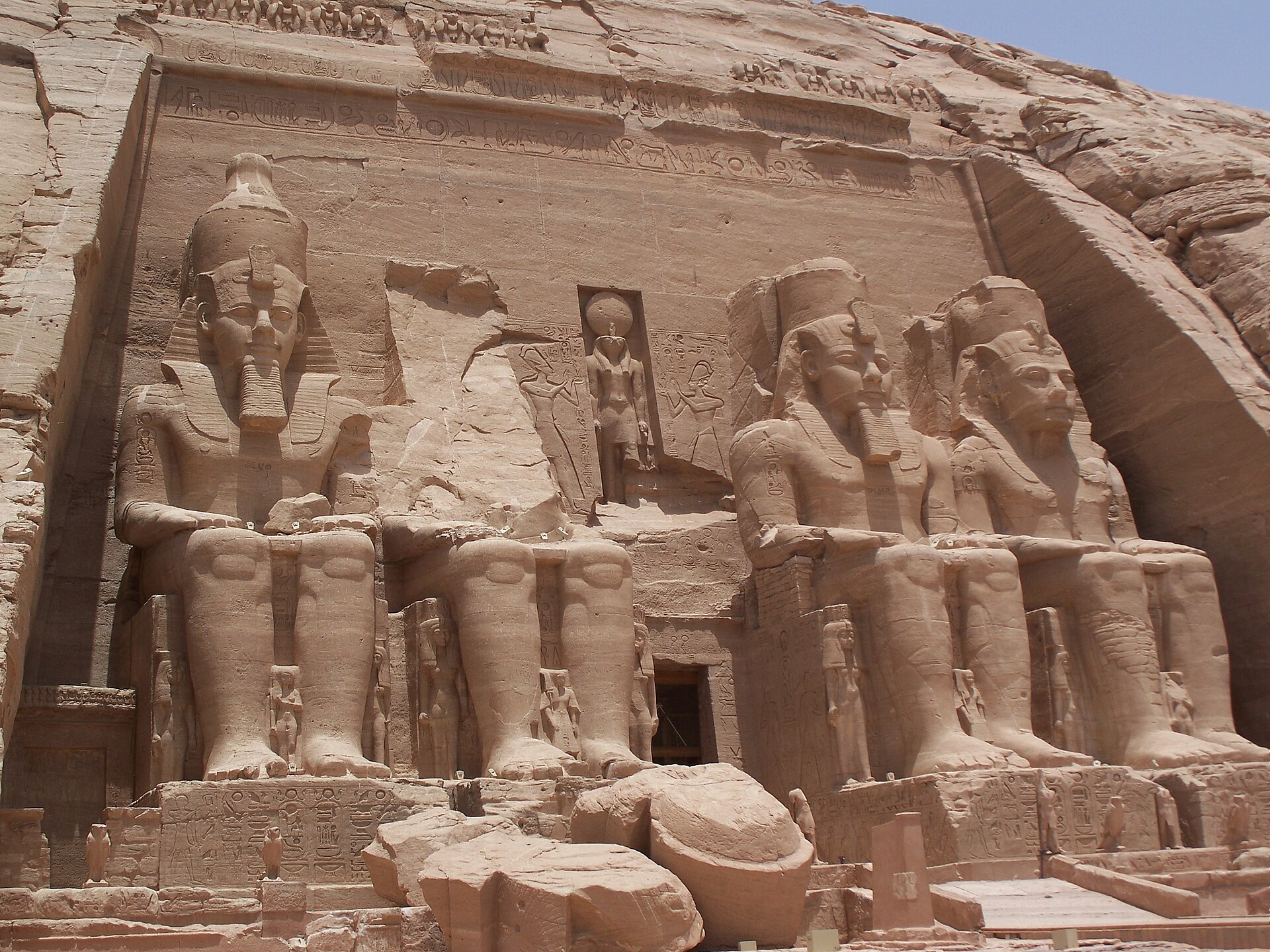
Egyptologists have no doubts about the builder: Ramesses II's names, images and battle reliefs — including the great Battle of Kadesh cycle — cover the temples, and construction is placed roughly between his 5th and 24th regnal years, c. 1264–1244 BC. The site served both piety and politics, projecting the god-king's power deep into Nubia at the empire's southern approaches. The rock-cut form belongs to a well-documented Egyptian and Nubian tradition of speos (cave) temples, and the interior programme follows orthodox New Kingdom temple design, simply executed in negative — carved out of the mountain rather than built up from the ground.
The solar alignment is accepted as deliberate. Archaeoastronomers such as Juan Antonio Belmonte, who has surveyed the orientations of hundreds of Egyptian temples, place Abu Simbel within a coherent tradition of solar and stellar alignment; a one-off axis that finds the sanctuary on just two mornings a year, in a temple where the sun-god shares the innermost shrine with the deified king, is not plausibly coincidence. The popular claim that the dates — originally around 21 February and 21 October — marked Ramesses' birthday and coronation, however, is a modern tradition: no ancient inscription says so, the Egyptian civil calendar drifted against the solar year, and Egyptologists note the dates may instead relate to seasonal festivals or the jubilee cycle.
The 1964–68 rescue, coordinated by UNESCO after the Aswan High Dam decision, remains a landmark of both engineering and archaeology. The temples were cut into 1,036 numbered blocks of up to 30 tonnes, hoisted up the cliff, and reassembled with millimetre care on an artificial hill — yet the geometry could not be reproduced perfectly, and the solar event now falls a day later, on 22 February and 22 October, an honest scar of the 20th century on a 13th-century-BC instrument.
- Ramesses II's cartouches, colossi and Kadesh battle reliefs throughout both temples
- Fit within the documented New Kingdom tradition of rock-cut speos temples in Nubia
- Belmonte's surveys placing the axis within a coherent Egyptian practice of solar orientation
- Foundation and dedication evidence placing construction in Ramesses' early regnal decades
- Complete 1960s documentation of the fabric during the UNESCO dismantling, block by block