What archaeology says
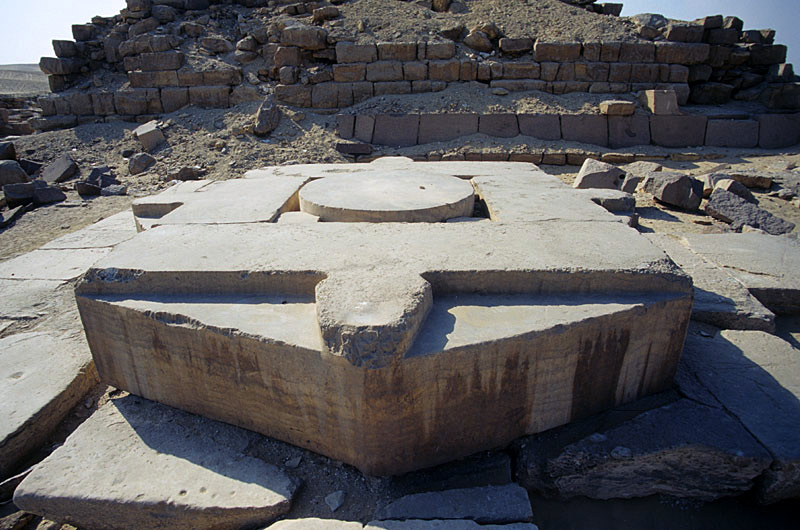
The sun temples are a documented 5th Dynasty phenomenon: royal annals record six of them, and Nyuserre's — excavated by Ludwig Borchardt and Friedrich von Bissing in 1898–1901 — comprised a squat obelisk on a monumental podium, an open courtyard with the alabaster altar, magazines, and a causeway to a valley temple. Its reliefs, now largely in Berlin, celebrate the sun's renewal of life through the seasons. The neighbouring Abusir pyramids and their mortuary temples have been excavated for decades by the Czech mission of Charles University (under Miroslav Verner and later Miroslav Bárta), while since 2019 an Italian–Polish team led by Massimiliano Nuzzolo and Rosanna Pirelli has re-excavated Nyuserre's sun temple, finding a mud-brick predecessor building beneath it and, in 2022–2025, remains of the valley temple — ordinary, incremental archaeology anchoring the whole complex firmly in the 25th century BC.
On the stonework, mainstream researchers do not deny the tool marks — they embrace them. The basalt pavements at Abusir and Abu Ghurab preserve unfinished cuts, overshoots and 'wandering' saw striations that record copper slabbing-saws fed with quartz sand abrasive, exactly the process Denys Stocks reconstructed experimentally, cutting granite and basalt with replica copper saws and tubular drills. Flinders Petrie catalogued the drill cores and saw cuts as early as 1883 and attributed them to sawing and drilling with hard abrasive. The many tube-drill holes at Abu Ghurab, some abandoned mid-hole, likewise show the stages of a laborious manual process. The alabaster altar and basins, though beautifully finished, are in calcite — a soft stone (Mohs 3) readily worked with the era's tools.
The basins and their channel system are debated within Egyptology itself — older readings as blood drains for animal sacrifice have given way to interpretations involving purification or libations — but no mainstream researcher sees anything at either site beyond ambitious Old Kingdom craft.
- Royal annals naming the 5th Dynasty sun temples and their builders
- Borchardt and von Bissing's excavations tying obelisk podium, altar and reliefs to Nyuserre
- Denys Stocks' experiments cutting basalt and granite with copper saws, drills and sand abrasive
- Unfinished cuts, overshoots and abandoned drill holes recording a manual, stage-by-stage process
- The 2022–2025 Italian–Polish excavations revealing a mud-brick predecessor temple and valley temple remains