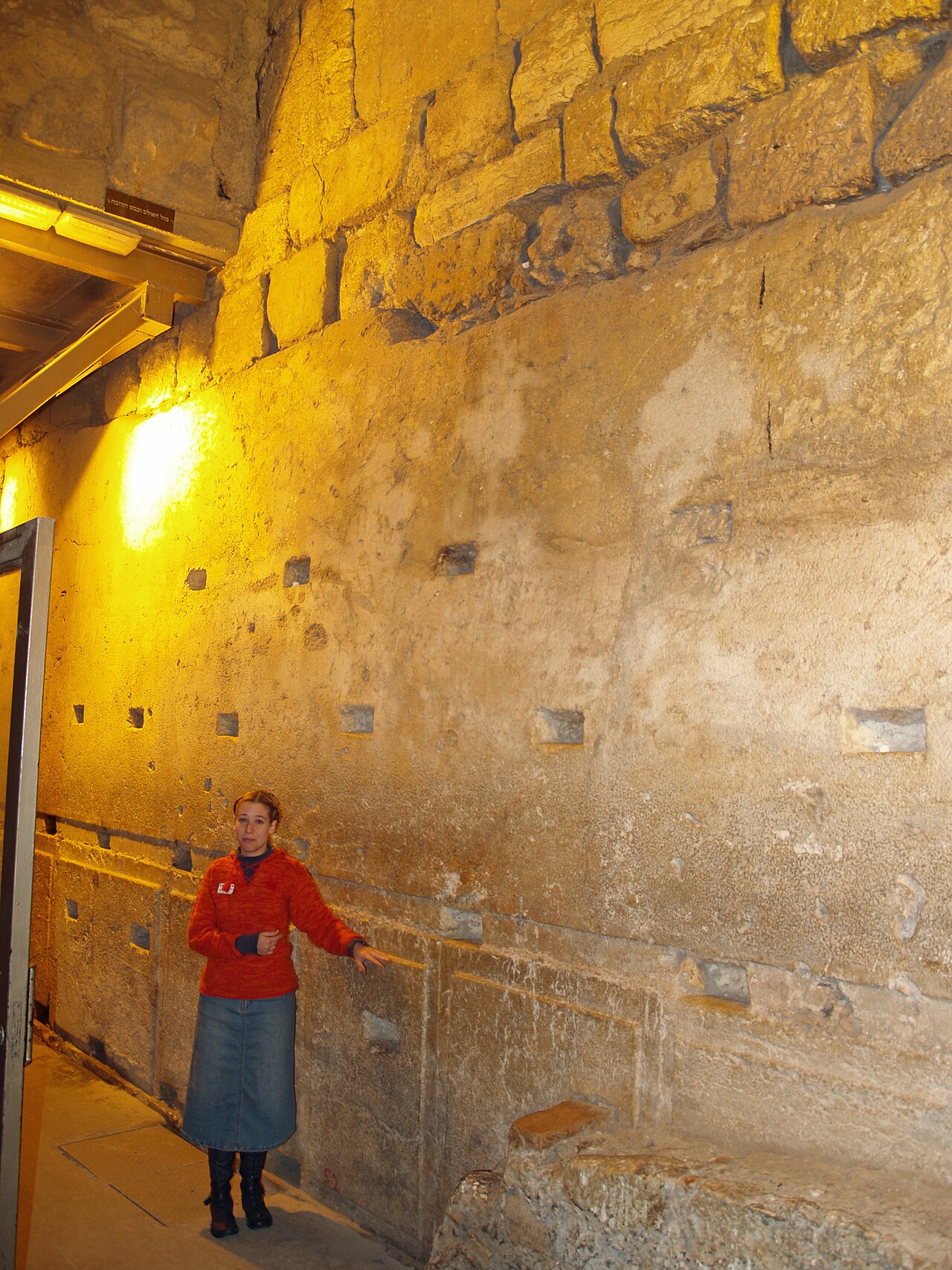
What archaeology says
Archaeologists attribute the Western Stone and its 'Master Course' to Herod the Great's reconstruction of the Temple Mount, begun around 19 BC — one of the largest building projects of the Roman world. The block is local meleke limestone, quarried close to the city and slightly uphill of the Temple Mount, so the stones could be moved largely on the level or downhill on rollers and sledges pulled by oxen. The distinctive Herodian dressing — flat central boss framed by narrow drafted margins — matches Herodian masonry across the region, from Hebron's Cave of the Patriarchs enclosure to Herodium.
Engineering studies suggest the giant course was structural: massive headers stabilised the wall against earth pressure from the vaulted fills behind it, and the sheer mass locked the lower courses in place without mortar. Roman-era lifting technology — cranes, capstans, lewis holes, levers and earthen ramps — is well documented by Vitruvius and by surviving hardware elsewhere; for the very largest blocks, builders likely used ramps and rollers rather than lifting them free of the ground.
Excavations in the tunnel, including quarries found north of the Temple Mount with partially detached blocks of comparable scale, support local extraction and short-distance transport during the late first century BC.
- The drafted-margin-and-boss dressing matches securely dated Herodian masonry at Hebron, Herodium and elsewhere
- Josephus describes Herod's Temple Mount project and the enormous stones used in it
- Local meleke limestone quarries north of the Old City, uphill of the site, held partially detached mega-blocks
- Transport was mostly level or downhill, feasible with rollers, sledges, oxen and capstans
- The massive course functions structurally, buttressing the wall against fill pressure behind it
- Coins and pottery in construction fills beneath associated Herodian streets date the work to the late 1st century BC and after