What archaeology says
Maresha appears in the Hebrew Bible as a town of Judah and rose to prominence in the Hellenistic period as a prosperous, cosmopolitan city of Edomites, Sidonians, Judaeans and Greeks. Its inhabitants discovered that beneath a metre or two of hard nari crust lay thick, soft, self-supporting chalk: by cutting a narrow shaft through the crust they could bell out storage and working space below their own houses almost without limit. Excavations directed for decades by the late Amos Kloner documented the resulting underground city in detail — Hellenistic oil presses, water cisterns with spiral staircases, ritual baths, hideaway systems from the Bar Kokhba revolt of AD 132–135, and painted Sidonian burial caves.
The columbaria are among the most striking spaces: chambers lined with thousands of small niches for raising doves, with estimates for Maresha's columbaria running to tens of thousands of niches in total. Scholars generally interpret them economically — pigeons for meat, sacrificial use and dung fertiliser — though the sheer scale, and cruciform plans of some chambers, keep a partly ritual function under discussion.
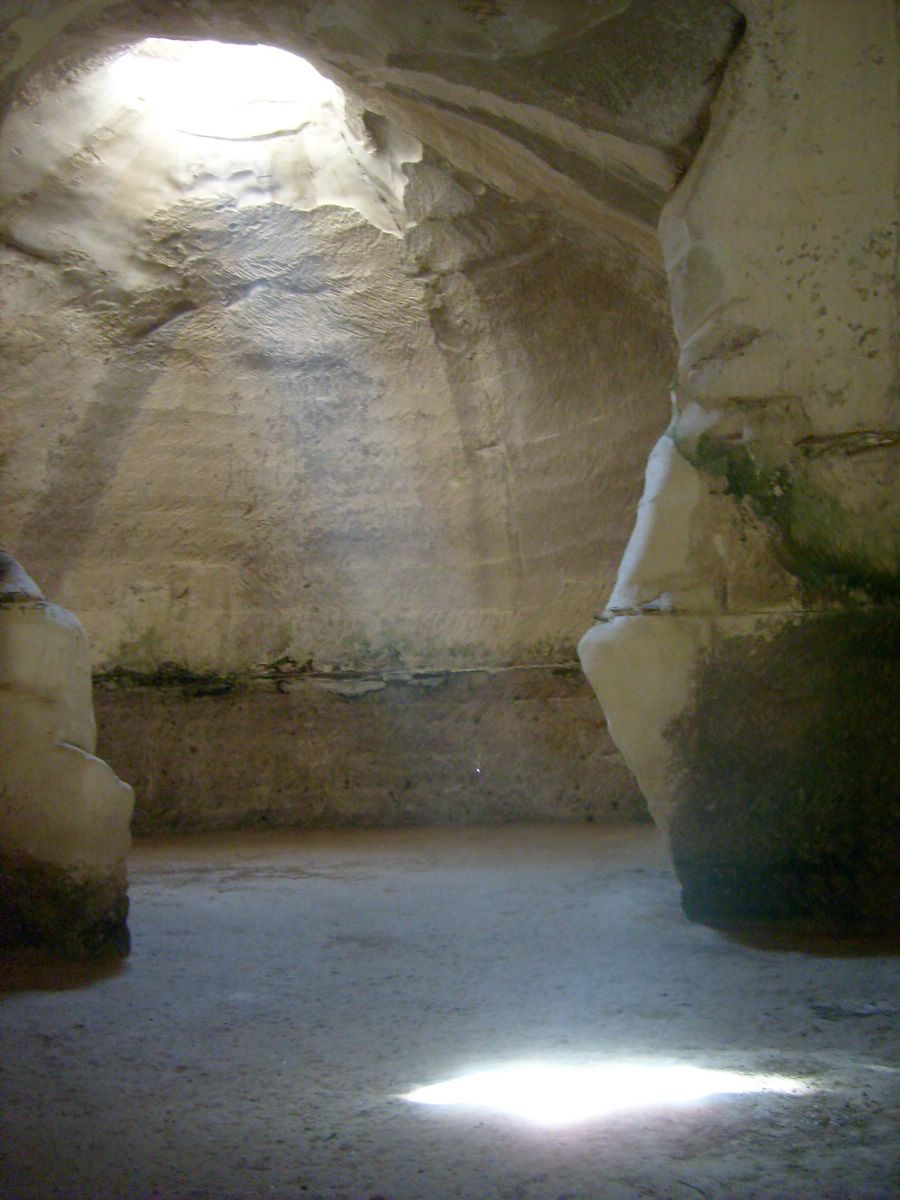
The great bell caves concentrated at Beit Guvrin are later and different: quarries of the Byzantine and Early Islamic periods (roughly 6th–10th centuries AD), dug top-down from a narrow opening so the chalk could be extracted while the bell shape kept the roof stable. Arabic inscriptions and crosses on their walls date the workings. The whole complex, in the mainstream account, is a legible 2,000-year continuum of practical quarrying and adaptation — remarkable, but fully explained.
- Some 3,500 chambers documented across Maresha and Beit Guvrin, UNESCO-listed in 2014
- Coins, pottery and inscriptions date the main quarrying from the Hellenistic to Early Islamic periods
- Amos Kloner's long-running excavations documented oil presses, cisterns, baths and Bar Kokhba hideaways in datable contexts
- About 800 bell caves show a documented Byzantine–Early Islamic top-down quarrying technique, some bearing crosses and Arabic inscriptions
- The nari-over-chalk geology fully explains the shaft-and-bell excavation method
- Faunal and residue evidence supports pigeon-raising in the columbaria