Lost Worlds · Off Atlit, Carmel Coast, Israel

Atlit Yam

A genuine 9,000-year-old village on the seabed — complete with a megalithic stone circle, the world's oldest known wells, and the earliest cases of tuberculosis.

Mainstream: c. 6900–6300 BC (Pre-Pottery Neolithic C), submerged by post-glacial sea-level riseAlternative: Date undisputed — the debate is over its end: gradual inundation, or a catastrophic tsunami from the collapse of Mount Etna c. 6500 BC32.71°, 34.94°

At a glance

Atlit Yam
Photo: Hanay · CC BY-SA 3.0

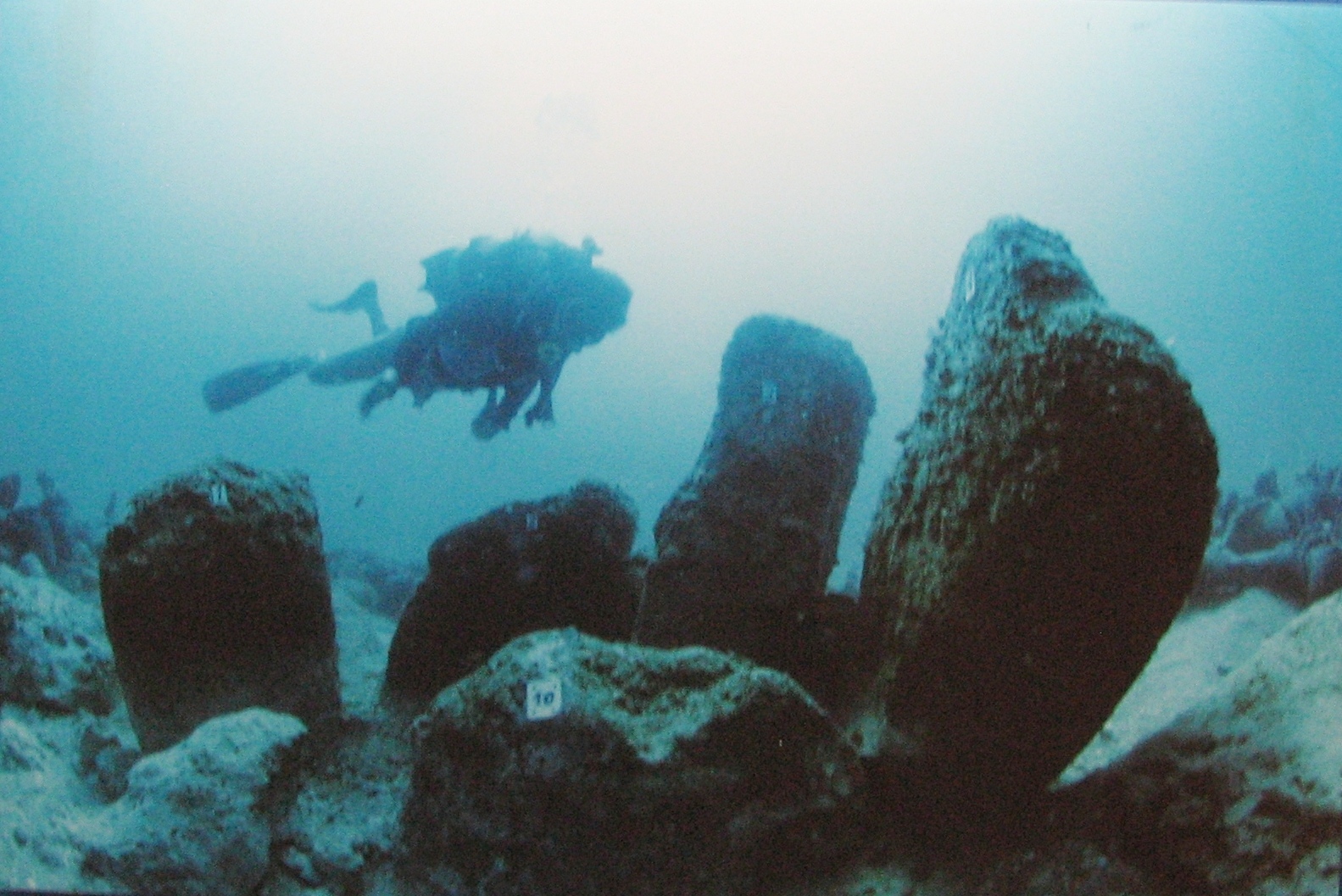
Ten metres down, a few hundred metres off the Crusader town of Atlit south of Haifa, lies one of the best-preserved prehistoric settlements ever found underwater. Discovered in 1984 by marine archaeologist Ehud Galili and excavated over subsequent decades with the University of Haifa and the Israel Antiquities Authority, Atlit Yam covers some 40,000 square metres — a full Neolithic village with rectangular stone houses, paved areas, ritual installations, stone-lined water wells and more than 65 human burials. Its centrepiece is a semicircle of seven megaliths weighing up to 600 kilograms, marked with cupmarks and originally set around a freshwater spring. Sealed beneath sand and clay for nine millennia, the site preserves organic remains — seeds, timber, fish bones, even insects — with astonishing fidelity, offering an unmatched snapshot of the moment humans first fused farming, herding and serious seafaring.

See it on the globe →
The mainstream view

What archaeology says

Radiocarbon dates place occupation at roughly 6900–6300 BC, in the Pre-Pottery Neolithic C. Atlit Yam's inhabitants ran what Galili has called the earliest known 'Mediterranean fishing village' economy: they grew wheat, barley, lentils and flax, herded goats, sheep, cattle and pigs, hunted, and fished intensively — thousands of bones of triggerfish and other species were found processed and apparently stored for trade or winter use. Several male skeletons show auditory exostoses, bony growths of the ear canal caused by habitual diving in cold water, direct biological evidence of routine underwater fishing. The village's stone-built wells, sunk to reach the coastal aquifer, are among the oldest water wells known anywhere; one, over five metres deep, later became a rubbish dump as its water turned brackish — a detail that proved interpretively decisive.

In 2008, DNA analysis of a woman and infant buried at the site identified the earliest confirmed cases of human tuberculosis, showing the disease predates the domestication of cattle-borne strains. The megalithic semicircle, with its cupmarked stones arranged around a former spring, is read as a water-related ritual installation — a reminder that monumental stone arrangements were within the capability of small Neolithic fishing-farming communities thousands of years before Stonehenge.

On the village's end, the mainstream position — argued in detail by Galili and colleagues — is unglamorous but well-evidenced: post-glacial sea-level rise gradually salinised the wells and drowned the coastal plain, and the inhabitants moved on in an orderly fashion. Fragile in-place remains, stored fish, the absence of crushed skeletons, damaged structures or characteristic tsunami deposits all argue against sudden catastrophe.

Key evidence cited
  • Consistent radiocarbon dates of c. 6900–6300 BC from waterlogged organic material across the site
  • Stone-lined wells — among the world's oldest — whose fill records gradual salinisation, not sudden disaster
  • Auditory exostoses in male skeletons proving habitual cold-water diving and a genuine maritime economy
  • 2008 DNA identification of tuberculosis in a buried woman and infant — the earliest confirmed cases known
  • Galili's field tests finding none of the boulder beds, damage or trauma a mega-tsunami should have left
The alternative view

What the skeptics propose

Atlit Yam occupies an unusual position in alternative history: nobody disputes that it is real, ancient and drowned — which is precisely why writers like Graham Hancock invoke it. In 'Underworld', Hancock presents Atlit Yam as proof-of-concept for his central claim: that fully formed settlements do lie on the continental shelves, that the sea really did swallow inhabited lands within human memory, and that flood myths worldwide may encode such events. If one 9,000-year-old village with a megalithic monument survived intact under the Mediterranean, he asks, what else lies deeper, on shorelines drowned earlier in the post-glacial rise? The stone semicircle — popularly billed as an 'underwater Stonehenge' — is cited as evidence that megalithic tradition is far older than conventional narratives once allowed.

The site also has a genuine scientific catastrophe debate. In 2006, a team led by Maria Teresa Pareschi of Italy's National Institute of Geophysics and Volcanology modelled the collapse of Mount Etna's eastern flank around 8,500 years ago and calculated that it would have sent a tsunami up to 40 metres high racing across the eastern Mediterranean — striking the Levantine coast within hours. They proposed this wave destroyed and abandoned Atlit Yam, pointing to the heaps of stored fish as a freeze-frame of daily life interrupted. Catastrophists have embraced the scenario as a documented example of the sudden, ocean-scale violence that mainstream gradualism tends to downplay.

Galili's team published a systematic rebuttal, checking the field evidence against what a mega-tsunami should leave: chaotic coarse deposits, transported boulders, smashed architecture, animal carcases and traumatic injuries. None of it is present — the village's slender standing stones remained upright, and the stratigraphy records slow marine encroachment. The exchange is a model of how a dramatic hypothesis should be tested, and both interpretations remain in the literature.

Key evidence cited
  • Pareschi's 2006 modelling of an Etna flank-collapse tsunami up to 40 metres high reaching the Levant c. 6500 BC
  • Heaps of processed, stored triggerfish read by catastrophists as daily life interrupted mid-task
  • A megalithic cupmarked stone semicircle millennia older than Stonehenge, 10 metres beneath the sea
  • The site's very existence validates the premise that inhabited lands drowned within human memory
  • Hancock's argument that earlier, deeper shoreline settlements should exist and remain unsurveyed

Genuinely open questions

  1. What ritual was performed at the megalithic semicircle and its freshwater spring?
  2. Did the Etna collapse tsunami strike this coast at all — and if so, why did it leave no trace at Atlit Yam?
  3. How many similar Neolithic villages lie undiscovered on the drowned shelves of the Mediterranean?

Worth knowing

Some of Atlit Yam's fishermen are the earliest humans known to suffer 'surfer's ear' — bony ear-canal growths caused by long hours diving in cold water — meaning we can diagnose a 9,000-year-old occupational hazard from their skeletons.