What archaeology says
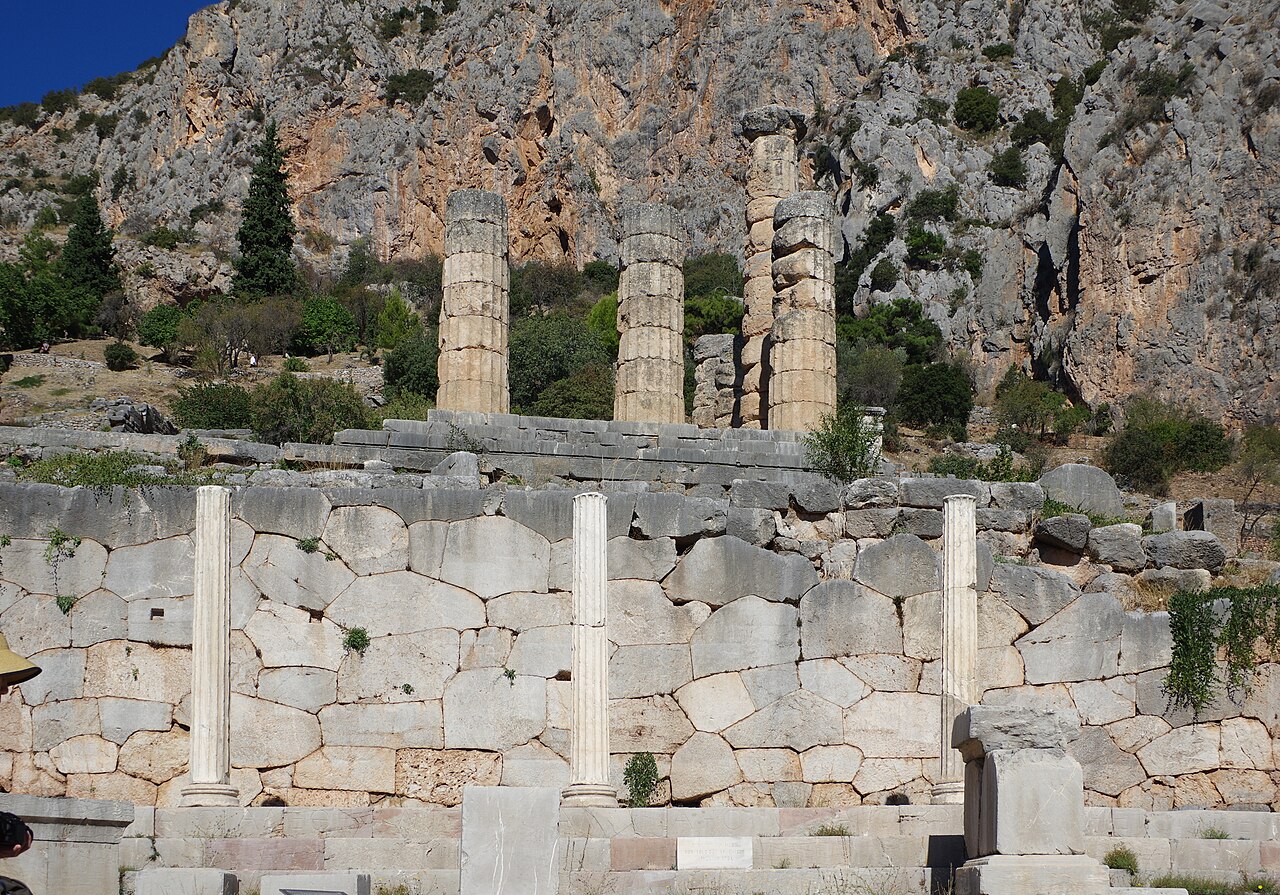
Classical archaeologists date the wall securely to the second half of the sixth century BC. When the Temple of Apollo burned in 548 BC, the sanctuary was re-terraced on a grander scale, and the polygonal wall was built to retain the enlarged temple platform, financed partly by the Alcmaeonid family of Athens. The date rests on the archaeological sequence of the terrace fills, the wall's relationship to the temple foundations, and the broader, well-documented history of the sanctuary.
Polygonal and so-called Lesbian masonry with curved joints was a recognised Greek technique of the seventh and sixth centuries BC, seen at sites across Greece and Asia Minor. Engineers note that interlocking curvilinear joints are a rational choice for a retaining wall in one of Greece's most seismically active zones: the joints allow micro-movement and dissipate energy, and the style also economised on stone by fitting blocks as they came rather than squaring them.
The hundreds of manumission inscriptions carved into the wall from the second century BC onward show it standing and revered through antiquity, and Greek literary sources discuss the sanctuary's rebuilding, leaving little room chronologically for a mysterious earlier origin.
- The wall's stratigraphic relationship to the post-548 BC temple terrace dates it to the late 6th century BC
- Polygonal and Lesbian masonry are attested at many archaic Greek sites, showing a living local tradition
- Over 800 inscriptions from c. 200 BC onward were carved into the wall, documenting its continuous classical history
- Curved interlocking joints are recognised seismic engineering, well suited to Delphi's earthquake zone
- Ancient sources record the sanctuary's rebuilding programme and its Alcmaeonid financing
- The limestone is local, with tool marks consistent with iron-age Greek stoneworking