Ancient Engineering · Erusheti Mountain, Samtskhe-Javakheti, Georgia

Vardzia Cave Monastery

A 13-storey city carved inside a mountain by a warrior queen — invisible until an earthquake tore the cliff face away.

Mainstream: AD 1156–1203 (built under King Giorgi III and Queen Tamar; shattered by the earthquake of 1283)Alternative: Date not seriously disputed — argument surrounds the fabled 6,000 rooms, legends of secret tunnels, and Bronze Age occupation of the valley41.38°, 43.28°

At a glance

Vardzia Cave Monastery
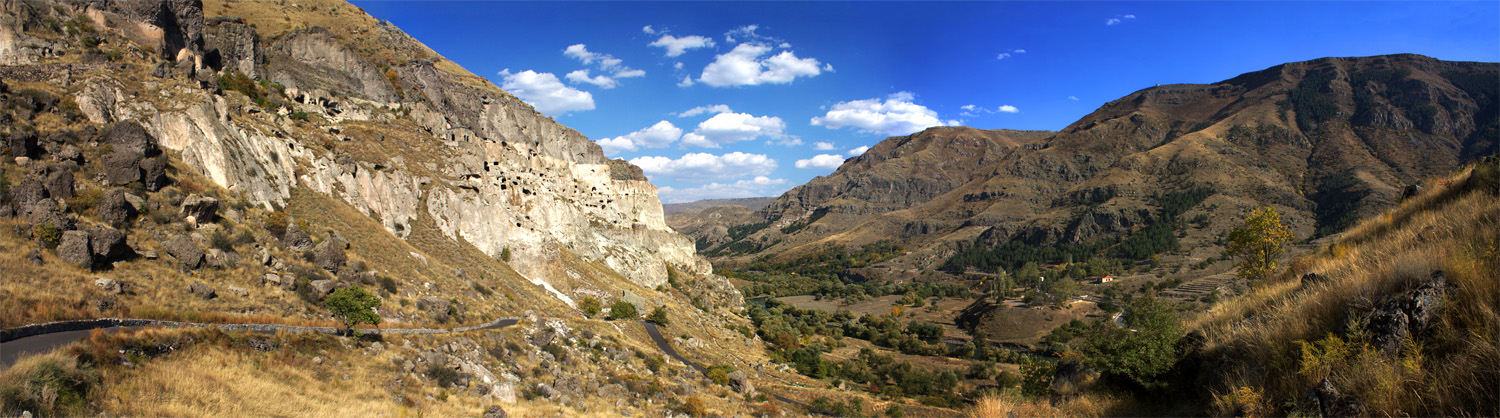
Photo: Levan Gokadze · CC BY-SA 2.0

Vardzia is a city hollowed out of the living rock of Erusheti Mountain, high above the Mtkvari (Kura) river in southern Georgia. At its height in the late 12th century it ran for some 500 metres along the cliff and up to 19 tiers deep into it, with hundreds of rooms including churches, chapels, refectories, a pharmacy, libraries, bakeries, stables and around 25 wine cellars with great clay qvevri sunk into the floors. An internal irrigation and spring-water system, still partly functioning, allowed the community to survive indefinitely without showing itself. That was the point. Vardzia was conceived as a fortress-monastery against the Seljuk Turks: in its original form almost everything lay concealed inside the mountain, reachable only through hidden passages from the river. Then, in 1283, a catastrophic earthquake sheared away the outer skin of the cliff, collapsing perhaps two-thirds of the city and exposing the honeycomb interior to open air — the dramatic, gutted cross-section that visitors see today. The site is inscribed on Georgia's cultural register as a museum-reserve and remains a working monastery, with a small community of monks in residence again since the late 1980s.

See it on the globe →
The mainstream view

What archaeology says

Georgian historical sources and the site's own inscriptions and frescoes give Vardzia an unusually secure chronology. Construction began under King Giorgi III (1156–1184), and his daughter Tamar — crowned co-ruler in her father's lifetime and reigning in her own right from 1184 — expanded it into a great royal monastery. The Church of the Dormition at the complex's heart was carved and painted between 1184 and 1186; its frescoes, executed by a painter who signed himself Giorgi, include a rare contemporary portrait of Queen Tamar shown unmarried, which art historians use to pin the date. Tradition holds that Tamar prayed at Vardzia before the pivotal victory of Basiani against the Seljuks around 1202.

Archaeologists count roughly 500 to 650 surviving rooms across the eastern and western sections — a fraction of the original complex, most of which fell with the cliff in 1283. The monastery was partly rebuilt afterwards (a bell tower was added in the late 13th century) but never fully recovered; it was sacked by the Persian Shah Tahmasp I in 1551, when the monks were killed or enslaved and treasures carried off, and abandoned under Ottoman control later that century.

Since 2012 conservators from the Courtauld Institute of Art in London have worked with Georgia's National Agency for Cultural Heritage Preservation to stabilise the fragile Dormition frescoes, while Georgian and international teams monitor rockfall risk along the earthquake-weakened cliff — the same geological instability that both destroyed and revealed the city.

Key evidence cited
  • Frescoes of 1184–1186 in the Church of the Dormition, including a datable contemporary portrait of Queen Tamar
  • Georgian chronicles and the Vardzia Gospel notation documenting construction, the 1283 earthquake and the 1551 Persian sack
  • The painter Giorgi's signature and inscription evidence tying the decoration to Tamar's early reign
  • Roughly 500–650 surveyed rooms whose carving technique and church architecture match 12th-century Georgian practice
  • Courtauld Institute and Georgian heritage agency conservation studies since 2012 confirming the medieval fresco technique
The alternative view

What the skeptics propose

Vardzia's dating is not contested; its mythology is where history and legend wrestle. The famous foundation story derives the name from a hunting trip: the child Tamar, lost in the caves, called out 'aq var, dzia' — 'I am here, uncle' — and the delighted king ordered the city built and named after her cry. Linguists prefer a derivation from older roots (one theory links it to 'varj', a Persian term for Georgians), but the tale is inseparable from the site, part of the extraordinary cult of Tamar, a female king later canonised as a saint, around whom Georgian folklore accumulated near-mythic powers.

Popular accounts also insist Vardzia held 6,000 rooms housing up to 50,000 people or 3,000 monks, with secret tunnels running for kilometres to distant fortresses such as Khertvisi. Documented surviving rooms number in the hundreds, and no long-range tunnel has ever been mapped — but defenders of the larger figures argue, not unreasonably, that two-thirds of the city fell into the river in 1283 and lies unexcavated in the rubble slope below, so the medieval sources' grander numbers cannot simply be dismissed. Concealed passages, water conduits and escape routes certainly exist within the mountain, and parts of the complex remain unsurveyed.

A further strand notes that the Vardzia valley was occupied from the Bronze Age, and that neighbouring cave sites (such as Vanis Kvabebi, a few kilometres away, dating from at least the 8th century) show rock-cutting traditions far older than Tamar. Some alternative writers therefore suggest the medieval builders enlarged a much older troglodyte settlement rather than starting fresh. Mainstream archaeology accepts earlier occupation of the valley but finds no evidence that the monastic city itself predates the 12th century — the tool marks, church plans and frescoes all speak the architectural language of Georgia's Golden Age.

Key evidence cited
  • Persistent traditions of 6,000 rooms and thousands of inhabitants, unfalsifiable while the 1283 collapse debris remains unexcavated
  • The foundation legend of Tamar's cry 'aq var, dzia', woven into the site's very name
  • Genuine hidden passages and water tunnels inside the mountain, fuelling stories of secret routes to distant fortresses
  • Bronze Age occupation of the valley and older cave complexes nearby, hinting at a pre-medieval troglodyte tradition
  • The near-mythic status of Tamar in Georgian folklore, a canonised female king credited with superhuman feats

Genuinely open questions

  1. How much of the original city lies buried in the collapse debris at the cliff's foot, and could excavation settle the true room count?
  2. Where did Vardzia's concealed entrance passages originally run, and were there really escape tunnels beyond the mountain?
  3. Can the fragile Dormition frescoes — including Tamar's portrait — be stabilised against the same seismic forces that destroyed the city?

Worth knowing

Vardzia's monks made wine on an industrial scale inside the mountain — about 25 rock-cut cellars survive with qvevri jars sunk in the floors — and after eight centuries, monks returned in the 1980s and live in the caves again today.