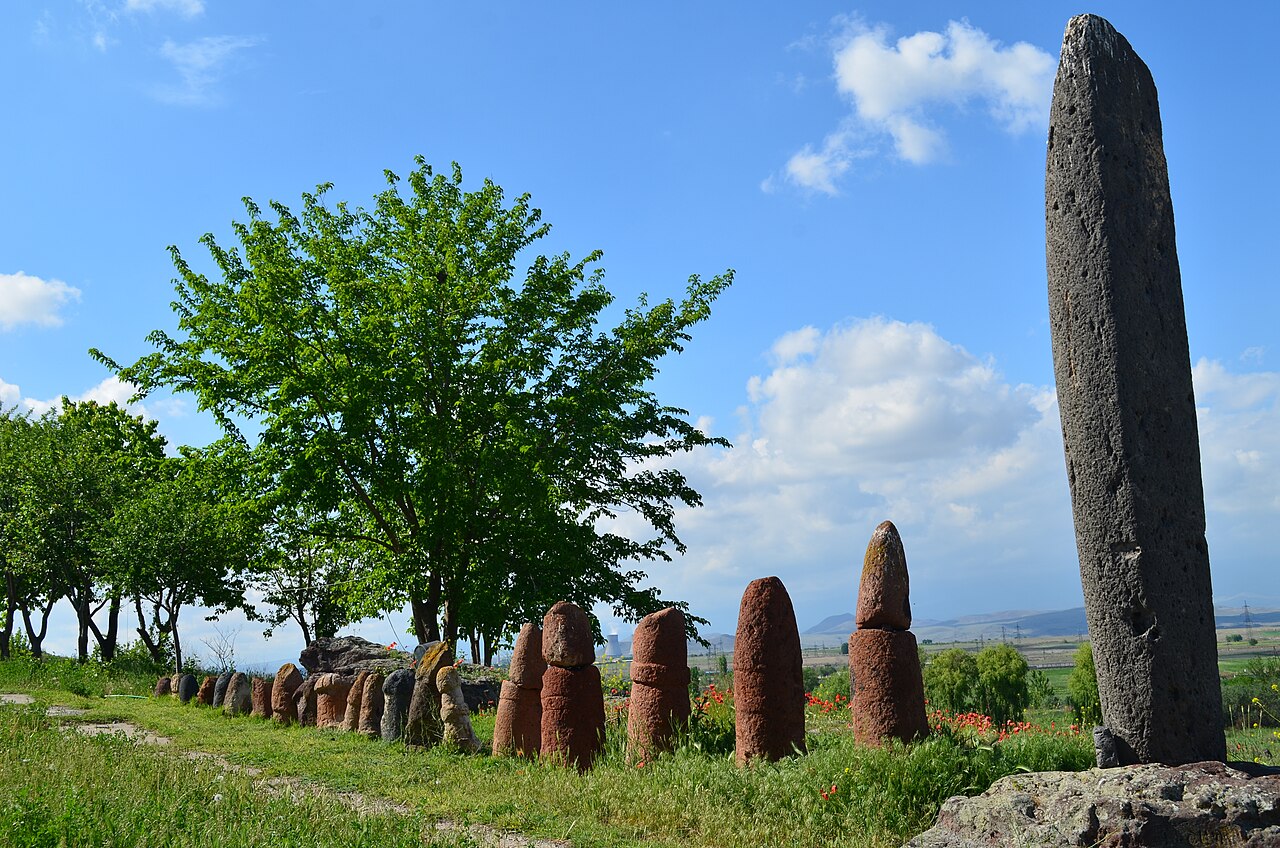
Ancient Technology · Near Taronik, Armavir Province, Armenia

Metsamor

A Bronze Age metal-working town whose carved rocks became the Soviet era's most romantic observatory claim

Mainstream: Settlement from c. 4000 BC; 'observatory' platforms c. 2800-2500 BC (claimed)Alternative: c. 2800 BC — one of the world's first observatories, tracking Sirius from carved stone platforms40.14°, 44.18°

At a glance

Metsamor
Photo: Sonashen · CC BY-SA 3.0

Metsamor, on the Ararat plain within sight of the sacred mountain, was one of the great Bronze Age centres of the Armenian highlands: a fortified settlement occupied from the fourth millennium BC, famous for its early and extensive metallurgical workshops. Excavated from 1965 by Emma Khanzadyan, the site also drew astrophysicist Elma Parsamian of Byurakan Observatory, who in the late 1960s identified rock-cut platforms on its southern spur as astronomical observing stations, complete with carved sight-lines and star symbols — from which, she argued, Bronze Age Armenians watched the heliacal rising of Sirius around 2800-2500 BC. The claim became a fixture of Soviet-era popular science and remains both cherished and contested.

See it on the globe →
The mainstream view

What archaeology says

What is securely established about Metsamor is impressive enough without astronomy. Excavations revealed a citadel with cyclopean walls, dense occupation from the Early Bronze Age (Kura-Araxes culture) through the Iron Age and beyond, and one of the largest known ancient metallurgical complexes in the region — dozens of smelting furnaces, casting moulds and slag heaps processing copper, bronze and later iron. Rich Late Bronze Age tombs yielded imports including an Egyptian faience frog-weight and a carnelian seal with Babylonian connections, showing Metsamor sat in far-reaching trade networks. Polish-Armenian excavations since 2013, led by Krzysztof Jakubiak with Ashot Piliposyan, continue to refine the sequence.

The 'observatory' is another matter. The southern rock spur does carry artificial steps, basins, grooves and pecked markings, some resembling stars or geometric figures. But mainstream archaeologists note that such rock-cut installations are common at highland sanctuaries and can relate to libations, metallurgy or cult; the astronomical interpretation rests on selecting particular grooves as sight-lines. No peer-reviewed modern survey has confirmed Parsamian's alignments, and international literature on archaeoastronomy generally lists Metsamor as an intriguing but unverified claim.

Scholars also point to the Soviet context: the 1960s-80s saw enthusiastic nationalist archaeoastronomy across the USSR, and Armenia's claims for Metsamor and the Zorats Karer ('Karahunj') stones served understandable cultural pride. That context calls for careful re-examination, not automatic dismissal.

Key evidence cited
  • Continuous occupation from the fourth millennium BC is documented through stratified excavation since 1965
  • Extensive smelting installations make Metsamor one of the oldest large metallurgical centres known in the Near East
  • Imported Egyptian and Babylonian prestige objects in the tombs confirm long-distance connections, not isolation
  • The rock-cut platforms, steps and basins parallel ritual installations at other highland sanctuaries without needing astronomy
  • No modern peer-reviewed survey has verified the proposed alignments, leaving the observatory unproven by current standards
The alternative view

What the skeptics propose

Parsamian's case, first advanced in 1967 after fieldwork with Khanzadyan, is more specific than its critics sometimes allow. She documented three carved platforms and showed that one bears a groove and pointer arrangement indicating due east, south and north — functioning, she argued, as a fixed compass rose. A trapezium engraved with four star-like marks, when its axis is extended to the horizon and the sky is rewound with precession, points to the rising of Sirius around 2800-2600 BC — the era when Sirius' heliacal rising, famously calendar-defining in Egypt, would have followed hard on the summer solstice at Metsamor's latitude.

Armenian researchers have built on this: the astronomer Benik Tumanyan and later writers connected Metsamor's platforms to a broader highland tradition including Karahunj, arguing the region that later gave the world some of its oldest calendar words maintained observational astronomy from the third millennium BC. Popular accounts go further still, calling Metsamor the world's oldest observatory and crediting it with zodiacal knowledge transmitted to Babylon — claims that outrun anything Parsamian herself published.

Sceptics reply that due-east grooves recur in many cults, that the trapezium-to-Sirius chain involves several unfalsifiable choices, and that no Bronze Age Armenian texts exist to corroborate any of it. Parsamian, one of Armenia's most distinguished astronomers, always presented the work as evidence-based hypothesis; its inflation into national certainty happened largely without her. A rigorous modern archaeoastronomical survey of the platforms — never yet undertaken — could settle much of the argument.

Key evidence cited
  • Parsamian's platform carvings indicate cardinal directions with an accuracy she argued exceeds decorative intent
  • The engraved trapezium's extended axis matches the rising point of Sirius around 2800-2600 BC after precessional correction
  • Sirius' heliacal rising was the premier calendar star of the Bronze Age world, making it a plausible target
  • Star-like pecked symbols on the platforms suggest celestial rather than purely cultic notation
  • A settlement running advanced metallurgy for centuries plainly commanded the practical scheduling that a seasonal star calendar provides

Genuinely open questions

  1. Would a modern instrumented survey confirm or refute Parsamian's Sirius alignment?
  2. Are the platform carvings Bronze Age, Iron Age, or accumulations from many periods?
  3. Did Metsamor's astronomical lore, if real, connect to Mesopotamian or Egyptian star calendars through its attested trade links?
  4. How should post-Soviet scholarship disentangle genuine highland archaeoastronomy from nationalist embellishment?

Worth knowing

Among the finds from Metsamor's tombs is a carnelian frog-shaped weight inscribed for an Egyptian pharaoh's era — a Nile artefact buried in the shadow of Mount Ararat, a thousand kilometres from the nearest crocodile.