Ancient Knowledge · Syunik Province, Armenia

Karahunj / Zorats Karer

Armenia's 'speaking stones' — hailed as the world's oldest observatory by a radiophysicist, and a Bronze Age cemetery by the archaeologists.

Mainstream: c. 2000–300 BC (Middle Bronze Age to Iron Age necropolis)Alternative: c. 5500 BC (Herouni's claimed astronomical observatory)39.55°, 46.03°

At a glance

Karahunj / Zorats Karer
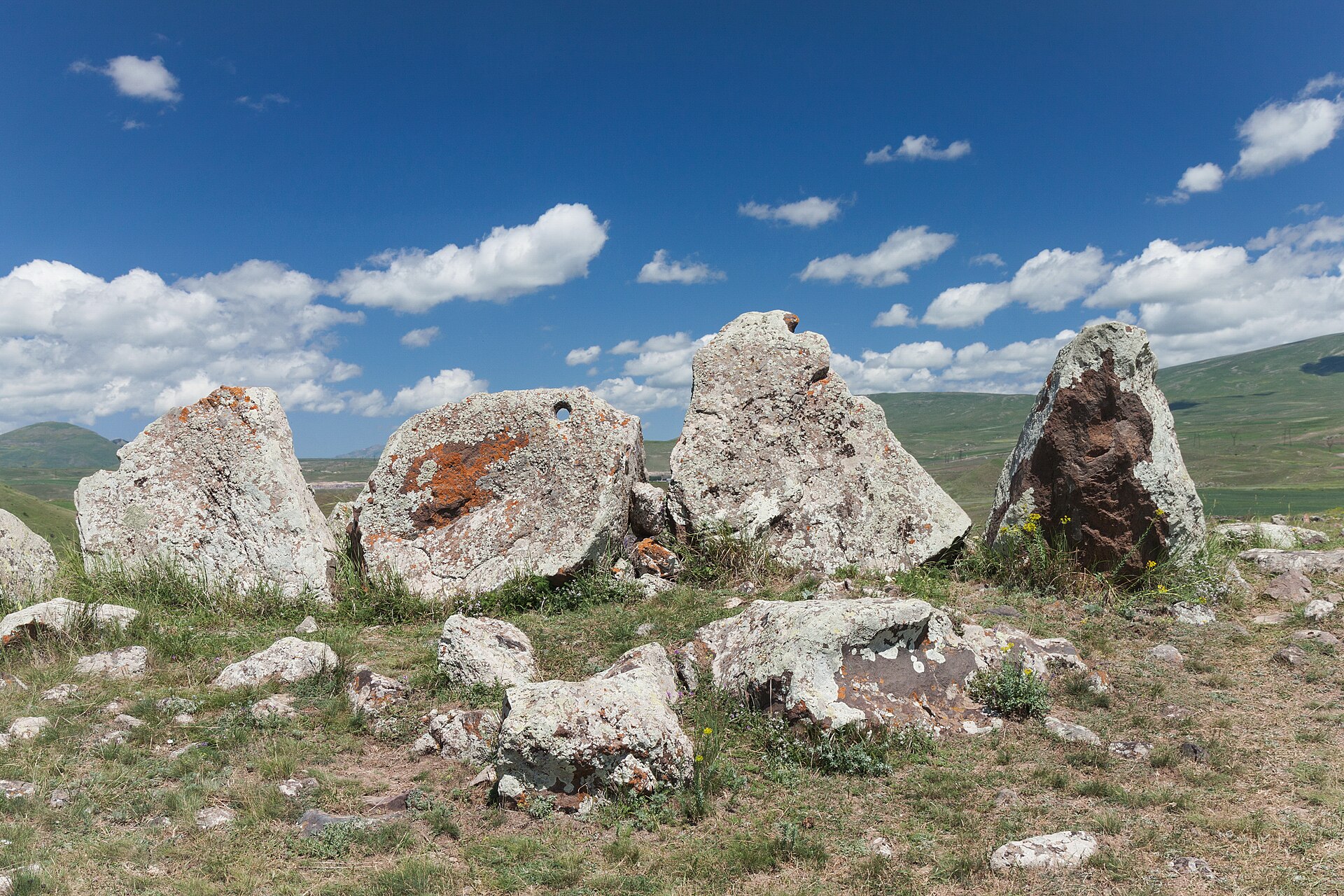
Photo: Marcin Konsek · CC BY-SA 4.0

On a basalt plateau 1,770 metres up in Armenia's Syunik Province stand 223 catalogued stones, arranged around a central chamber-tomb with arcs, alignments and an avenue trailing off across roughly seven hectares. About eighty of the stones carry a smooth circular hole bored near the top edge — the feature that makes the site unique among the world's megalithic monuments and drives the entire controversy. On windy days the holes are said to whistle, giving the popular name Karahunj, 'speaking stones'. Depending on who you ask, this is either the oldest astronomical observatory on Earth, predating Stonehenge by millennia, or a Bronze Age necropolis whose holed stones have been over-interpreted into a prehistoric instrument.

See it on the globe →
The mainstream view

What archaeology says

Archaeological attention began after Onnik Khnkikyan, an Armenian archaeologist, first described the stones in 1984, but the key fieldwork came in 2000, when a team from the Institute for Ancient Near Eastern Studies at the University of Munich, working with Armenian colleagues under Stephan Kroll, surveyed and test-excavated the site. Their conclusion was straightforward: Zorats Karer is principally a necropolis of the Middle Bronze Age to Iron Age, containing substantial stone cist tombs of those periods, and the line of standing stones may later have served as reinforcement for a defensive wall, possibly Hellenistic, around a hilltop settlement. Grave goods and construction parallels tie the site comfortably into the megalithic and burial traditions of the South Caucasus in the second and first millennia BC. Nothing excavated at the site dates anywhere near 5500 BC.

The astronomical claims received a formal hearing in the archaeoastronomical literature. A. César González-García's 2014 assessment for the Handbook of Archaeoastronomy and Ethnoastronomy accepted that a few solar alignments at the site are plausible — hardly surprising for any arrangement of over two hundred stones — but found the strong claims untenable: the famous holes are short, rough and weathered, giving fields of view of several degrees, far too wide for the precision observations claimed. Herouni's own solution was to postulate narrow sighting tubes once inserted into the holes, for which no archaeological evidence whatsoever exists. Clive Ruggles of the University of Leicester, the doyen of the field, has likewise described the observatory interpretation and the Stonehenge comparison as unwarranted. For mainstream science, the holes more likely relate to hauling the stones, ritual, or something not yet understood — a real puzzle, but not a telescope.

Key evidence cited
  • 2000 Munich–Armenian excavations identifying Middle Bronze Age to Iron Age tombs at the heart of the site
  • Grave architecture and finds paralleling known South Caucasus burial traditions of c. 2000–300 BC
  • González-García's 2014 analysis showing the holes' fields of view are far too wide for precision astronomy
  • No archaeological trace of the sighting tubes Herouni's observatory model requires
  • Nothing excavated at the site dating remotely close to the claimed 5500 BC
The alternative view

What the skeptics propose

The observatory case belongs to Paris Herouni, a distinguished Soviet-Armenian radiophysicist and antenna engineer, member of the Armenian Academy of Sciences, who led four expeditions to the site between 1994 and 2001. Measuring the azimuths and elevations of the holed stones and applying the astronomy of precession, Herouni concluded that dozens of holes had pointed at the rising and setting sun at solstices and equinoxes, at the moon's standstills, and at bright stars — notably Sirius and Capella — as they appeared around 5500 BC. On that reading Karahunj would predate Stonehenge by about three thousand years and the Giza pyramids by even more, making it the oldest known observatory on the planet. Herouni went further, deriving the name Carahunge from Armenian kar (stone) and hunge (sound or voice), arguing the same root lies hidden inside the name Stonehenge itself, and framing Armenia as a cradle of prehistoric astronomy. His 2004 book Armenians and Old Armenia laid out the full case, and in the same year the Armenian government formally renamed the site the 'Karahunj Observatory' by decree.

Critics — including sympathetic ones — note the difficulties. The precession calculation only yields 5500 BC if you first assume the holes were precision instruments; the holes themselves are too wide and rough for that precision without Herouni's hypothetical inserted tubes; stellar alignments are statistically cheap, since some star always fits any given direction at some date; and the etymological link to Stonehenge is rejected by linguists (the English name derives from Old English for 'hanging stones'). Archaeoastronomers such as González-García and Ruggles also point out that Herouni's team worked largely without archaeologists, so the astronomical model floats free of the excavated Bronze Age evidence. Supporters respond that the mainstream has never systematically re-surveyed all eighty holed stones, that a necropolis and an observatory are not mutually exclusive, and that the sheer effort of boring precise holes through basalt demands a better explanation than archaeology has yet offered.

Key evidence cited
  • Herouni's measured alignments of holed stones to solstice, equinox and lunar-standstill points
  • His precession-based calculations converging on dates around 5500 BC for stellar alignments
  • Roughly eighty deliberately bored holes in basalt — a feature with no agreed archaeological explanation
  • The kar-hunge 'speaking stones' etymology and claimed echo in the name Stonehenge
  • The site's high-altitude horizon views, well suited to systematic sky-watching

Genuinely open questions

  1. What were the bored holes in the standing stones actually for?
  2. Could parts of the stone arrangement be older than the Bronze Age tombs among them?
  3. Why has no full modern re-survey combined excavation with a rigorous archaeoastronomical test of Herouni's alignments?

Worth knowing

In 2004 Armenia's parliament settled the science by decree — officially renaming the site the 'Karahunj Observatory', to the continuing exasperation of the archaeologists who consider it a cemetery.