Ancient Engineering · Demre (ancient Myra), Antalya Province, Turkey

Lycian Rock Tombs of Myra

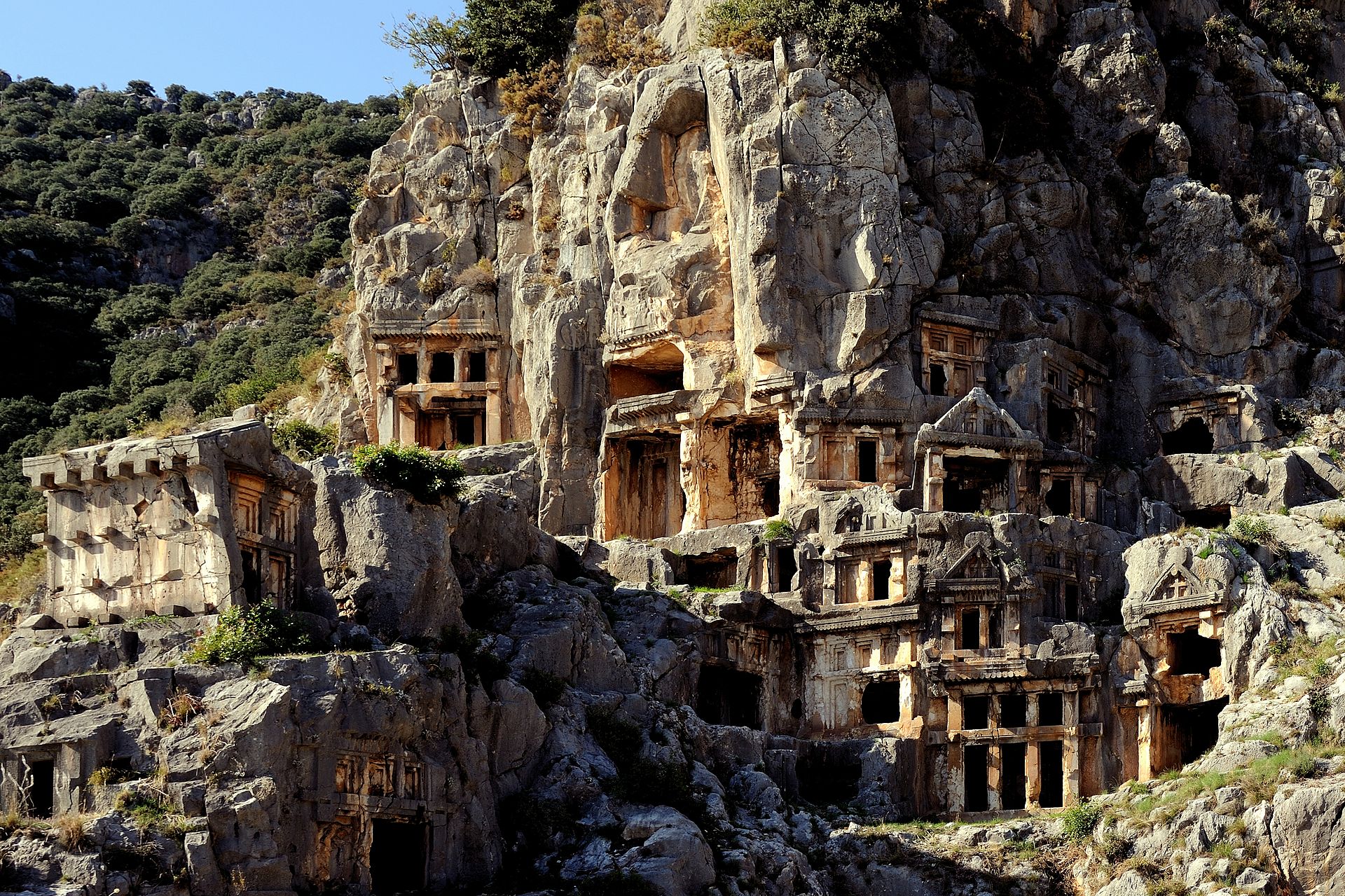
Houses for the dead carved into a vertical cliff — built high so that winged spirits could carry the souls away.

Mainstream: c. 5th–4th century BC (main necropoleis; the city flourished into the Byzantine era)Alternative: Date not seriously disputed — debate centres on Lycian afterlife beliefs, the winged beings carved on their tombs, and why the dead were housed high on sheer cliffs36.26°, 29.99°

At a glance

Lycian Rock Tombs of Myra
Photo: Saffron Blaze · CC BY-SA 3.0

Above the ruins of ancient Myra, near modern Demre on Turkey's Mediterranean coast, dozens of tombs are carved directly into the vertical limestone cliff in the unmistakable form of Lycian houses — complete with imitation timber beams, projecting joist ends, pitched roofs and porches, all rendered in solid rock. Two great necropoleis survive, one above the river valley and one beside the Roman theatre, their facades stacked up the cliff face like a village of the dead suspended in mid-air. When the British traveller Charles Fellows reached Myra in 1840, many facades still carried their original paint in bands of red, yellow and blue. Myra was one of the six most important cities of the Lycian League, and its rock-cut cemetery is among the finest expressions of a funerary tradition unique to Lycia, where the boundary between house and tomb was deliberately blurred. The city below was buried under metres of river silt — its excavator calls it the 'Pompeii of Anatolia' — and it later became famous for a different reason entirely: its 4th-century bishop was Nicholas of Myra, the historical figure behind Santa Claus.

See it on the globe →
The mainstream view

What archaeology says

Systematic excavation of Myra and its harbour Andriake has been led since 2009 by Professor Nevzat Cevik of Akdeniz University, whose team has uncovered the theatre with its trove of Hellenistic terracotta figurines, a Byzantine chapel preserved to its roofline beneath the alluvium, and, in work publicised in 2025, an unusual Roman thermal and healing complex built over natural hot springs. The tombs themselves are dated mainly to the 5th and 4th centuries BC on the evidence of their Lycian-language inscriptions, sculpted reliefs in late Classical style, and parallels with dated monuments at Xanthos and Limyra.

Archaeologists read the house-shaped facades as literal translations of Lycian domestic timber architecture into stone — the tomb as an eternal dwelling for the dead. Reliefs at Myra show funerary banquets and family groups, and inscriptions record fines payable to the city for violating a tomb, showing these were legally protected family properties. The famous winged figures of Lycian funerary art, best known from the Harpy Tomb at Xanthos (now in the British Museum), are interpreted by most scholars as sirens or harpy-like psychopomps gently carrying the small figures of the dead — matching later Greek accounts of Lycian belief that winged spirits bore souls to the afterlife, and offering one explanation for why tombs were cut as high up the cliff as possible.

Modern work concentrates on conservation and recording: the facades are suffering salt weathering and earthquake cracking, and Turkish teams have been documenting the necropoleis with laser scanning while restoring the theatre with original stones under the Heritage for the Future programme.

Key evidence cited
  • Lycian-language tomb inscriptions and Classical-style reliefs date the necropoleis to the 5th–4th centuries BC
  • Facades faithfully copy Lycian timber house construction, supporting the 'eternal dwelling' interpretation
  • Charles Fellows in 1840 recorded surviving red, yellow and blue paint, confirming the tombs were brightly finished, not austere
  • Nevzat Cevik's excavations since 2009 tie the tombs into a well-dated urban sequence from Classical Lycia to Byzantium
  • Inscriptions recording fines for tomb violation show the tombs functioned as protected family property within civic law
The alternative view

What the skeptics propose

Myra attracts far less pseudo-archaeology than Egypt or Peru, and its dating is not seriously contested. The genuinely contested territory is cultural and interpretive. The Lycians are one of the Mediterranean's more mysterious peoples: many researchers, following Hittite and Egyptian records of the 'Lukka lands' and the Lukka raiders among the Sea Peoples, see them as descendants of a Bronze Age maritime people, and popular writers have leaned into Herodotus's striking claim that Lycians reckoned descent through the mother — presenting Lycia as a rare matrilineal survival in the ancient world. Sceptical historians reply that the epigraphic record shows Lycian men naming their fathers in the normal patrilineal way, and that Herodotus may have garbled a more limited custom.

A second strand concerns the tombs' placement and meaning. The romantic reading — repeated by travel writers since the 19th century and embraced by modern spiritual authors — is that the Lycians carved their dead into the sky because winged beings, the creatures shown on the Harpy Tomb, could only collect souls from high places. Some alternative commentators go further, suggesting the cliff necropolis encodes a shamanic or bird-cult cosmology inherited from remote antiquity, and point to the sheer difficulty of carving ornate facades on a vertical cliff — work that would demand elaborate scaffolding, rope access or carving from the top down — as evidence of techniques and motivations we underestimate.

Mainstream archaeologists counter that height served practical and social ends: elevated tombs were harder to rob, more visible as status displays, and simply followed the available rock faces; the winged-spirit interpretation, while plausible, rests on later Greek sources rather than any surviving Lycian text. Both sides agree the Lycian language itself, only partially deciphered, may still hold the answer — most tomb inscriptions can be read only in outline.

Key evidence cited
  • Hittite and Egyptian texts on the Lukka lands link the Lycians to the enigmatic Sea Peoples of the Bronze Age collapse
  • Herodotus's report that Lycians took their names from their mothers, read as evidence of a rare matrilineal society
  • Winged psychopomp figures on Lycian monuments such as the Harpy Tomb, suggesting souls were collected from high places
  • The extreme difficulty and danger of carving ornate facades on a sheer cliff, implying strong non-practical motivation
  • The only partially deciphered Lycian language, leaving the tombs' own testimony largely unread

Genuinely open questions

  1. What do the untranslated portions of the Lycian tomb inscriptions actually say about their owners' beliefs?
  2. Were the winged figures of Lycian funerary art truly seen as soul-carriers, or is that a later Greek gloss?
  3. How much of Classical Myra — and how many more tombs — still lie sealed beneath the metres of river silt that buried the city?

Worth knowing

The bishop of Myra in the early 4th century AD was Nicholas — the generous saint whose legend, filtered through Dutch 'Sinterklaas', became Santa Claus. His original tomb lies in the church at Demre, directly below the cliff of Lycian tombs.