What archaeology says
Mainstream prehistorians read Val Camonica as a ten-thousand-year diary of alpine life and belief. Emmanuel Anati's chronology, refined by later researchers, tracks the engravings from post-glacial hunting scenes through Neolithic praying figures and ploughing scenes, Copper Age daggers and sun symbols on statue-stelae, and an explosion of Iron Age imagery — warriors, duels, riders, looms, four-wheeled wagons, huts and inscriptions — that matches what archaeology knows of the Camunni, the local people the Romans eventually absorbed. The engravings' subjects evolve in lockstep with excavated material culture, which is the strongest argument that the artists were recording their own world.
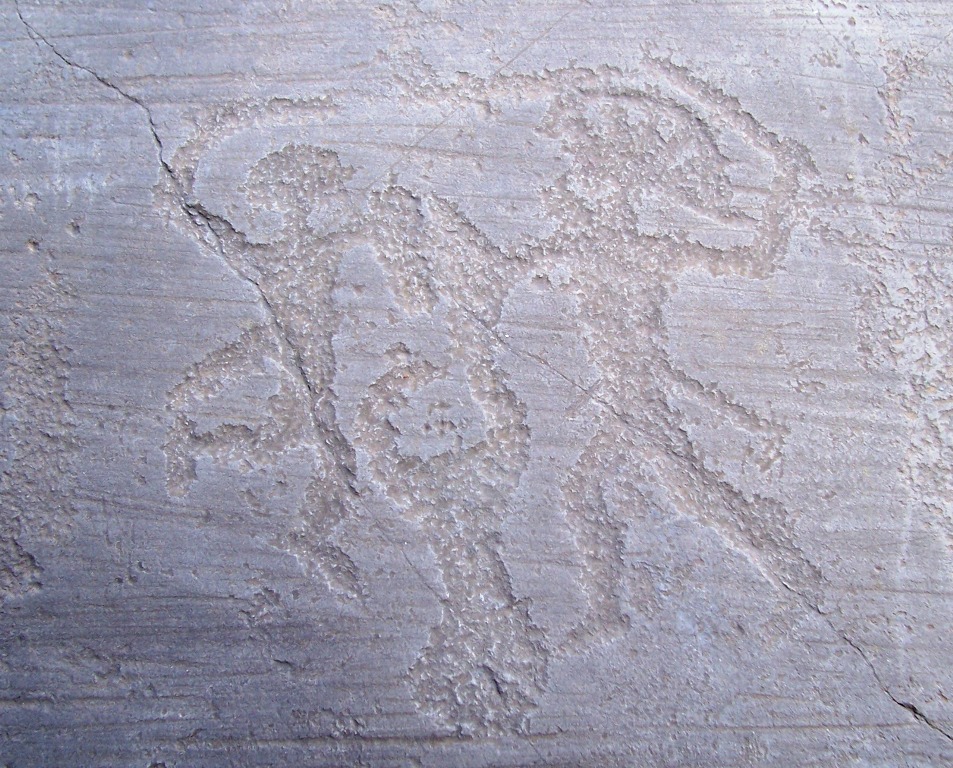
The famous 'astronauts' are, to specialists, Iron Age cult figures. The paired anthropomorphs at Zurla hold implements and are surrounded by radiating halos, a convention that appears on many Camunian figures and is generally interpreted as divine light, feathered or horned headdresses, or solar attributes attached to gods, heroes or masked celebrants. Comparable rayed and horned figures occur widely in Iron Age Europe with no suggestion of technology. Superimposition studies place such figures firmly within the local stylistic sequence rather than outside it.
The Camunian rose, engraved dozens of times in the valley, is likewise read as a solar or apotropaic symbol of the Camunni, its four-lobed loop traced around nine cup-marks. Its afterlife is thoroughly modern: a stylised version was adopted in 1975 as the official emblem of the Lombardy region, making a prehistoric petroglyph one of the few to serve as contemporary government branding.
- Over 140,000 documented engravings form a continuous stylistic sequence matching excavated artefacts from Epipalaeolithic to Roman times
- The haloed 'astronaut' figures share their rayed-head convention with many other Camunian figures interpreted as gods or celebrants
- Iron Age scenes depict verifiable period technology — looms, wagons, duelling warriors — anchoring the artists in their own material world
- Emmanuel Anati's Centro Camuno di Studi Preistorici has systematically catalogued the valley since 1964, enabling superimposition-based dating
- Comparable rayed and horned anthropomorphs occur across Iron Age European art without any technological reading
- UNESCO's 1979 inscription (Italy's first) rested on the art's demonstrated ten-millennium local development