What archaeology says
Archaeologists interpret Monte d'Accoddi as an open-air sanctuary — an altar-platform rather than a tomb or dwelling. The first monument, dated by radiocarbon to roughly 4000-3650 BC, was a platform supporting a red-painted shrine; after a destruction episode, perhaps by fire, it was entombed within a second, larger stepped structure of the Sub-Ozieri phase around 3500-3000 BC, with its long processional ramp. Around the monument Contu's excavations of the 1950s and Tinè's campaigns of 1979-1990 found hearths, animal sacrifice remains, carved stelae, female figurines and quantities of decorated Ozieri pottery, with activity continuing until abandonment around 1800 BC.
The ziggurat comparison is not a fringe invention — excavators themselves used the word, and scholars have noted formal parallels with early Mesopotamian temple platforms such as the White Temple terrace at Uruk, which is broadly contemporary with the second phase. The mainstream position, however, is convergence rather than contact: ramped platforms are a natural architectural solution for raising a shrine above a plain, and there is no material evidence — no imports, no Near Eastern objects — of a fourth-millennium connection between Sardinia and Mesopotamia.
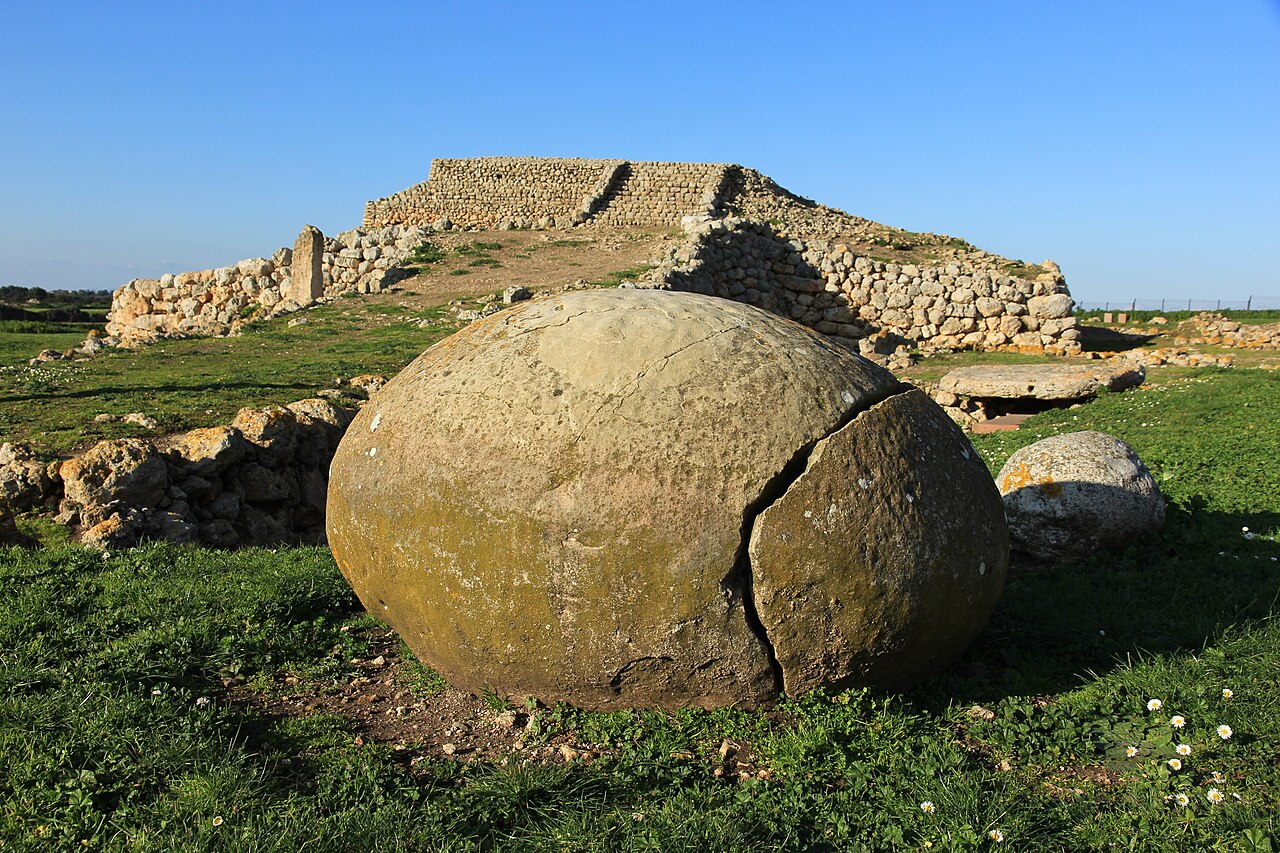
Alongside the platform stand a menhir over four metres tall, dolmen-like slabs interpreted as offering tables, and a large boulder carved into an egg-like sphere, all consistent with the rich megalithic and ritual traditions of Neolithic Sardinia.
- Radiocarbon dates placing the first platform at c. 4000-3650 BC within the local Ozieri culture
- Continuous local material culture — Ozieri pottery, figurines, stelae — with no Near Eastern imports
- Excavations by Ercole Contu (1954-58) and Santo Tinè (1979-1990) documenting two building phases
- Animal sacrifice remains and hearths consistent with an open-air sanctuary
- Ramped platforms arise independently in many cultures as a way to elevate a shrine