Belief & Society · Thompson Wash, near Thompson Springs, Grand County, Utah, USA

Sego Canyon

Hollow-eyed 'spirit figures' in a Utah wash — archaic shamanic visions or the most televised 'aliens' in American rock art?

Mainstream: Barrier Canyon style panels c. 2000 BC to AD 500 (dating contested; possibly later), with Fremont and Ute art alongsideAlternative: Read by ancient-astronaut proponents as eyewitness portraits of visitors, age uncertain39.03°, -109.72°

At a glance

Sego Canyon
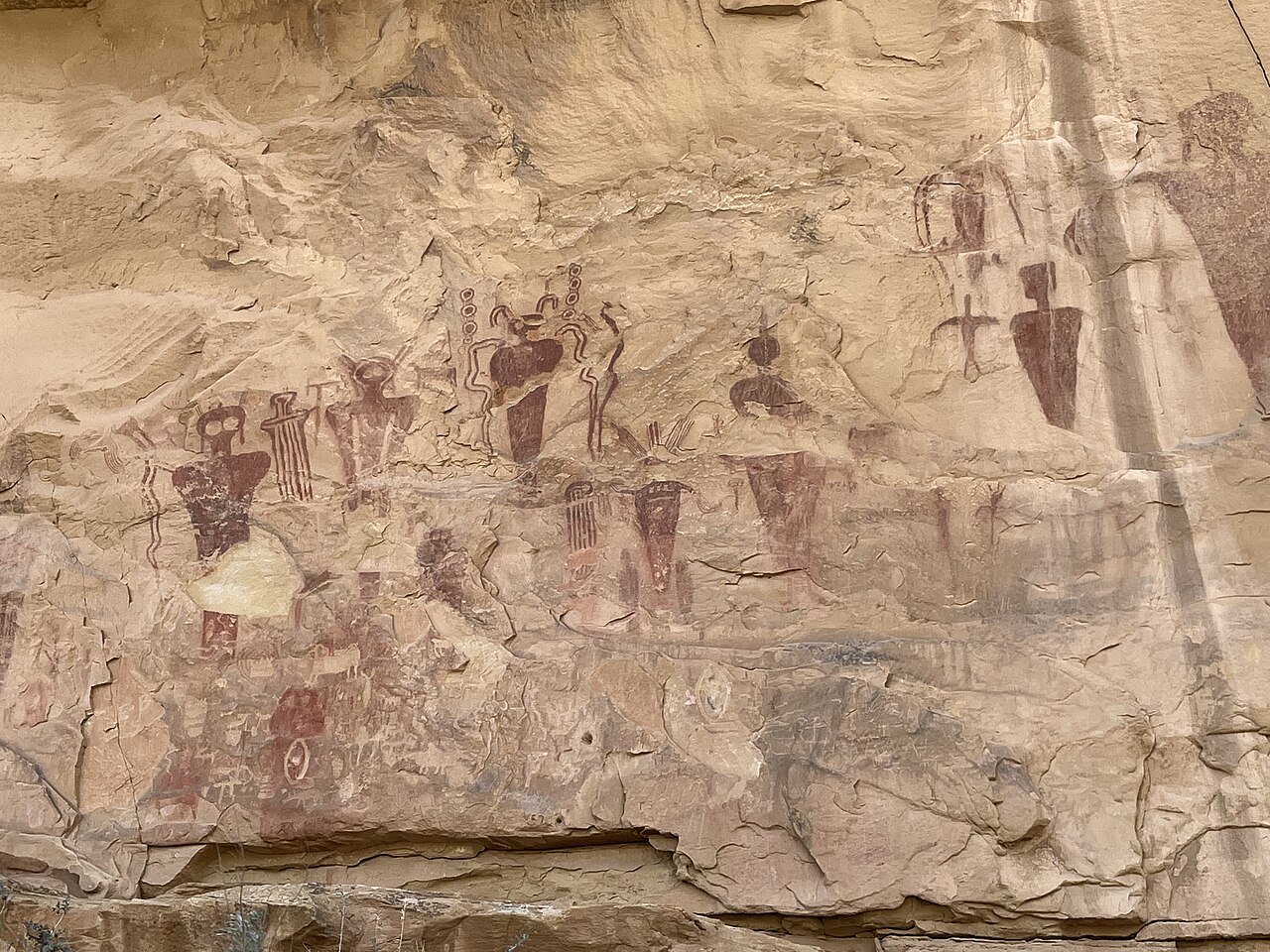
Photo: Steven Heath, BLM Utah · Public domain

A few miles north of the near-ghost town of Thompson Springs, Utah, the walls of Sego Canyon carry one of the most accessible and most photographed rock art galleries in the American West. Three cultures left their marks here across thousands of years: Barrier Canyon style painters, whose life-sized, limbless, hollow-eyed anthropomorphs seem to hover on the sandstone; Fremont people, who pecked trapezoidal warriors with shields; and historic Ute artists, who added horses and bison after European contact. The Barrier Canyon figures — gaunt, spectral forms with enormous vacant eyes and sometimes antennae-like projections — have made Sego Canyon a fixture of ancient-aliens television, while archaeologists see them as among the most powerful religious images ever painted in North America. The site was listed on the National Register of Historic Places in 1980.

See it on the globe →
The mainstream view

What archaeology says

Archaeologists attribute the ghostly Sego Canyon paintings to the Barrier Canyon style, named by rock art scholar Polly Schaafsma after the type-site in Horseshoe (Barrier) Canyon, home of the famous Great Gallery. The style is associated with Archaic hunter-gatherers of the Colorado Plateau, and its elongated, armless, staring figures are widely interpreted as spirit beings or shamanic visions rather than portraits of ordinary people. Schaafsma and others point to details such as snakes held in hands, birds attending the figures, and skeletal or translucent bodies — classic markers, in comparative religion, of trance experience and spirit-helper imagery documented among historic Native American peoples.

Dating the style is an honest problem that mainstream researchers debate openly. Traditional estimates ran from the late Archaic, several thousand years BC, to around AD 500. A 2014 luminescence study of the Great Gallery led by geologist Joel Pederson at Utah State University surprised everyone by narrowing that panel's likely window to roughly AD 1 to 1100, later than most had assumed and overlapping with early Fremont farmers. Whether that result applies to all Barrier Canyon panels, including Sego, remains contested — a genuine open question about age, though not about authorship.

Crucially, the succession at Sego Canyon itself argues for cultural continuity, not anomaly. Fremont and Ute art on the same walls shows successive Indigenous peoples returning to a place that was plainly significant for a very long time. Descendant communities regard such sites as sacred, and the hollow-eyed figures fit within a deep Native American tradition of depicting powerful spirit beings — beings that were never intended as literal zoology.

Key evidence cited
  • The figures fit Polly Schaafsma's well-defined Barrier Canyon style, documented at scores of Utah sites with consistent conventions
  • Trance-associated details — attendant birds, snakes in hands, skeletal bodies — parallel shamanic imagery in documented Native American religions
  • A 2014 luminescence study led by Joel Pederson dated the type-site Great Gallery to roughly AD 1-1100, grounding the style in known regional prehistory
  • Fremont and Ute art on the same Sego Canyon walls shows continuous Indigenous use of the site across millennia
  • No artefacts, materials or techniques at any Barrier Canyon site require anything beyond hunter-gatherer technology
  • Descendant communities recognise the imagery as ancestral spirit beings within living religious frameworks
The alternative view

What the skeptics propose

To ancient-astronaut proponents, the Sego Canyon figures look less like visions and more like witnesses' sketches. The Barrier Canyon anthropomorphs' domed heads, huge dark eye sockets, absent limbs and antenna-like projections are read as helmets, visors and communication gear; their hovering, legless posture is taken as figures floating above the ground. The panels have been showcased repeatedly on the History Channel's Ancient Aliens, where commentators such as Giorgio Tsoukalos present them alongside Tassili and the Wandjina as one more entry in a worldwide catalogue of big-eyed sky beings, arguing that unrelated cultures kept drawing the same thing because they kept seeing the same thing.

Proponents also lean on the dating uncertainty. If mainstream scholars can disagree by three millennia about when the paintings were made, they argue, confidence about what the paintings depict should be equally modest. Some writers connect the figures to regional Native American stories of star beings and sky people, contending that such traditions are garbled records of real encounters rather than mythology.

Native American perspectives complicate both readings. Ute, Paiute, Hopi and other descendant communities generally describe such figures as powerful spirit beings tied to specific places and ceremonies, and many find the alien framing disrespectful — a repackaging of their religious heritage as science fiction. But tribal views also resist the flattening tendency of some archaeological language: these are not merely 'art' or 'style horizons' but sacred presences, and several communities ask visitors to treat Sego Canyon as they would a church. The vandalism and bullet scars already disfiguring parts of the panels give that request practical urgency.

Key evidence cited
  • The hollow-eyed, dome-headed, limbless figures are visually striking matches for popular imagery of suited or 'grey' aliens
  • Some figures bear antenna-like projections and appear to float, features proponents read technologically
  • Mainstream dating of the Barrier Canyon style has shifted by thousands of years, which proponents cite as interpretive humility owed
  • Similar big-eyed spectral figures recur in rock art worldwide, presented as a cross-cultural contact signature
  • Regional Native traditions speak of star beings and sky people, which proponents treat as corroborating memory

Genuinely open questions

  1. When exactly were the Barrier Canyon panels at Sego Canyon painted, and does the late Great Gallery date generalise?
  2. What experiences — visionary, ritual or otherwise — inspired the hollow-eyed spirit figure convention?
  3. Who were the Barrier Canyon painters in relation to later Fremont and Ute peoples?
  4. How can a heavily visited, already vandalised roadside site best be protected while remaining accessible?

Worth knowing

Sego Canyon offers a rare single-wall timeline of the American West: Archaic spirit figures, Fremont shield-bearers and Ute horsemen share the same sandstone, with the horses instantly dating the newest layer to after European contact.