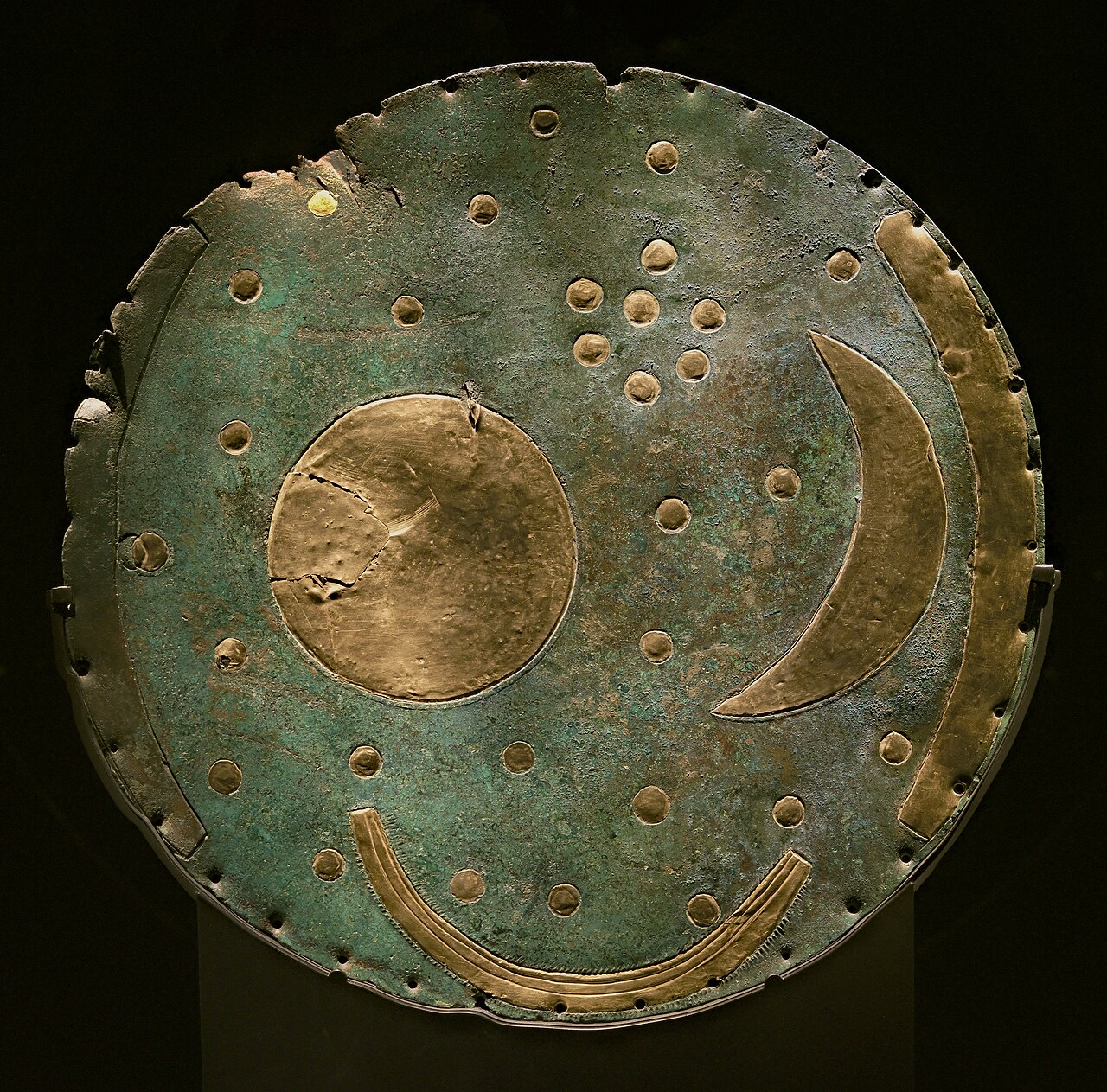
Ancient Knowledge · Found on the Mittelberg hill near Nebra, Germany; displayed at the State Museum of Prehistory, Halle

Nebra Sky Disk

The oldest known map of the sky — dug up by looters, sold on the black market, and still fought over

Mainstream: c. 1800-1600 BC, buried c. 1600 BC (Early Bronze Age)Alternative: c. 800-50 BC (Iron Age), per the Gebhard-Krause challenge51.28°, 11.52°

At a glance

Nebra Sky Disk
Photo: Shonagon · CC0

The Nebra Sky Disk is a bronze disc about 30 centimetres across, patinated blue-green and inlaid with gold symbols: a sun or full moon, a crescent, thirty-two stars including a cluster read as the Pleiades, later-added horizon arcs and a curved 'sun boat'. Two metal-detectorists dug it up illegally on the Mittelberg hill near Nebra in 1999, along with bronze swords, axes and armrings, and sold the hoard into the black market. It was recovered in a 2002 police sting in a Basel hotel, and UNESCO has called it the oldest known concrete depiction of cosmic phenomena. Because it entered the world through looters rather than archaeologists, its find context has been contested ever since — most dramatically in a 2020 academic challenge to its very age.

See it on the globe →
The mainstream view

What archaeology says

The consensus, defended by the Halle museum team and the chemist-archaeometallurgist Ernst Pernicka, dates the disc to the Early Bronze Age Unetice culture and its burial to around 1600 BC. The associated swords are classic Bronze Age types; radiocarbon on birch-bark remnants in a sword hilt gave about 1600 BC; trace-element and lead-isotope analyses tie the disc's copper to the Mitterberg mine in the Austrian Alps and its gold to the Carnon river in Cornwall, a sourcing pattern coherent for the period. Soil traces on the disc were matched to sediments at the Mittelberg find spot, and the looters' account of the hoard was tested in court during their 2003-2005 trials, with one looter leading investigators to the pit.

Astronomically, the mainstream reading treats the disc as a functioning piece of knowledge: the Pleiades beside the crescent moon may encode a leap-month rule known from the much later Babylonian mul.apin texts, and the horizon arcs span the 82-degree swing of sunrise between solstices at the site's latitude.

In 2020, Rupert Gebhard and Ruediger Krause argued the disc was not part of a closed hoard and looked Iron Age in style. Pernicka and colleagues published detailed rebuttals, and a 2020 review in Archaeologia Austriaca concluded the Bronze Age dating stands; most of the field agrees, and the disc anchored the British Museum's 2022 Stonehenge exhibition as a Bronze Age object.

Key evidence cited
  • Radiocarbon dating of birch bark in an associated sword hilt gave c. 1600 BC
  • The swords, axes and armrings in the hoard are classic, well-dated Early Bronze Age Unetice types
  • Lead-isotope and trace-element analysis sources the copper to the Mitterberg mine and the gold to Cornwall, consistent for the period
  • Soil adhering to the disc was matched to sediments at the Mittelberg find spot
  • The looters' account of a single closed hoard was cross-examined and upheld in German courts in 2003-2005
  • A 2020 Archaeologia Austriaca review of all the evidence reaffirmed the Early Bronze Age date against the challenge
The alternative view

What the skeptics propose

The principal alternative here is a scholarly minority view, not a fringe one. In September 2020, Rupert Gebhard, director of the Bavarian State Archaeological Collection in Munich, and Ruediger Krause, professor of prehistory at Frankfurt, published a paper arguing that the disc and the weapons were probably not deposited together — looters' testimony being inherently unreliable — and that, judged alone, the disc's iconography of sun boat and star field fits Iron Age motifs of the first millennium BC far better than the Early Bronze Age, which otherwise offers nothing remotely like it. If they are right, the disc is roughly a thousand years younger, and its status as the world's oldest sky map collapses.

Their case leans on the murky recovery: the disc was traded through fences for years, the find spot was identified only afterwards from looters bargaining for reduced sentences, and Gebhard and Krause reject the soil-attachment and geochemical arguments as inconclusive. The dispute grew heated, with duelling press releases between Munich, Frankfurt and Halle.

Beyond academia, the disc also attracts a softer fringe: writers who link it to Atlantean or astronaut astronomy, and a persistent forgery whisper — though even Gebhard and Krause accept the disc is a genuine ancient object. As of the mid-2020s the Iron Age hypothesis has won few converts, but its authors have not withdrawn it.

Key evidence cited
  • The disc has no parallel whatsoever in Early Bronze Age imagery, which is otherwise entirely non-figurative in the region
  • Sun-boat and celestial motifs are commonplace in first-millennium BC Iron Age art, where the disc would sit comfortably
  • The find was looted, fenced and resold for three years, so the 'closed hoard' rests on testimony from criminals seeking leniency
  • Gebhard and Krause argue the soil and geochemical matches show only plausibility, not proof, of association with the weapons
  • The disc itself contains no organic material and cannot be directly radiocarbon dated
  • The find spot was never excavated undisturbed; archaeologists only re-excavated a hole the looters had already emptied

Genuinely open questions

  1. Can any independent physical method ever date the disc's manufacture directly, settling Bronze Age versus Iron Age for good?
  2. Was the disc genuinely buried with the swords and axes, or assembled into a saleable 'hoard' after discovery?
  3. Does the Pleiades-crescent pairing really encode a leap-month rule a thousand years before Babylonian texts record one?
  4. Who made it — local Unetice smiths, or a workshop connected to Mediterranean or British astronomical traditions?

Worth knowing

The two looters found the disc with a cheap metal detector in under half an hour of digging, sold the whole hoard for 31,000 Deutschmarks — and later received jail sentences that were increased on appeal after they complained.