What archaeology says
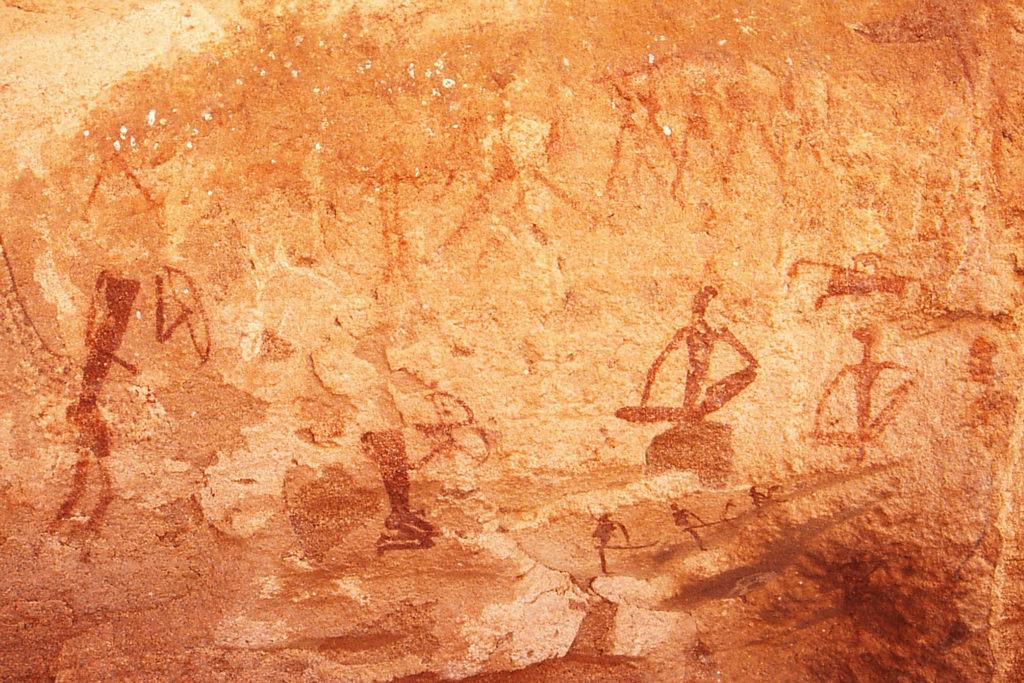
The dominant scholarly interpretation of Twyfelfontein descends from the shamanic model of southern African rock art developed by David Lewis-Williams and colleagues from San (Bushman) ethnography. On this view, the engravings are not simple wildlife illustration but ritual imagery bound up with trance: medicine people entered altered states at potent places like the spring, and beings part-animal, part-human record the experience of transformation. The Lion Man is the exhibit-in-chief — a lion given five toes on each paw (real lions have four) and a tail ending in a six-toed, hand-like print, deliberate anatomical impossibilities that signal a shaman transformed into a lion, a specific and well-documented concept in San belief. Panels combining animals with geometric entoptic patterns, and engravings of tracks clustered like teaching charts, are read within the same ritual frame.
An older, literalist school — prominent among earlier recorders of Namibian rock art — saw the engravings instead as a practical archive: hunting magic, tallies of game, track-recognition lessons for young hunters, and even maps, with cupules and circles marking waterholes. Some panels, such as the so-called Dancing Kudu and the dense spoor panels, can be argued either way, and modern researchers increasingly allow that instruction and ritual need not exclude one another.
Chronology rests on excavated deposits at the site, which document hunter-gatherer occupation from at least the sixth millennium BC into the first millennium AD, when pottery and livestock signal Khoekhoe herders. Most engravings are attributed to the hunter-gatherer phases, ancestors of today's San peoples, whose descendants' ethnography supplies the interpretive key the shamanic school relies on.
- The Lion Man's five-toed paws and hand-like tail-tip are deliberate impossibilities matching documented San beliefs about shamans transforming into lions
- San ethnography, the interpretive foundation of the shamanic model, derives from descendants of the region's hunter-gatherer engravers
- Excavations at Twyfelfontein document occupation from at least the sixth millennium BC, anchoring the engravings in local prehistory
- Panels of animal tracks arranged like charts support instructional readings that complement rather than contradict ritual ones
- The site's setting at a rare permanent spring explains its intensity of use without invoking outside actors
- UNESCO inscription in 2007 followed decades of systematic recording, beginning with surveys such as Ernst Rudolf Scherz's