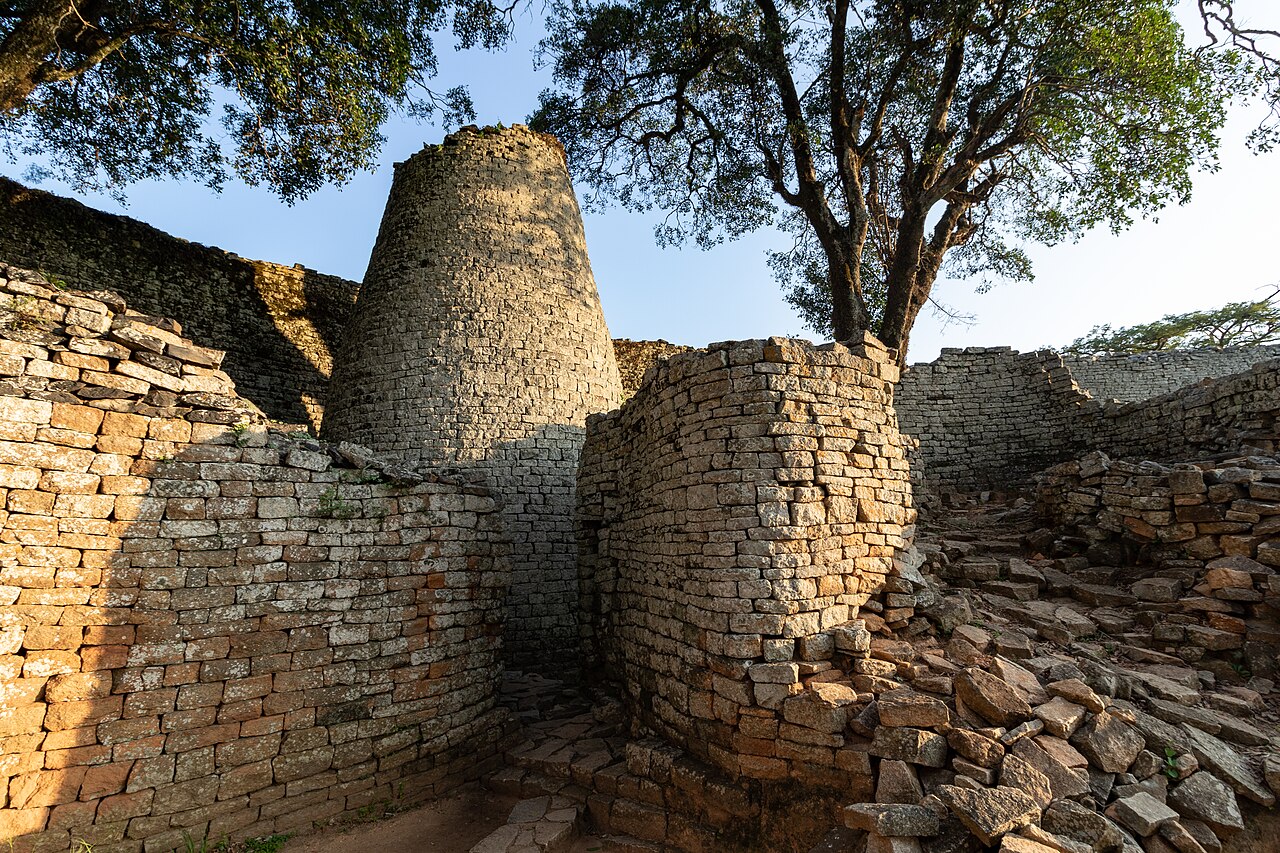
Lost Worlds · Great Zimbabwe, Zimbabwe (most famous candidate; the biblical port's true location is unknown)

Ophir

Solomon's fabled source of gold has been hunted from Africa to India to Peru — and the hunt itself changed history.

Mainstream: 10th-6th centuries BC (biblical accounts of Solomon's fleets)Alternative: c. 950 BC (literal voyages to a single real Ophir)-20.27°, 30.93°

At a glance

Ophir
Photo: Andrew Moore · CC BY-SA 2.0

The Hebrew Bible says King Solomon's fleet, sailing from Ezion-Geber on the Red Sea with Phoenician crews, returned every three years from a land called Ophir bearing gold, silver, ivory, sandalwood, apes and peacocks. Where Ophir lay is never stated, and the puzzle has obsessed geographers for two thousand years. Candidates have included Sofala and Great Zimbabwe in southern Africa, the port of Supara in India, the goldfields of Arabia, and even Peru. This entry is anchored at Great Zimbabwe — the most consequential candidate, because the Ophir theory was used for decades to deny that Africans built Africa's greatest medieval stone city.

See it on the globe →
The mainstream view

What archaeology says

Most biblical scholars accept that Ophir was a real place known to Iron Age traders — it appears not only in scripture but on an 8th-century BC Hebrew ostracon from Tell Qasile reading gold of Ophir to Beth-Horon, which suggests a genuine commercial toponym rather than pure legend. The favoured locations are those reachable by a Red Sea fleet: south-west Arabia (the gold-bearing regions of Yemen and Asir, with Mahd adh-Dhahab in the Hijaz a noted candidate), the Horn of Africa near the land Egyptians called Punt, or western India, where the trade goods listed — ivory, apes, peacocks and the loan-words used for them — point for many philologists towards an Indian connection.

What mainstream archaeology emphatically rejects is the identification of Ophir with Great Zimbabwe. When Karl Mauch reached the ruins in 1871 he declared them the work of the Queen of Sheba's civilisation, and Cecil Rhodes's British South Africa Company promoted the Ophir myth to cast white settlers as heirs reclaiming an ancient non-African colony; a company-backed outfit, Rhodesia Ancient Ruins Ltd, ransacked sites for gold, and journalist Richard Nicklin Hall stripped archaeological deposits he dismissed as Kaffir occupation.

Scientific excavation demolished the myth twice over: David Randall-MacIver in 1905 and Gertrude Caton-Thompson in 1929 both concluded that Great Zimbabwe was medieval, built between roughly the 11th and 15th centuries AD by ancestors of the Shona people, some two thousand years after Solomon. Radiocarbon dating has since confirmed this beyond doubt. The Rhodesian government's suppression of these findings into the 1970s is now a textbook case of archaeology distorted by colonial politics.

Key evidence cited
  • The Tell Qasile ostracon (8th century BC) mentioning gold of Ophir shows the name was a genuine trade toponym in the Iron Age Levant.
  • Radiocarbon dating places Great Zimbabwe's construction between the 11th and 15th centuries AD — roughly two millennia after Solomon.
  • Randall-MacIver (1905) and Caton-Thompson (1929) independently found only African material culture in undisturbed deposits at Great Zimbabwe, with no Near Eastern artefacts.
  • Imported finds at Great Zimbabwe — Chinese celadon, Persian pottery, Kilwa coins — date its trade connections firmly to the medieval Indian Ocean world.
  • Philological analysis of the trade goods (Hebrew terms for apes, peacocks, sandalwood) points many scholars towards India or Arabia, not southern Africa.
  • The Ophir-Zimbabwe myth is documented as a political tool of the Rhodes era, with Rhodesia Ancient Ruins Ltd destroying deposits in the search for Solomonic gold.
The alternative view

What the skeptics propose

Literalists have long insisted Ophir was a single, fabulously rich land awaiting rediscovery. The African school ran from the Portuguese chroniclers — João de Barros and others linked Sofala's gold trade to Ophir in the 16th century — through Mauch, Hall and the novelist H. Rider Haggard, whose King Solomon's Mines (1885) fixed the idea in the popular imagination. Adherents pointed to the real antiquity of the southern African gold trade: thousands of ancient workings dot the Zimbabwe plateau, and gold from this region genuinely reached the Indian Ocean world through Sofala for centuries.

An eastern school, with respectable philological backing, places Ophir in India: the Septuagint renders Ophir as Sophir, an old name associated with western India, and the Hebrew words for apes and peacocks in the Solomon narrative have plausible Indian-language etymologies. The Spanish scholar Benito Arias Montano proposed Peru in the 16th century, deriving Ophir from a grandson of Noah whose descendants he imagined crossing the Pacific — a theory that helped justify Spanish claims in the New World. Ferdinand Magellan's contemporaries and later Spanish writers looked instead to the Philippines and the Solomon Islands, the latter actually named in 1568 on the hope that they were Solomon's gold source.

Modern alternative writers keep several of these candles burning. Some argue the sheer scale of ancient gold workings in southern Africa exceeds what medieval trade alone should require, hinting at an older, unrecorded extraction era; others revive the India thesis or propose that Ophir names a network of ports rather than one land. The common thread is the conviction that the biblical text records real long-distance voyaging on a scale mainstream history is reluctant to grant the 10th century BC.

Key evidence cited
  • Southern Africa holds thousands of pre-colonial gold workings, and its gold demonstrably reached the Indian Ocean trade through Sofala — the raw material of the legend is real.
  • Portuguese sources from the 16th century record local traditions at Sofala linking the inland stone ruins to ancient gold trade, predating any colonial motive.
  • The Septuagint's rendering of Ophir as Sophir, and Josephus's placement of it in India, give the Indian candidate ancient literary support.
  • The three-year round trip described in Kings suits a genuinely distant destination, further than Arabia, literalists argue.
  • Mahd adh-Dhahab (the Cradle of Gold) in Saudi Arabia is a real, anciently worked gold mine on the Arabian candidate route.
  • The consistent biblical pairing of Ophir with fine gold across multiple books suggests to literalists a well-known real source, not a poetic invention.

Genuinely open questions

  1. Where was Ophir — Arabia, East Africa, India, or nowhere singular at all?
  2. How far did Phoenician-crewed Red Sea fleets actually range in the 10th century BC?
  3. How much archaeological information was permanently lost when Rhodesian-era treasure hunters gutted Great Zimbabwe and related sites?
  4. Could future finds at Red Sea ports such as Ezion-Geber or Khor Rori settle the direction of Solomonic-era trade?

Worth knowing

The Solomon Islands in the Pacific owe their name to the Ophir hunt: Spanish navigator Alvaro de Mendana named them in 1568 in the optimistic belief he had found the source of Solomon's gold — the islands had no gold worth mining.