What archaeology says
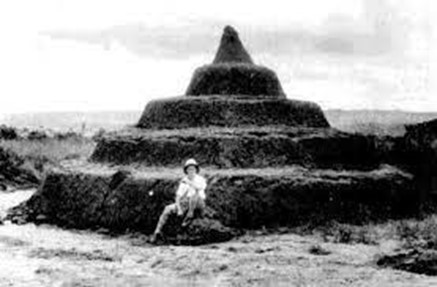
The documentary record for the Nsude pyramids is thin but coherent. Besides Jones's 1935 photographs, the ethnographer George Basden recorded a visit and local accounts, and Kenneth Murray, pioneer of Nigerian heritage preservation, described ten solid mud pyramids in two rows on open ground outside the village, each roughly circular, stepped in five diminishing tiers, and crowned with a stick representing the residence of the god. Oral tradition holds that each of the ten quarters, or extended family groups, of Nsude built and maintained one pyramid.
Scholars of Igbo religion situate the monuments within well-attested practice: monumental mud shrine-building, the cult of Ala/Uto as earth deity and moral guardian, and the cyclical renewal of sacred architecture. Because unfired clay erodes within decades, the pyramids Jones photographed were almost certainly rebuildings of earlier versions — meaning the tradition could be considerably older than any surviving fabric, though no excavation has ever tested the site's antiquity.
The mainstream lament is neglect rather than mystery. The structures were never protected, and today only remnants and the memory of elders mark the spot. Nigerian heritage advocates, journalists and Enugu State officials have periodically called for reconstruction and for archaeological investigation, which has yet to happen at any scale.
- G. I. Jones's 1935 photographs, the primary record, held in the Cambridge archive
- Kenneth Murray's published description of ten stepped clay pyramids in two rows
- Living oral tradition tying each pyramid to one of Nsude's ten village quarters
- Consistency with documented Igbo mud-shrine architecture and the Ala/Uto cult
- Unfired clay construction implying frequent rebuilding rather than ancient fabric