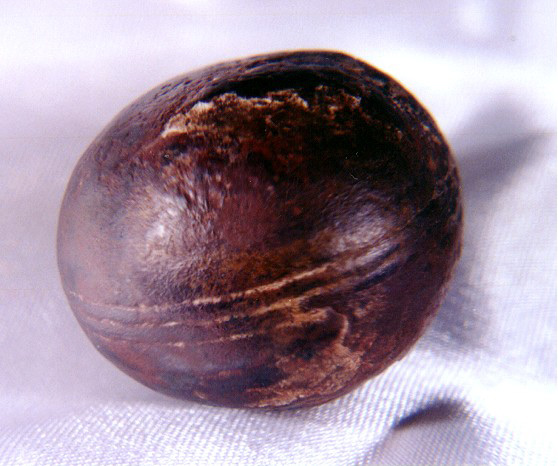
Ancient Technology · Mined near Ottosdal, North West Province, South Africa; examples in the Klerksdorp Museum

Klerksdorp Spheres

Grooved metallic-looking spheres from 3-billion-year-old rock — machined by whom, or by chemistry?

Mainstream: c. 3.0 billion years old — natural concretionsAlternative: c. 3.0 billion years old — claimed as manufactured objects-26.81°, 25.99°

At a glance

Klerksdorp Spheres
Photo: Robert Huggett · Public domain

Miners working the pyrophyllite ('wonderstone') deposits near Ottosdal, South Africa, have for decades turned up small spheroidal objects — typically one to ten centimetres across, dark reddish-brown, some strikingly disc-like with parallel grooves running around their equators. The host rock is about three billion years old. Popularised by Michael Cremo and Richard Thompson's Forbidden Archeology (1993) and by paranormal media as 'machined spheres' from an age when Earth hosted only microbes, they became a staple anomaly. Geologists identify them as concretions and nodules whose grooves record the sedimentary layering they grew across — striking, but entirely natural.

See it on the globe →
The mainstream view

What archaeology says

Geological studies, notably those publicised by researcher Paul V. Heinrich and South African geologists including Bruce Cairncross of the University of Johannesburg, identify the objects as concretions formed within volcanic ash and sediment roughly three billion years ago. They consist of pyrite or of hematite and wollastonite derived from original pyrite and gypsum during metamorphism — not of any machined metal; none is a true perfect sphere, and many are flattened, fused into groups, or irregular, exactly as concretions are.

The 'machined' grooves are the giveaway feature in reverse: they correspond to fine laminations in the surrounding sediment. A concretion growing outward through subtly layered ash builds ridges and furrows where layers of different composition intersect its surface — the same phenomenon seen in the famous Moqui marbles of Utah and in concretions worldwide. Latitudinal ridges therefore mark bedding planes, not lathework.

Claims that the spheres are harder than steel, perfectly balanced, or that NASA found they rotate by themselves in vacuum, trace to garbled retellings of remarks attributed to former Klerksdorp Museum curator Roelf Marx, who himself stated he was misquoted and considered the objects natural. Tested specimens have ordinary mineral hardness, and no laboratory rotation study exists.

Key evidence cited
  • Petrographic analysis identifies the objects as pyrite and hematite-wollastonite concretions and nodules, not metal
  • The equatorial grooves align with fine laminations in the host pyrophyllite, marking bedding planes the concretions grew across
  • Specimens range from spherical to flattened, fused and irregular — a natural population, not manufactured uniformity
  • Comparable grooved concretions occur worldwide, including Utah's Moqui marbles and Schoharie County, New York carbonate concretions
  • Roelf Marx stated he was misquoted about rotating spheres and regarded the objects as natural limonite concretions
  • Hardness and balance claims fail on testing; no laboratory has ever documented self-rotation or steel-exceeding hardness
The alternative view

What the skeptics propose

The spheres entered alternative literature through Forbidden Archeology, in which Michael Cremo and Richard Thompson presented them among evidence for their Vedic-inspired thesis of 'extreme human antiquity' — that anatomically modern humans, or intelligent beings, have existed on Earth for billions of years, with the evidence filtered out by what they call a knowledge filter in mainstream science. A grooved metallic sphere from three-billion-year-old strata, they argue, is precisely the kind of find that would be shelved rather than studied.

The popular case leans on a cluster of specific claims: that the spheres are perfectly spherical and balanced to extraordinary tolerances; that their shells are harder than steel and cannot be scratched; that a letter attributed to curator Roelf Marx described them as puzzling and mentioned NASA interest, with later versions asserting a sphere rotated slowly on its axis inside a vibration-free display case. The three parallel grooves around some specimens' equators are presented as too regular for nature. These claims circulated through paranormal magazines, ancient-astronaut television and countless websites.

Current status: the load-bearing claims have not survived checking — Marx repudiated the quotes, hardness tests are ordinary, and the grooves are demonstrably sedimentary — but the objects remain a fixture of out-of-place-artefact lists, partly because photographs of the best disc-shaped specimens genuinely do look turned on a lathe.

Key evidence cited
  • Some specimens display strikingly regular parallel grooves that photograph like machining, the core visual anomaly
  • Cremo and Thompson catalogued them within a larger pattern of allegedly suppressed anomalous finds in Forbidden Archeology
  • A widely circulated letter attributed to the Klerksdorp Museum curator described the spheres as inexplicable
  • Popular accounts claim extraordinary sphericity and balance, said to approach precision-engineering tolerances
  • The host rock's three-billion-year age would, if the objects were artificial, rewrite the history of life entirely — the stakes advocates emphasise
  • Advocates argue mainstream geology examined only convenient specimens and never the most machine-like discs

Genuinely open questions

  1. What formation chemistry produces the most extreme disc-and-groove specimens, which remain visually startling even to geologists?
  2. How many spheres have been recovered over the mining decades, and where did most of them end up?
  3. Could a systematic published study of the best 'machined-looking' examples close the case in a way scattered reports have not?
  4. How did the Marx 'rotating sphere' quote originate and mutate — a documented case study in anomaly folklore still incompletely traced?

Worth knowing

The wonderstone quarries' pyrophyllite is prized for another reason entirely: the same soft, heat-resistant stone has been used in high-pressure experiments to synthesise industrial diamonds.