What archaeology says
Historians know Shi Cheng's story in unusual detail because it happened in the modern era. The walled county town at the foot of Wu Shi (Five Lion) Mountain was a functioning community until the late 1950s, when the Xin'anjiang Reservoir project — one of the People's Republic's flagship hydroelectric schemes — flooded the valley. The submergence was documented bureaucracy, not legend: residents were resettled, and the town was left standing as the water rose.
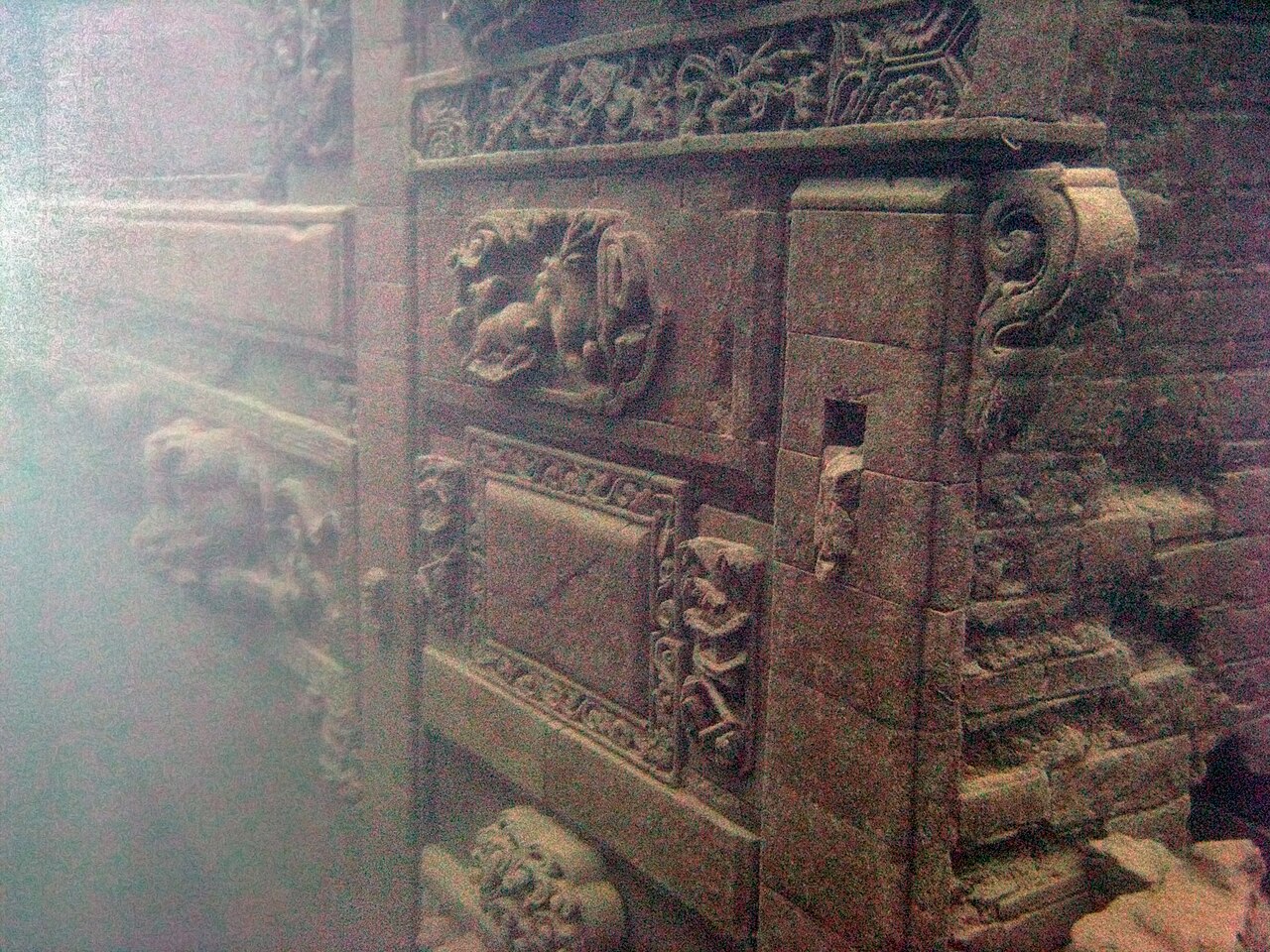
The city was largely forgotten until 2001, when the local tourism bureau and diving operators began exploring the lake bed. Dives and a widely publicised National Geographic feature revealed remarkable preservation: intact walls, memorial archways (paifang) with crisp relief carvings dated to the Ming and Qing dynasties, and timber structures that would have rotted or burned long ago on land. Chinese authorities have since restricted casual diving and debated protection measures, including proposals for submersible tourism, while surveys continue to map the site.
For archaeologists, Shi Cheng's chief scientific value is as a preservation experiment. It demonstrates what several decades in cold, still, low-oxygen fresh water does to masonry and wood — a direct analogue for evaluating older drowned sites, and a caution that underwater preservation can be dramatically better than terrestrial survival.
- The flooding is fully documented: the Xin'an River hydroelectric project of 1959 created Qiandao Lake and displaced roughly 290,000 residents
- Historical records place Shi Cheng's founding in the Tang dynasty (c. AD 621) and He Cheng's county status in AD 208
- Dive surveys since 2001 have photographed five city gates, wall circuits and dozens of Ming-Qing memorial archways with dated inscriptions and carvings
- Preserved wooden beams, banisters and door frames confirm the exceptional preservation conditions of cold, low-oxygen fresh water
- Former residents relocated in the 1950s have corroborated the town's layout and identified buildings from dive footage
- The architectural style — paifang arches, lion and phoenix reliefs — matches standard late imperial Chinese county-town construction