What archaeology says
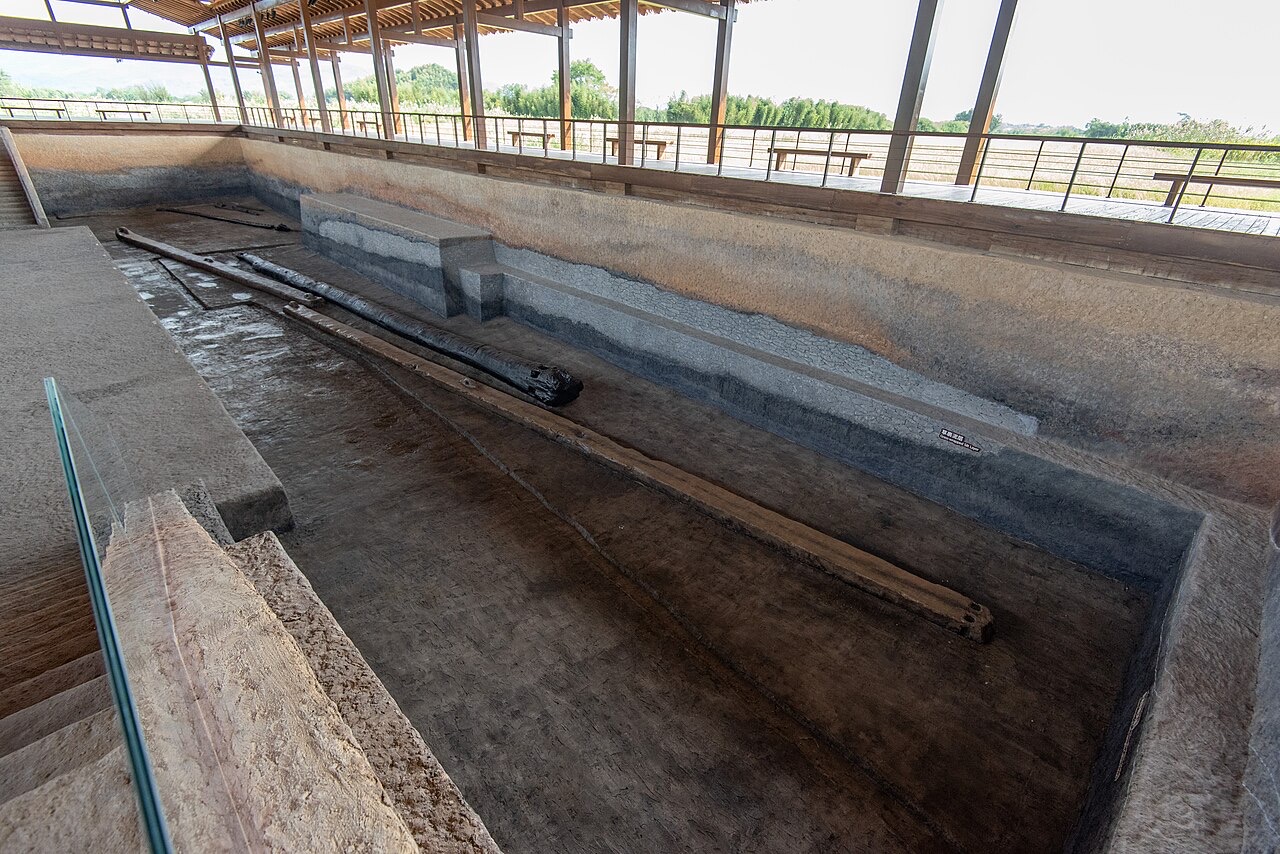
Liangzhu has transformed the archaeology of early China. Work led by Liu Bin of the Zhejiang Provincial Institute of Cultural Relics and Archaeology, following the 2007 identification of the city walls, revealed a planned capital with a raised palatial precinct at Mojiaoshan, huge rice granaries, and a peripheral hydraulic system whose dams have been radiocarbon dated to about 3100-2900 BC — earlier than any comparable waterworks on Earth. Colin Renfrew, co-writing with Liu Bin, argued in Antiquity that Liangzhu displays state-level society, with coercive labour mobilisation estimated in the millions of person-days, a millennium before the Erlitou culture that traditionally opens Chinese 'civilisation'.
The jade industry anchors the interpretation. Cong tubes and bi discs, produced to standardised forms and concentrated in a few spectacular graves such as Fanshan Tomb 12 (home of the 6.5-kilogram 'cong king'), carry a repeated man-riding-beast motif read as a unifying religious emblem. The extreme concentration of jades marks steep social stratification — kings or priest-kings — without any evidence of writing beyond isolated incised symbols.
The end is equally instructive. A 2021 study in Science Advances led by Zhang Haiwei, analysing cave stalagmites, tied Liangzhu's abandonment around 2300 BC to decades of extreme monsoon rainfall; thick flood silts cap the city's deposits. The world's first hydraulic society, on this account, was destroyed by the very water it had mastered.
- Radiocarbon dates establish the city and dams at c. 3300-2900 BC, the world's earliest large-scale hydraulic system
- A 2.9-square-kilometre walled city with the raised Mojiaoshan palatial platform and massive rice stores
- UNESCO World Heritage inscription in 2019 as an early regional state in East Asia
- Fanshan Tomb 12 and other elite graves with thousands of standardised ritual jades showing steep hierarchy
- Labour estimates for walls and dams implying coordinated mobilisation of tens of thousands of workers
- Flood silts over the site and the 2021 speleothem study linking collapse c. 2300 BC to extreme monsoon decades