What archaeology says
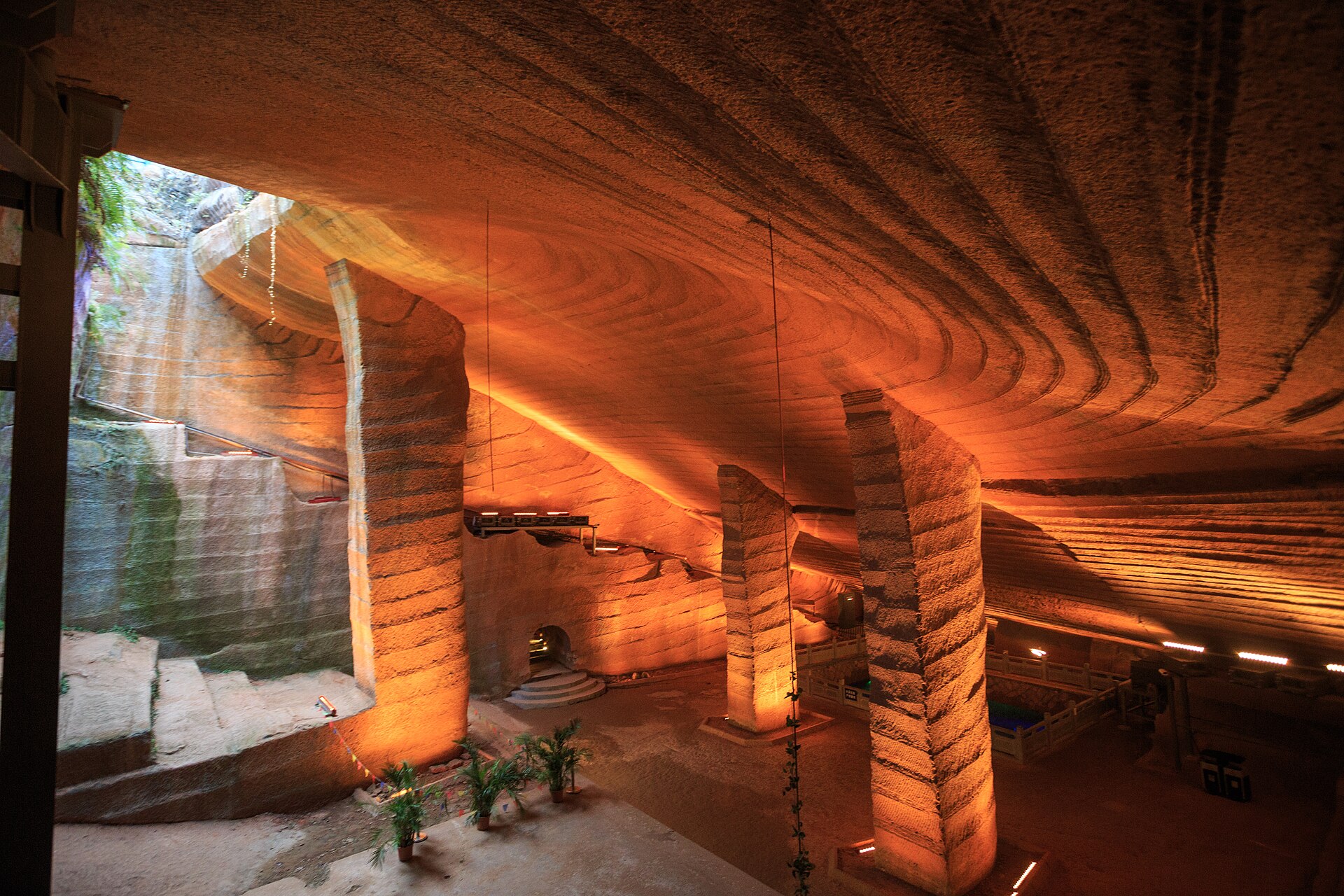
Chinese researchers generally place the caverns before or around the Qin and Han dynasties. Pottery recovered from the silt has been dated to between 206 BC and AD 23, giving a minimum age of about two thousand years, and a 17th-century poem by Yu Xun shows the chambers were known (as the 'Xiaonanhai stone chambers') in later imperial times, when some served as Buddhist retreats. Short iron and steel chisels found in one cavern, together with the tool marks themselves, indicate the rock was quarried top-down in shallow layers by large organised workforces — entirely within the capabilities of Bronze and Iron Age China, which produced comparably vast projects from royal tombs to canals.
The genuine scholarly puzzle is purpose, not possibility. Hypotheses aired at Chinese symposiums and in the engineering literature include quarrying (the fine-grained siltstone was useful stone, and blocks could be barged away down the Qu River, which would explain the missing spoil), storage cellars, tomb complexes, and a military staging or concealment role — one popular suggestion links them to King Goujian of Yue hiding troops in the 5th century BC. A 2009 engineering study by Li and colleagues in Tunnelling and Underground Space Technology analysed the caverns' remarkable stability, showing the ancient builders maintained consistent wall angles, ceiling inclinations and pillar placement that modern rock mechanics endorses.
Archaeologists such as Yang Hongxun of the Chinese Academy of Social Sciences have acknowledged frankly that the site is anomalous: the investment of labour is enormous, the decorative-looking chiselling seems far beyond utilitarian need, and the total silence of the historical record for a project of this scale in literate China is genuinely odd. Mainstream opinion treats these as open research questions rather than reasons to abandon a conventional timeline.
- Pottery in the cave silt dated to 206 BC – AD 23, giving a minimum two-thousand-year age
- Iron and steel chisels found in one cavern, matching the tool marks
- A 17th-century poem by Yu Xun showing the chambers were known in later imperial times
- The 2009 Li et al. engineering study explaining the caverns' stability through consistent, skilled design
- Parallels with other massive documented labour projects of Bronze and Iron Age China