What archaeology says
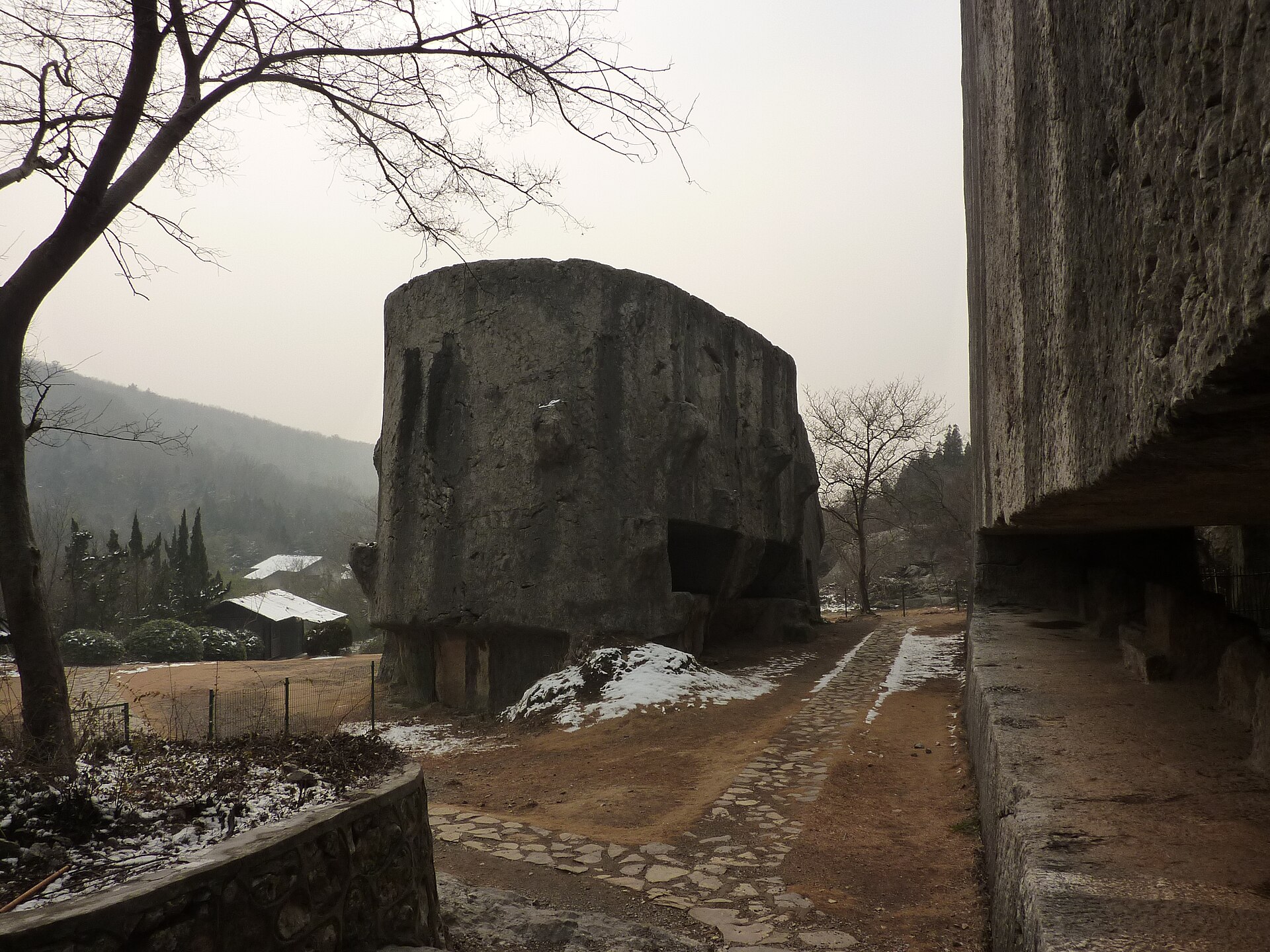
The historical record is unusually secure. The Yongle Emperor, who had just taken the throne by overthrowing his own nephew in a civil war, ordered the giant stele in 1405 as an extravagant act of filial piety toward Hongwu — part of the same burst of legitimising megaprojects that produced the Forbidden City, the Treasure Fleet of Zheng He and the Yongle Encyclopedia. Thousands of workers cut the three blocks from Yangshan's limestone, and local tradition preserves the cost: labourers who failed to produce their daily quota of rubble faced punishment, and the nearby village of Fentou ('grave mound') is said to take its name from the burials of workers who died. Around 1407 the project was halted, and in 1413 a conventional stele — the Shengong Shengde stele, still an imposing 8.78 metres — was erected at Ming Xiaoling instead.
Why begin at all? Ming engineers were the world's best movers of megaliths: within two decades they hauled stones of 200–300 tonnes (with some records suggesting larger) over 70 kilometres to Beijing on artificial ice roads in winter, a technique analysed in a 2013 engineering study. But 8,000–16,000 tonnes is two orders of magnitude beyond that, and historians conclude the scheme outran feasibility — whether through courtly overreach, deliberate propaganda in which the gesture mattered more than completion, or a genuine miscalculation recognised only once the blocks took shape. Some scholars suspect Yongle's advisers allowed an impossible imperial whim to proceed until it could be quietly abandoned without loss of face.
The quarry itself had supplied Nanjing with stone since the Six Dynasties (AD 220–589), and the stele blocks preserve dense fields of chisel marks, wedge pits and drainage cuttings entirely consistent with documented Ming quarrying technique.
- Ming records of the Yongle Emperor's 1405 stele commission for the Ming Xiaoling mausoleum
- The substitute Shengong Shengde stele erected at Ming Xiaoling in 1413
- Dense chisel marks, wedge pits and drainage cuttings matching documented Ming quarrying technique
- Local tradition and the 'Fentou' village name preserving memory of the workforce and its casualties
- Documented Ming megalith logistics (ice-road transport to Beijing) defining exactly what was — and was not — possible