Lost Worlds · Kekova Sound, Antalya Province, Turkey

Kekova-Simena

A Lycian shoreline that dropped into the sea, leaving staircases that walk into the water

Mainstream: Lycian-Roman town, submerged by earthquakes in the 2nd century ADAlternative: Romanticised as a pristine 'sunken city' of deep antiquity in travel lore36.19°, 29.86°

At a glance

Kekova-Simena
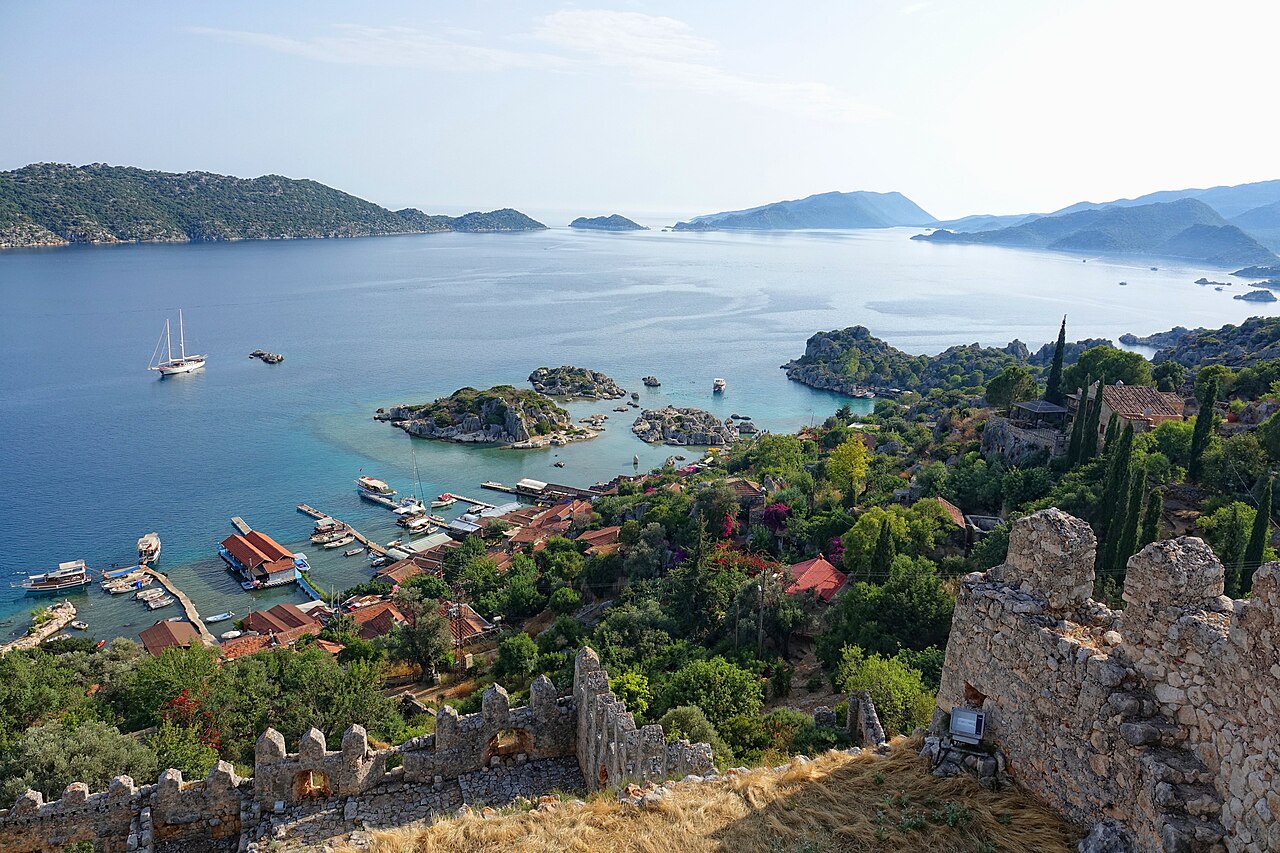
Photo: Bjørn Christian Tørrissen · CC BY-SA 4.0

Along the north shore of Kekova island in southern Turkey, the ruins of the ancient Lycian settlement of Dolchiste run half in, half out of the sea: house foundations, staircases and quay walls descend from the rocky shore into clear turquoise water. Across the narrow sound sits Simena (modern Kaleköy), with a medieval castle above and a Lycian sarcophagus standing photogenically in the shallows. Earthquakes in the 2nd century AD dropped this stretch of coast by several metres, drowning the lower town. Today the area is a strictly protected zone, viewed mainly from glass-bottomed boats and kayaks, and it has become Turkey's most famous 'sunken city'.

See it on the globe →
The mainstream view

What archaeology says

Archaeologists attribute the submergence to tectonic subsidence along the seismically active Lycian coast, most often linked to major earthquakes in the 2nd century AD. The eastern Mediterranean's plate boundaries can drop or raise blocks of coastline abruptly — the same tectonic regime that lifted western Crete by up to nine metres in AD 365 lowered other shores — and Kekova preserves the result with unusual clarity, its ancient sea-level features now a few metres below the modern waterline.

Dolchiste was a modest Lycian town, later part of the Roman world, that lived from fishing, trade and boat-building; after the earthquakes it was partly rebuilt but declined through the Byzantine era, exposed to Arab raids. Simena opposite, with its rock-cut tombs, small theatre carved into the hillside and later Crusader-era castle, survived as a village and remains one continuously inhabited today.

The Turkish state declared Kekova a Specially Protected Area in 1990, and diving and swimming are banned over the core ruins to prevent looting and anchor damage. Researchers value the site as a natural gauge of relative sea-level change on the Anatolian coast, where drowned quays and fish tanks record exactly where the Roman-era shoreline stood.

Key evidence cited
  • Drowned quay walls, house foundations and staircases lie at depths consistent with a coastal drop of a few metres, matching known Lycian coast tectonics
  • The visible architecture is typical Lycian-Roman small-town construction, with datable masonry styles and associated pottery
  • Simena's rock-cut Lycian tombs, hillside theatre and inscriptions anchor the settlement firmly in the documented Lycian League world
  • Regional studies of uplifted and submerged shorelines across the eastern Mediterranean corroborate abrupt 2nd-century and 4th-century seismic events
  • The half-submerged Lycian sarcophagus at Kaleköy stands at a tilt in the shallows, directly recording relative sea-level rise since antiquity
  • Protection as a Specially Protected Area since 1990 reflects formal archaeological assessment of the ruins' identity and value
The alternative view

What the skeptics propose

Kekova is not the subject of any serious scholarly controversy — its date and cause of submergence are well understood — but it plays an outsized role in the popular imagination of sunken cities. Travel writing routinely inflates it into a mysterious drowned metropolis of vast age, and it is a fixture of 'real-life Atlantis' listicles, often with the implication that its origins are unknown. In reality the visible remains are largely Roman and Byzantine structures of a small harbour town.

For alternative-history writers, Kekova serves as a vivid demonstration piece: it shows that coastal subsidence can happen suddenly, within a single generation, rather than over millennia. Authors sympathetic to catastrophist readings of the past — from Immanuel Velikovsky's successors to modern proponents of earthquake-storm theories such as those inspired by Amos Nur's work on Bronze Age collapse — cite the Lycian coast as evidence that seismic catastrophe is a recurring, underrated force in Mediterranean history.

The honest significance of Kekova for the sunken-cities debate is calibration. It shows what a genuinely earthquake-drowned classical town looks like: shallow, close to shore, continuous with land ruins, and historically documented. When far grander claims are made elsewhere — sunken pyramids, drowned Ice Age harbours — Kekova is the sober benchmark against which they can be compared.

Key evidence cited
  • Popular media routinely present Kekova as an enigmatic 'sunken city' of unknown or immense age, far older than the Roman-era remains support
  • Its appearance in 'real Atlantis' lists keeps it circulating as supposed evidence that drowned cities are common and mysterious
  • Catastrophist writers cite the Lycian coast as proof that earthquakes can erase towns overnight, supporting sudden-collapse readings of ancient history
  • Local lore and tourism narratives embroider the site with tales of a city punished or claimed by the sea
  • The sheer visual drama — stairs descending into clear water — makes it a favourite illustration in books arguing that many more cities lie undiscovered offshore

Genuinely open questions

  1. Which specific earthquake or sequence of earthquakes dropped this stretch of coast, and can it be tied to documented 2nd-century events?
  2. How much of Dolchiste extends into deeper water beyond the visible nearshore ruins?
  3. What was the relationship between Dolchiste, Simena and the neighbouring harbour town of Teimiussa in the Lycian League?
  4. Can precise measurement of the submerged shoreline features refine models of vertical tectonic movement on the Anatolian coast?

Worth knowing

Swimming and diving over the core sunken ruins have been banned for decades — so the classic way to see Kekova's underwater streets is exactly how 19th-century travellers saw them: leaning over the side of a boat.