What archaeology says
Historians treat Penglai as pure mythology — part of a coherent early Chinese cosmology of paradises at the world's edges, the eastern maritime counterpart to the western mountain paradise of Kunlun. What they treat as sober history is the court's response to it: the Shiji of Sima Qian documents Qin Shi Huang's patronage of magicians (fangshi) from the coastal states of Yan and Qi, Xu Fu's commission and enormous funding, his excuse on returning empty-handed (a great fish blocked the way, so the emperor personally shot at sea monsters with crossbows), and his final departure around 210 BC, after which he found flat plains and broad marshes, made himself king there, and never came back.
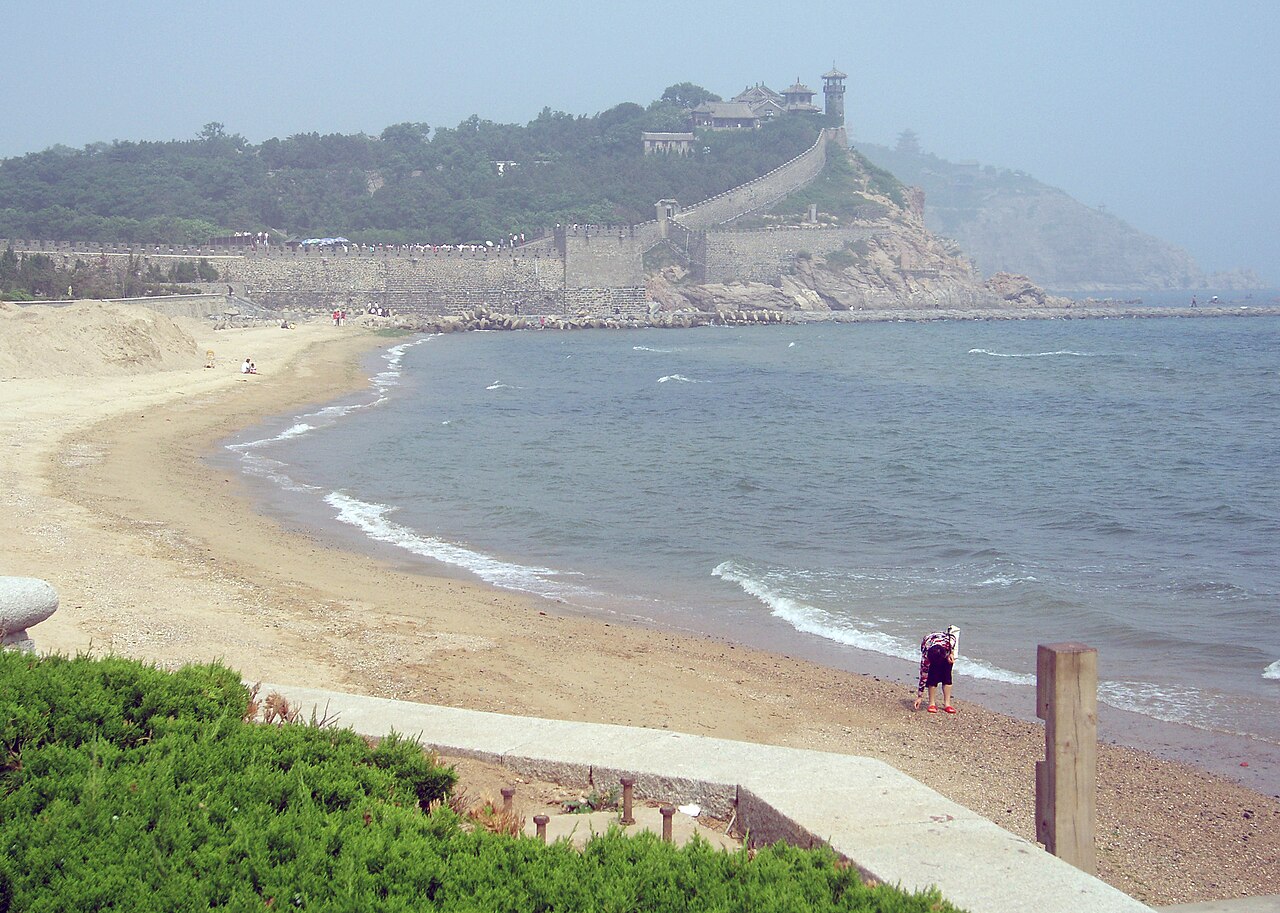
A favourite mainstream explanation for the legend's grip is meteorological. The Bohai coast at Penglai is one of the world's most reliable venues for superior mirages — fata morgana — in which real islands and ships are stretched into shimmering towers and floating cities above the sea, most often in May and June. Chinese sources across the centuries record these apparitions at Penglai as visions of the immortals' isles; the Song polymath Shen Kuo discussed such sea-market mirages in the 11th century. On this reading, sailors and coastal folk genuinely saw Penglai — as an optical phenomenon.
As for Xu Fu, most historians accept he was a real person — his home is plausibly identified at Xufu village in Jiangsu — and that his non-return reflects either shipwreck, prudent self-exile from an emperor who buried scholars alive, or genuine settlement somewhere overseas that cannot now be verified. The tale mainly illustrates the lengths to which the First Emperor's fear of death drove him: his tomb's rivers of mercury and his fatal consumption of mercury-based elixirs belong to the same obsession.
- The Shiji of Sima Qian (c. 94 BC) documents the Penglai belief and Xu Fu's expeditions in detail within living memory of the Qin court.
- Penglai belongs to a systematic early Chinese mythology of edge-of-world paradises, paralleling the western Kunlun — a literary cosmology, not geography.
- The Bohai coast at Penglai is a world-class site for superior mirages, recorded for centuries as visions of immortal isles, offering a natural explanation for sightings.
- No island matching Penglai exists in the Bohai Sea, which is shallow and was well navigated by the Han period.
- Qin Shi Huang's documented elixir obsession — including the mercury consumption implicated in his death and the mercury rivers reported in his tomb — explains the expeditions without any real island.
- The Yayoi transition in Japan began well before Xu Fu's voyages and shows a continental route through Korea, not a single Chinese colonising event.