Ancient Engineering · Ganghwa Island and Jeolla provinces, South Korea

Gochang, Hwasun and Ganghwa Dolmen Fields

The Korean peninsula holds some 35,000 dolmens — around 40 percent of all the megalithic tombs on Earth. Why here?

Mainstream: c. 1000-100 BC (Korean Bronze Age)Alternative: Some argue for older origins and links to a global megalithic culture37.78°, 126.44°

At a glance

Gochang, Hwasun and Ganghwa Dolmen Fields
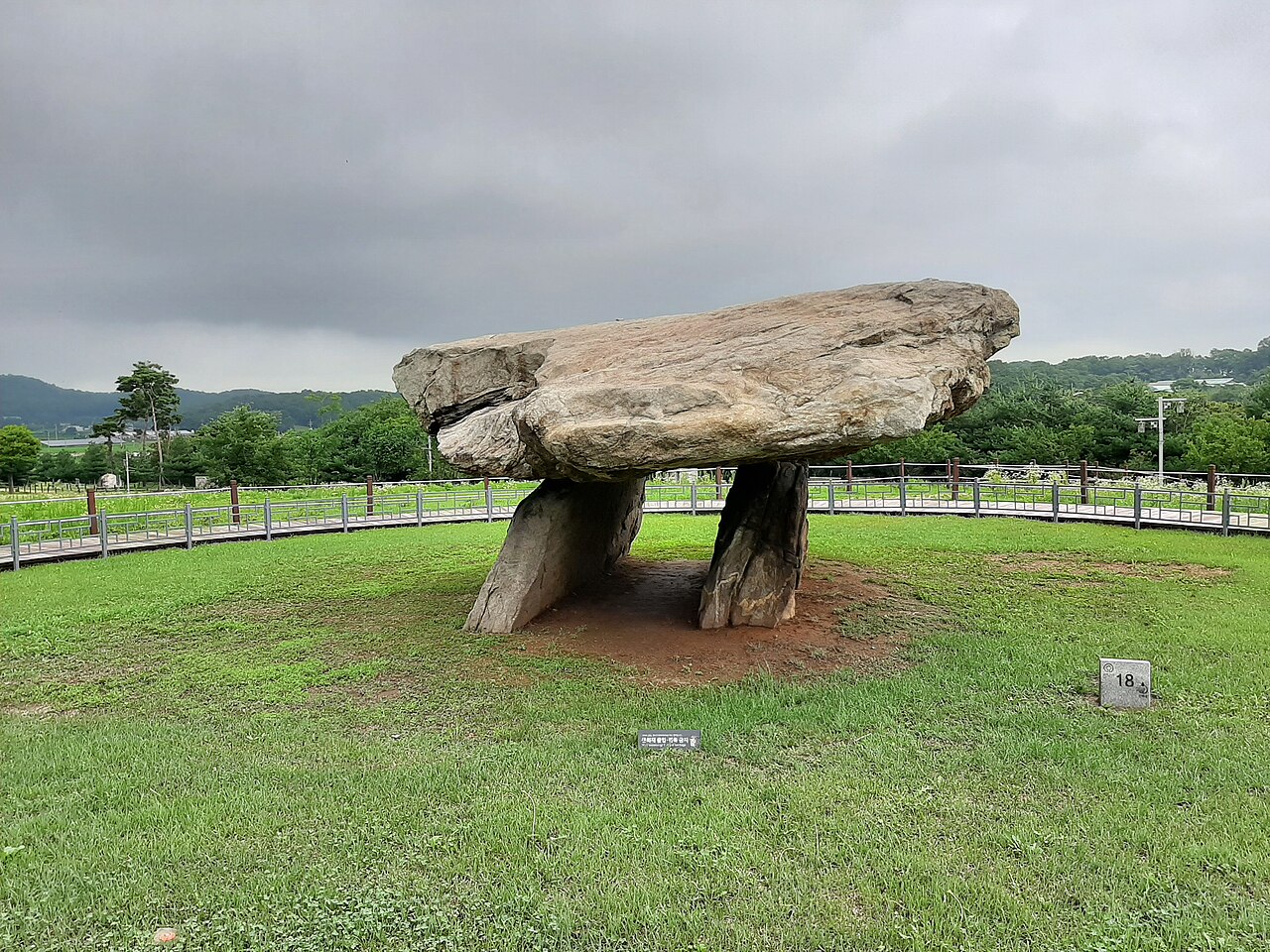
Photo: Taewangkorea · CC BY-SA 4.0

Korea is the world's unlikely megalith superpower: an estimated 35,000-plus dolmens stand on the peninsula, roughly 40 percent of the global total, with the greatest concentrations at Gochang, Hwasun and Ganghwa — jointly inscribed as a UNESCO World Heritage Site in 2000. These three areas alone contain over a thousand monuments, from low 'go-board' southern types to dramatic northern table dolmens like the Bugeun-ri dolmen on Ganghwa Island, whose capstone is estimated at over 50 tonnes. Some Hwasun capstones may exceed 200 tonnes. Most are dated to the first millennium BC, making Korea's megalithic boom strikingly late — and strikingly intense.

See it on the globe →
The mainstream view

What archaeology says

Korean archaeologists date the dolmens primarily to the Bronze Age, roughly the first millennium BC, on the basis of grave goods — polished stone daggers, bronze artefacts, red burnished pottery — found beneath and around them, together with radiocarbon dates from associated settlements. The dolmens are understood as burial and ceremonial monuments of increasingly stratified farming communities: the labour needed to quarry, move and raise multi-tonne capstones signalled the power of emerging elites.

Quarries have been identified near several dolmen fields — at Hwasun, source outcrops sit within a few hundred metres of the monuments — and the working model involves splitting slabs from bedrock using wooden wedges swollen with water, then moving them on log rollers and earthen ramps with rope teams. Experiments in Korea have shown modest teams can move surprisingly large slabs this way.

The density is explained demographically and geologically: fertile rice-farming basins supported large populations, suitable granite and gneiss outcrops were everywhere, and the practice remained in fashion for centuries — long after megalith building had ceased in Europe, which is why comparisons across continents can mislead.

Key evidence cited
  • Grave goods beneath dolmens — stone daggers, bronze items, burnished pottery — consistently date to the first millennium BC
  • Identified quarries sit close to dolmen fields, with split-slab extraction traces
  • UNESCO inscription (2000) recognises Gochang, Hwasun and Ganghwa as the densest, most varied dolmen concentrations anywhere
  • Korean hauling experiments show rope teams and log rollers can move multi-tonne slabs
  • Dolmen types form regional sequences (northern table, southern go-board) matching cultural zones
  • Associated settlement sites radiocarbon-date to the Korean Bronze Age
The alternative view

What the skeptics propose

Alternative researchers ask why 40 percent of the world's dolmens cluster on one small peninsula, and whether the standard Bronze Age dating tells the whole story. Writers in the global-megalith tradition — including Graham Hancock's circle and megalith documentarians such as Hugh Newman — note the strong family resemblance between Korean table dolmens and dolmens in India, the Caucasus, the Middle East and Atlantic Europe, and propose a shared megalithic impulse, or even a diffused tradition, far older and more connected than mainstream prehistory accepts.

Some Korean fringe theories link the dolmens to legendary early states and push their origins back thousands of years before the accepted dates; others emphasise the largest Hwasun capstones — estimated at 200 tonnes or more — as beyond what small Bronze Age chiefdoms should have managed, hinting at older, more capable builders whose tombs later communities imitated.

Mainstream scholars counter that dolmen forms are simple enough to be invented independently wherever people stack big stones, that the artefact record under Korean dolmens is consistently Bronze Age, and that the peninsula's density reflects preservation and enthusiasm, not mystery. The debate nonetheless keeps a genuinely open question alive: why did this one region embrace megalith building so much more intensely than anywhere else on Earth?

Key evidence cited
  • Korea's 35,000-plus dolmens are a global anomaly no demographic model fully explains
  • The largest Hwasun capstones, estimated over 200 tonnes, rival famous megaliths built by state-level societies
  • Table dolmens closely resemble monuments in the Caucasus, India and Atlantic Europe, suggesting connection to some
  • Korean megalith building post-dates Europe's by millennia — or, proponents argue, its roots are simply undated
  • Most dolmens have never been excavated or directly dated
  • Legendary Korean histories speak of ancient polities older than the archaeological consensus allows

Genuinely open questions

  1. Why did the Korean peninsula build megaliths on a scale unmatched anywhere else?
  2. How were the largest 200-tonne-class capstones at Hwasun raised onto their supports?
  3. Are the formal similarities with dolmens elsewhere convergence, diffusion, or coincidence?
  4. What would systematic excavation and dating of the unexamined majority of dolmens reveal?

Worth knowing

The Bugeun-ri table dolmen on Ganghwa Island is such a national icon that it appears in Korean school textbooks as the face of the country's Bronze Age — a 50-tonne classroom celebrity.