Ancient Engineering · Ma'an Governorate, Jordan

Petra

A rose-red city carved from sandstone cliffs, kept alive in the desert by some of the finest water engineering of the ancient world.

Mainstream: c. 4th century BC – AD 106 (Nabataean kingdom; main building boom 1st century BC – 1st century AD)Alternative: Date not seriously disputed — the genuine mysteries concern how much of the city remains buried, what the great facades were for, and how the water system was engineered30.33°, 35.44°

At a glance

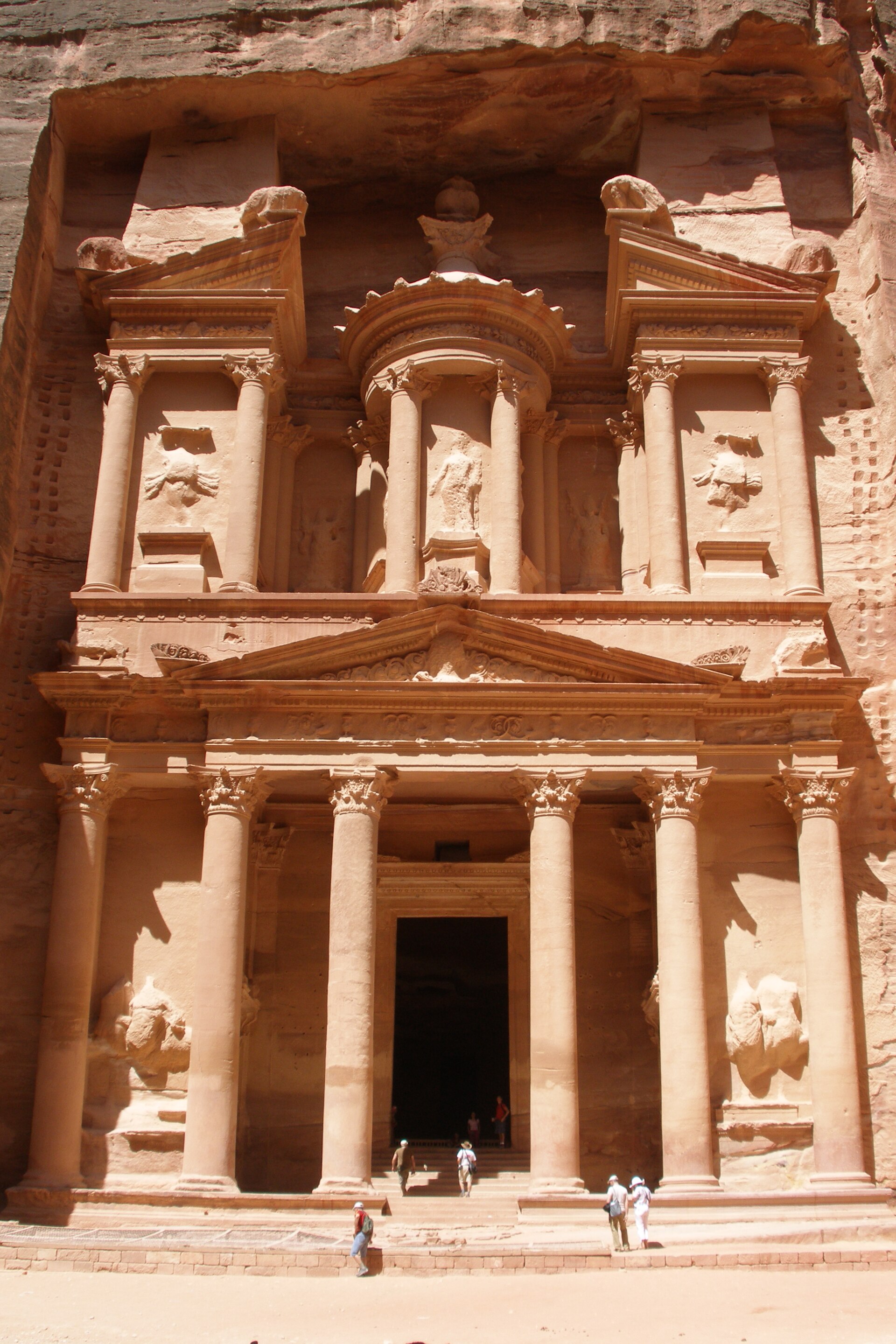
Petra
Photo: Vyacheslav Argenberg · CC BY 4.0

Hidden in the sandstone canyons of southern Jordan, Petra was the capital of the Nabataeans — Arab traders who grew rich controlling the incense and spice routes between Arabia and the Mediterranean. Approached through the Siq, a winding kilometre-long fissure that opens suddenly onto the carved facade of the Treasury (Al-Khazneh), the city held perhaps 20,000 people at its 1st-century peak. Its survival in a region receiving barely 100 millimetres of rain a year depended on a masterful network of dams, channels, pipelines and cisterns. Annexed by Rome in AD 106 and crippled by the earthquake of AD 363, Petra faded from Western knowledge until the Swiss explorer Johann Ludwig Burckhardt reached it in disguise in 1812.

See it on the globe →
The mainstream view

What archaeology says

Archaeology traces occupation of the Petra basin back to the Neolithic (nearby Beidha was farmed by 7000 BC), with the Nabataeans arriving as nomadic pastoralists and settling from around the 4th century BC. The monumental city — the Treasury, the Monastery, the theatre, the Great Temple and hundreds of rock-cut tomb facades — belongs mostly to the 1st centuries BC and AD, dated by pottery, coins, inscriptions and architectural style. The great facades are funerary and ceremonial monuments of the Nabataean elite, blending Hellenistic, Egyptian and Mesopotamian influences into a style entirely their own.

The city's real wonder is hydraulic. The Nabataeans built dams to break the force of flash floods (including one diverting the Wadi Musa away from the Siq), cut channels and ceramic pipelines along the canyon walls, and stored water in hundreds of plastered cisterns. The system delivered a reliable year-round supply with a sophistication that modern hydrologists have studied as a model of sustainable desert engineering. Work is still revealing new components: the Urban Development of Ancient Petra Project documented nine conduits on Jabal al-Madhbah, including a rare 116-metre pressurised lead pipeline, along with an unusual stepped-facade dam — findings published in 2025 showing the system was more experimental and adaptable than previously thought.

Discovery continues at a remarkable pace. In October 2024 a team led by Pearce Paul Creasman, with Josh Gates of Discovery's Expedition Unknown, excavated a hidden tomb beneath the Treasury itself, finding twelve articulated skeletons and grave goods around 2,000 years old — a nearly unique find, since most Petra tombs were looted or emptied long ago. Some researchers estimate the vast majority of the city, perhaps as much as 85 per cent, remains unexcavated beneath the valley floor.

Key evidence cited
  • Coins, Nabataean inscriptions and dated pottery anchoring the building boom to the 1st centuries BC–AD
  • Unfinished tomb facades preserving every stage of top-down carving with visible chisel work
  • The excavated water system: flood-diversion dams, channels, ceramic pipelines and hundreds of cisterns
  • The 2025-published discovery of a 116-metre pressurised lead pipeline and stepped dam on Jabal al-Madhbah
  • The 2024 tomb beneath the Treasury with twelve skeletons and 2,000-year-old grave goods
The alternative view

What the skeptics propose

Petra attracts comparatively little fringe theorising — its dating rests on abundant coins, inscriptions and pottery — and the more interesting debates happen largely within scholarship. The Treasury is the prime example: despite its name (from a Bedouin legend that the urn on its facade held a pharaoh's gold — it is solid stone, pocked by hopeful gunfire), its function has been argued over for two centuries. Tomb, temple, royal mausoleum of King Aretas IV, or some combination? The 2024 discovery of burials directly beneath it strengthens the mausoleum reading but raises new questions, since the twelve individuals were buried with modest goods rather than royal splendour.

A genuine research frontier is archaeoastronomy. A 2014 study by Juan Antonio Belmonte and colleagues found statistically significant astronomical orientations across Nabataean monuments: at the winter solstice, the setting sun illuminates the sacred podium of the Monastery (Ad Deir) through its doorway, an effect unlikely to be accidental. How systematically the Nabataeans encoded solar events into their architecture remains open.

Where alternative claims do surface, they tend to recycle the idea that the largest facades are 'too precise' for chisels, or that the site is vastly older than the Nabataeans — occasionally linking Petra to antediluvian civilisations. Mainstream rebuttals are straightforward: thousands of unfinished tombs and quarry faces across Petra preserve every stage of top-down carving, complete with chisel marks and abandoned scaffolding ledges, and the biblical and classical sources naming the Nabataeans in residence are unambiguous. The real enigmas — the buried city, the tombs' occupants, the full extent of the water system — need no lost civilisation to be compelling.

Key evidence cited
  • The Treasury's function is still unresolved after two centuries of study
  • Belmonte's statistical study of solstice alignments in Nabataean monuments, including the Monastery
  • Perhaps 85 per cent of the city remains unexcavated beneath the valley floor
  • Occupation of the wider basin reaches back to the Neolithic, millennia before the Nabataeans
  • Almost no Nabataean texts describe their own building methods, leaving the engineering undocumented

Genuinely open questions

  1. Who were the twelve people buried beneath the Treasury, and was the monument built for them?
  2. How much of Nabataean Petra lies unexcavated under the valley sediments?
  3. How did the Nabataeans plan and survey a pressurised, city-wide water network without any surviving technical texts?

Worth knowing

One skeleton in the tomb found beneath the Treasury in 2024 was cradling a ceramic chalice — an eerie coincidence, since the Treasury's facade played the resting place of the Holy Grail in Indiana Jones and the Last Crusade.