What archaeology says
Decades of survey and excavation — led in recent years by the Globalkites project under Rémy Crassard of the CNRS — have established the kites as mass-hunting megastructures. Herds of gazelle, oryx and other steppe game were driven between the converging walls, which subtly steered them (animals will not jump even a knee-high wall while running) into the killing enclosure, where pit-traps concealed at the corners broke their escape. Excavated pits contain bone assemblages dominated by gazelle; kite openings face migration routes; and at sites like Tell Kuran in Syria, mass deposits of gazelle remains testify to slaughters large enough to have contributed to the species' regional collapse. The earliest kites, in southeastern Jordan, date to around 8000 BC — built by Neolithic hunters even as farming spread through the region.
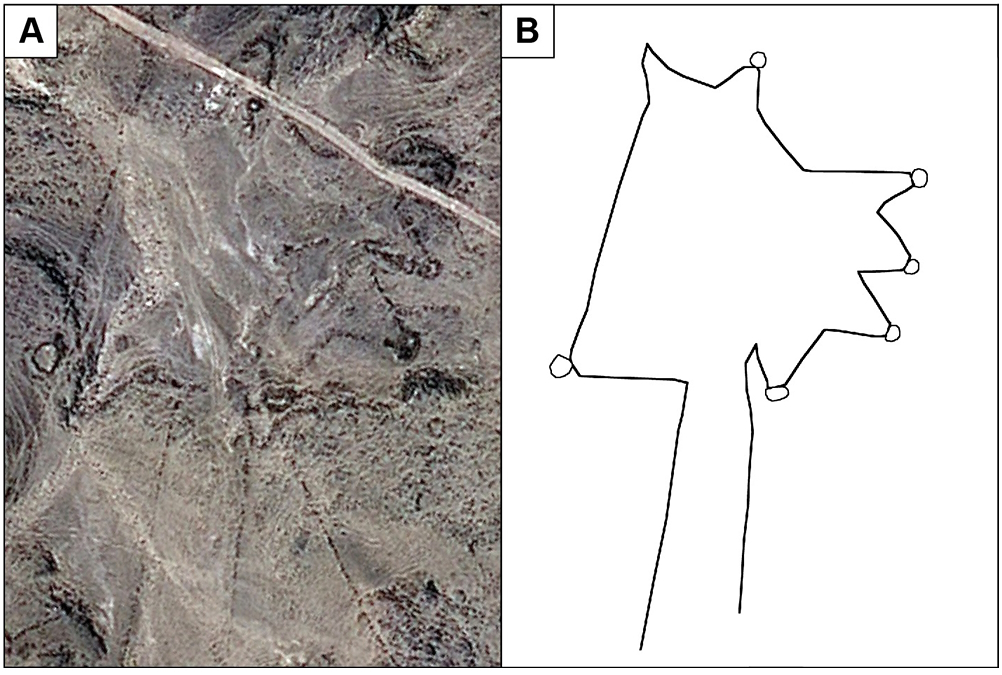
In 2023 the story gained a remarkable chapter: at Jibal al-Khashabiyeh in Jordan and Jebel az-Zilliyat in Saudi Arabia, Crassard's team published engraved stone monoliths, up to 9,000 years old, carved with accurate, to-scale plans of the neighbouring kites — the oldest known scaled architectural drawings in human history. The engravings answer the 'aerial view' puzzle directly: the builders could conceive, plan and communicate structures too large to see whole, using exactly the kind of representational thinking that later produced maps and blueprints.
- Excavated pit-traps with gazelle-dominated bone assemblages confirming the hunting function
- Kite openings and guide-walls aligned to documented game migration routes
- Radiocarbon and OSL dates placing the earliest Jordanian kites around 8000 BC
- The 2023 engraved monoliths at Jibal al-Khashabiyeh and Jebel az-Zilliyat — to-scale kite plans c. 7000 BC
- Over 6,000 kites mapped by the Globalkites project showing consistent regional design logic